SAACP: Mentorship Programme

SAACP: Mentorship Programme

SAACP: Mentorship Programme

Calling all counselling psychologists!

Whether you’re starting out or have years of experience behind you, the SAACP Mentorship Programme is your opportunity to connect, uplift, and grow.

This initiative is about more than just guidance – it’s about building a stronger professional community, sharing insights, and supporting one another through the journey of being a counselling psychologist in South Africa.

  • Sign up as a mentor.
  • Sign up as a mentee.
    Together, let’s strengthen our profession.

Register here by 15 July 2025.

Following registration, participants will receive further information and be paired with a mentor or mentee.

#CounsellingPsychology #MentorshipMatters #SAACP #Psychology #Community #Professionalsupport #growtogether

PiPS Online Workshop: Demystifying the POPIA Act

PiPS Online Workshop: Demystifying the POPIA Act

PiPS Online Workshop: Demystifying the POPIA Act

FREE CPD WORKSHOP

24 June 2025
18:00 – 20:00

Demystifying the POPIA Act – a practical and psychologist-focused guide to understanding South Africa’s data privacy law.

Join Barry Viljoen as we unpack how POPIA impacts psychological practice in public service settings—equipping you with the tools to stay compliant, protect client data, and navigate ethical dilemmas confidently.

2 General CPD Points!

Abstract

This presentation will provide an in-depth introduction to the Protection of Personal Information Act (POPIA), a key piece of legislation in South Africa designed to protect individuals’ personal data and ensure privacy rights. The POPIA Act regulates the collection, use, storage, and sharing of personal information by organizations and sets out the legal framework for how businesses must handle personal data. Throughout the presentation, we will explore the core principles of POPIA, including the conditions for lawful processing of personal information, the rights of data subjects, and the responsibilities of data controllers and processors. We will also discuss the practical application of the Act in various organizational settings, emphasizing how businesses can comply with its requirements through effective data protection measures and risk management strategies. Key topics will include obtaining consent, safeguarding data, ensuring transparency, and understanding the role of the Information Regulator in overseeing compliance. Furthermore, we will examine the potential consequences of non-compliance, including penalties and reputational damage, and the steps organizations can take to implement a robust data protection program. This presentation will equip attendees with a foundational understanding of POPIA, its implications for data privacy, and how to navigate the complexities of personal data protection in the digital age.

About the Presenter
Mr Barry Viljoen

Mr Barry Viljoen

Barry Viljoen is a Clinical Psychologist working in the public sector. He is involved in academics in terms of training. His areas of interests are child and adolescent psychology, psychology within forensic settings, assessment, and critical disability studies. He is currently completing his Dpsych in Child and Adolescent Psychology.


The Importance of Peer Support Amongst Psychology Professionals

The Importance of Peer Support Amongst Psychology Professionals

The Importance of Peer Support Amongst Psychology Professionals

Authors: Shaazia Patel (Additional member; The Division of Registered Counsellors and Psychometrists)
Editor: Zakiyah Hoosen (Vice chairperson; The Division of Registered Counsellors and Psychometrists)

Peer support has become an essential component in health and social care, particularly within the mental health sector (Kalina Mikolajczak-Degrauwe et al., 2023). It serves as a non-hierarchal support system in which individuals with similar experiences provide informative, empathetic, emotional and evaluative support to other professionals facing similar challenges (Kalina Mikolajczak-Degrauwe et al., 2023). This provides a space to construct a community based on the connections shared between mental health professionals navigating similar circumstances (Joo et al., 2022). In this article, we will explore the significance of peer support programmes for psychological professionals, their role in addressing mental health challenges in various contexts, and the implications for mental health care globally.

The Role of Peer Support programmes for Mental Health Professionals

As mental health professionals, establishing a sense of connection and comfort in challenging times can be difficult, particularly when managing intense emotions and life-changing circumstances (Distress Centre, 2024). Joining a peer support group can be valuable as it offers a safe environment to explore your thoughts and feelings openly without judgment (Distress Centre, 2024). Therefore, these peer support programmes tailored for psychological professionals can serve as invaluable contributors to the mental health field (Joo et al., 2022). These initiatives create a supportive network where mental health workers can share their experiences, challenges, and coping strategies associated with their roles (Joo et al., 2022). By connecting with peers who understand the unique pressures of the same profession, these programmes can alleviate feelings of isolation and stress that often accompany mental health work (Joo et al., 2022; Grouport, 2025). Moreover, this can promote a sense of belonging among professionals, by enhancing job satisfaction and resilience (Joo et al., 2022). However, these programmes are not without their challenges (Kalina Mikolajczak-Degrauwe et al., 2023). The success of peer support initiatives largely depends on ensuring a good fit between peers, as well as maintaining appropriate boundaries to safeguard the profession to which practitioners belong (Joo et al., 2022). However, there are several peer support programmes which have implemented strategies to navigate and address these hurdles, ultimately improving the quality of support provided within these spaces (Kalina Mikolajczak-Degrauwe et al., 2023).

Peer Support in Community Mental Health Services

Peer support plays an important role in low to middle-income countries’ (LMICs) mental health services, such as South Africa, where there is a significant treatment gap in the mental health sector (Sorsdahl et al., 2023). Peer support can create an understanding and empower those in need, enhancing the overall effectiveness of community-based mental health initiatives (Joo et al., 2022). Reflecting on one’s experiences to improve support strategies has emerged as a key facilitator in managing life stressors within peer support frameworks (Poremski et al., 2022). To further enhance these programmes, a support group entitled #SpacesforListening is put forth as a peer-support network for mental health professionals. The #SpacesforListening initiative was developed in 2020 by two psychologists based in the United Kingdom, Brigid Russell and Charlie Jones (Russell, 2024). The initiative offers a confidential structured process where mental health professionals are equally encouraged to share thoughts and feelings, and “to experience an equality of listening” (Russell & Jones, 2022). This approach could further enrich the peer support landscape within the South African context (Poremski et al., 2022). Peer support represents an effective form of assistance in the mental health sector, addressing both the emotional needs of individuals and the professional challenges faced by mental health professionals (Post Eye, 2024). The executive members of PsySSA’s Division for  Registered Counsellors and Psychometrists will be participating in a #SpacesforListening and aim to implement this initiative for RCP members in the second half of 2025. As we continue to strengthen peer support frameworks, it is essential to navigate the associated challenges to enhance their effectiveness and impact on mental health care systems in the South African context.

References

Embracing Uncertainty with DBT Skills: A Guide to Navigating Life’s Challenges | Grouport Journal. (2025). Grouporttherapy.com. https://www.grouporttherapy.com/blog/dialectical-behavior-therapy-uncertainty

Joo, Y., Kwon, J., & Lee, H. (2022). The effectiveness of peer support programs for mental health professionals: A review. Journal of Clinical Psychology, 78(2), 234-247.

Kalina Mikolajczak-Degrauwe, A., Goffin, K., & Martin, A. (2023). Support through peer engagement: A comprehensive overview of peer support in health and social care. Health Engagement Review, 15(1), 45-62.

Poremski, D., O’Neil, M., & D’Arcy, C. (2022). Reflexivity as a facilitator in peer support programs: Enhancing the effectiveness of mental health support. International Journal of Mental Health Systems, 16(1), 12-25.

Sorsdahl, K., Lund, C., & Stein, D. J. (2023). Bridging the treatment gap: The role of peer support in mental health services in South Africa. African Journal of Psychiatry, 26(1), 54-66.

Russell, B. (2024, November). Spaces for listening. Resurgence.org. https://www.resurgence.org/magazine/article6397-spaces-for-listening.html

Tips for Handling Stress and Mental Health in Today’s Busy World (2024). Post Eye. https://posteyes.com/tips-for-handling-stress-and-mental-health-in-todays-busy-world-2024/


Men’s Health Month 2025

Men’s Health Month 2025

Men’s Health Month 2025

Read our submissions from The DRM, SASCP and the AI Division!

As we mark Men’s Mental Health Month this June, the Division for Research and Methodology (DRM) of PsySSA reflects critically on the evolving discourse around men’s psychological well-being in South Africa. Despite growing awareness, men remain significantly underrepresented in mental health service use, often constrained by dominant ideals of masculinity that equate vulnerability with weakness.

In this short video and companion article, Executive Committee member Omphile Rammopo offers a timely and thought-provoking exploration into how mental health support for men can move beyond awareness toward action. Drawing from clinical insight, personal observation, and grounded local research, Rammopo challenges us to rethink therapeutic approaches that may inadvertently alienate men—and invites us to consider new, culturally relevant, strength-based frameworks.

Produced in collaboration with the DRM, this offering is both a call to reflection and a catalyst for transformation. As psychologists, researchers, and mental health advocates, we are urged not only to ask “Where to from here?”—but to act decisively in shaping support systems that resonate with the lived experiences of men across our diverse society.

#MensMentalHealthMonth #PsySSA #DRM #MentalHealthMatters #MasculinitiesInContext #PsychologyForSocialJustice

Men’s Mental Health Month 2025

By Sibusiso Vilakazi and Barry Viljoen

The month of June is dedicated to the awareness of Men’s Mental Health. The goal of which is to shine a light on and raise awareness regarding the unique mental health challenges faced by men. While there has been positive change in this regard, many men still continue to struggle in silence. One of the reasons for this could be as a result of societal expectations and the subsequent sigma, both internally and externally regarding the expression of vulnerability.

We know that statistically men are less likely to seek mental health support, which can and sadly often does lead to serious consequences. One such example being the higher suicide rates by men. It is hope that by giving a platform to these topics that friends, families, and communities will be encouraged to create safe spaces which are free of judgment and scrutiny. Reminding us that seeking help is a sign of strength and not that of weakness. Once again demonstrating that mental health is as important as that of physical health.

In this month we hope to break barriers by encouraging open conversations, which promote mental wellness and support those seeking the assistance required. In so doing we have collaborated with Sibusiso Vilakazi to share with us some of the work which he and his organisation are doing, to achieve these goals.

Brother’s Keeper SA (BKSA) is a men-only non-profit and registered organisation. BKSA serves as a support network and structure for men. It was established premised on the realisation that men do not have platforms through which they can be vulnerable and express their feelings and challenges. Unemployment, underemployment and a myriad of societal issues continue to beset men, resulting in psycho-emotional conditions such as stress, depression and, in extreme cases, suicide, substance abuse and propensity to criminal behaviour and detainment. In a world that prioritises and advances the rights and developmental needs of other members of society, little focus is devoted to the needs and a plethora of challenges that confronting men daily in South Africa. The number of men who are apprehended continue to rise, although it is understood that multiple factors account for this. BKSA loathes the acts of men who harm women.

BKSA came into existence at the height of the Covid-19 pandemic; at a time when greater support was needed, as the effects of pandemic were felt throughout the world. It was during this time when some men lost their jobs and some lost their spouses due to Covid-19.  It exists as a mechanism for providing a support network and structure for men to freely express their frustrations, challenges and needs in a space that is welcoming and free of prejudice and judgement.

BKSA hosts virtual support sessions monthly on Thursdays. Topics covered include social and emotional support, mental health, family issues, career development, financial health and physical health and fitness. Since its establishment, the organisation has developed an ongoing good relationship with practitioners and professionals across various fields. Ultimately, the organisation seeks to establish a formalised partnership with this network of professionals to enable sustainability of interventions and structured support services such as counselling, mentoring and coaching. Equally important, the organisation will partner with like-minded organisations whose mandates are geared towards development of men. It is through partnership that the organisation will be able to expand and widen its reach throughout the country.

BKSA observes local and international campaigns. The ultimate aim is to create a community of men who will be responsible, caring and able to be receptive to help and support. Men who participate in BKSA learn about how to be responsible in their communities, families and workplaces and responsive to the needs of their communities. There’s a sense of brotherhood and collective responsibility that is engendered through participation in BKSA.

In terms of how we operationalise our services, we identify men-related issues and:

  1. Raise awareness by running and supporting campaigns
  2. Referral to professional services and support
  • Targeted support, such as one-on-one intervention (mentorship)
  1. Community presentations
  2. Recreational activities

While our organisation has experienced a gradual increase in numbers, we intend to continually diversify our approach to topical issues and interventionary strategies. Whether participants are dealing with relationship issues, financial difficulties and mental health concerns or require any other form of support, our team is readily available to support them. While we maintain that we do not offer clinical, therapeutic or medical diagnosis or intervention, our platform exposes participants to qualified and seasoned experts in the various spheres of counsel and guidance to ensure appropriate approaches to healing.

The vision of the organisation ideates the creation of a safe, supportive and holistic community that encourages a culture of expressive, emotionally conscious and self-aware men as they navigate their lived experiences in an ever-changing world. To produce men who are psycho-emotionally healthy and resilient. We seek to build a transformational space for men and encourage authenticity and accountable men who contribute positively to a healthier society.

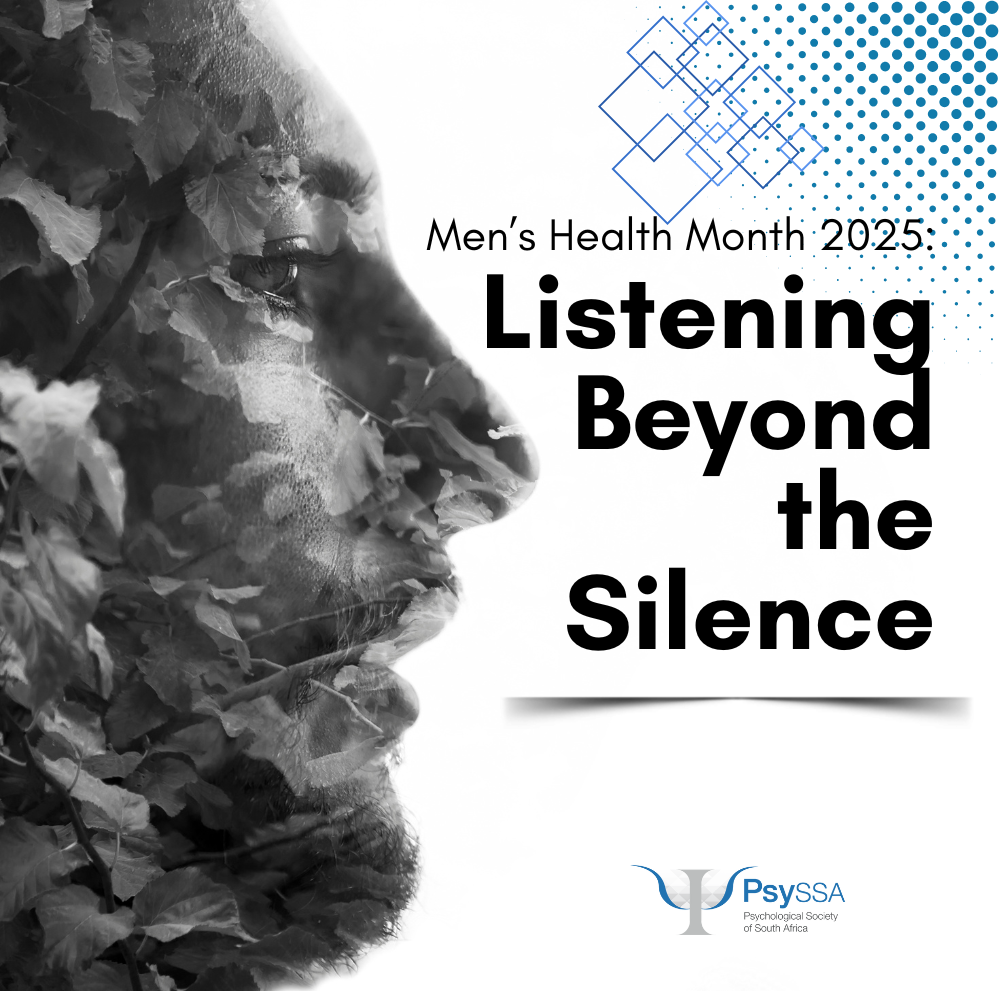
Men’s Health Month 2025: Listening Beyond the Silence
By Dr Ewald Crause
For the Psychological Society of South Africa

June is Men’s Health Month. But for many men in South Africa, health remains something unspoken. Not due to a lack of problems, but because speaking comes at a cost. In too many homes, clinics, and counselling rooms, silence has become the strategy. And for many men, silence is safer than honesty.

This year’s theme, “Check In, Not Out”, calls for early intervention and preventative care. It is a message that needs to land differently here. Because in the South African context, men are not simply failing to check in with doctors or therapists. They’re also checking out of themselves, their families, and for some, even their futures.

As psychology practitioners and academics, we observe it in statistics and sense it in the absences and silences. The man who doesn’t return for a second session. The father who disappears from the school meeting. The young adult whose first appointment only comes after an attempt. For too many, help arrives too late.

Behind these moments are pressures that psychology professionals know well. High rates of unemployment. Cycles of intergenerational trauma. The burden of being the provider, even when there is nothing left to give. Social scripts that still reward men for being silent, stoic, and self-contained…until they break.

In practice, male clients often arrive not because they chose therapy, but because someone else did. A partner insisted. A boss threatened. A court ordered. When they do arrive, they rarely use clinical language. They don’t say “anxiety” or “depression.” They talk about pressure. Sleeplessness. Losing control. Being “off.” These are not just linguistic differences. They are warnings. If we are not listening closely, we miss the distress altogether.

To work effectively with men, our role is not to convince them to talk. It is to ensure that when they do, they are heard without judgment, interruption, or interpretation. That our language doesn’t assume help-seeking is familiar or safe. That we acknowledge the resistance without reinforcing it.

Intervention needs to be practical, not idealistic. Most men are not looking for long-term therapy. They are looking for something that works. Brief interventions, solution-focused conversations, peer models, role clarity, and support that aligns with their roles as workers, fathers, sons, or leaders. Respect matters. So does structure. So does knowing when to step back and refer.

But this is not only about individual therapy. It is about the systems in which we operate. Access to care is uneven. Services in rural and peri-urban areas remain difficult to reach. Long waiting lists in the public sector often mean that prevention becomes impossible. For many men, especially working-class men, there is no clear path between noticing that something is wrong and receiving the support to address it. That space between is where we lose them.

This month must not be reduced to awareness slogans. The work is not about getting men to speak. It is about creating spaces where they do not have to defend their pain. It is about reducing the threshold for help. About making support a familiar part of life, not a crisis response. About including men in the broader mental health conversation without assuming they already know the terms of engagement.

To the men reading this: this month is not a campaign. It is a reminder that your life matters. That survival is not the only goal. That checking in is a strength, not a liability. That you are not meant to carry everything alone.

To the psychology professionals reading this: we can change the trajectory. To create systems, practices, and messages that speak to men without demanding that they first speak like us. That is the challenge. That is the opportunity.

Let’s meet men where there are, not where society expects them to be. And not just in June, but in the work we do every day.

PsySSA commemorates Child Protection Week (29 May – 5 June 2025) 

PsySSA commemorates Child Protection Week (29 May – 5 June 2025) 

PsySSA commemorates Child Protection Week (29 May – 5 June 2025) 

Every conversation matters

Role of Faith based leaders in the Protection of Women and Children

Author: Dr.Guru Kistnasamy

Historically the interpretation and misinterpretation of the scriptures of various Faiths together with its practice and implementation by Religious Leaders, resulted in the abuse or the protection of the vulnerable amongst us, women and children.

In ancient times women and children were considered dispensable and were even killed in the form of sacrifices in various parts of the world. In India, there was a time when widows were burnt to death after the death of their husbands. This conceptualization of the vulnerable coupled with a patriarchal attitude, served to keep women and children in servitude.

Today we find a similar attitude that results in the rape and sexual molestation of women and children by men. What is shocking today is that we find that these perpetrators are men entrusted with the protection of these victims.

A few recent examples of Faith Leaders accused of abusing their so called “sacred” positions include:

  • Timothy Omotoso accused of 32 counts of rape, human trafficking, and racketeering. He was acquitted by the Justice System. Now the Minister of Justice is asking for an enquiry.
  • A prominent Bishop accused of raping and sexually assaulting members of his congregation. The trial is continuing.
  • A Hindu priest accused of raping a 12 year old boy appeared in the Tongaat Court.
  • A Hindu priest accused of intimately touching a devotee appeared in Verulam Court.
  • 2 boys alleged a Moulana raped them in Germiston.

Prevalence of Gender Based Violence in South Africa.

An article published in the journal of Social and Development Sciences in 2024, revealed that 55.38% of respondents reported being victims of violence in places of worship.

A fact sheet on “Baseline Survey on Victimisation and Perpetration” issued by the HSRC in 2024 indicated the following:

Lifetime physical and/or sexual violence of women aged 18 years and over: 35.5%, translating into 7,847.438 women.

According to Statistics South Africa, we have the highest rate of femicide in the world. One out of four women have experienced GBV, and one out of three children have experienced physical violence and sexual violence before they turned 18. (Ref. “Gender-based violence as a destructive form of warfare against families, a practical theological response-2023”).

Psychological Aspects of Religious Abuse.

Psychological Abuse refers to psychological manipulation and harm inflicted on a person by using the teachings of  their religion. It is often directed to children and emotionally vulnerable adults. The abuse may result in mental health issues such as depression, phobias, dissociative disorders, paranoia, anxiety, and insomnia  The victim may not report the matter because of guilt, shame, fear of being ostracized or losing a privilege.

What is Spiritual Abuse

Spiritual abuse has been expressed as an exploitation of spiritual authority to manipulate, control, use or harm others through means such as shame, fear and indoctrination. Examples may include sexual abuse, extortion of money, suicidal attempts and even suicide. Spiritual abuse is said to support other forms of GBV.

What can Religious Leaders do to Protect the Vulnerable?

Concerns of the public were raised at government level about abuse in religious institutions and by their leaders. In 2017 Hearings were held in Parliament where submissions were made by 18 religious organisations on the recommendations and proposals of the Commission for the Promotion and Protection of the Rights of Cultural, Religious and Linguistic Communities.

This clearly indicated that there must be some form of regulation of religious institutions through mandatory registration, licensing, and monitoring.

Religious communities need to actively promote the equality and protection of genders. Places of worship are ideally suited for this discourse. Various sources of literature point us in the right direction in achieving this goal.

The Interfaith GBV Prevention and Mitigation Strategy 2024-2030 is the result of a national consultation process of scholars, activists and leaders. It was strengthened by the We Will Speak Out South Africa (WWSOSA). It includes partners from the following faiths: African Traditional, Baha’I, Brahma Kumaris, Buddhism, Christianity, Hinduism, Islam and Judaism. Their goal is to mobilize and equip the faith sector to address GBV more effectively.

The Interfaith GBV Prevention and Mitigation Strategy 2024-2030 was released in October 2024. The following is a summary of the commitments of the members of the faith sector in actively, intentionally and collaboratively supporting efforts to mitigate GBV by:

  • Including spiritual abuse as a type of GBV;
  • Being vocal and transparent about exposing GBV;
  • Dismantling the culture where victims are silenced;
  • Amplifying texts, traditions, rituals, ceremonies and symbols that promote dignity, gender equality and justice, and to change these where gender inequity or GBV is encouraged;
  • Becoming integrally involved in South Africa’s multi-sectoral efforts to prevent or respond to GBV;
  • Improving accountability measures and developing a joint policy to guide the sector’s work;


Conclusion.

It is important that leaders of all faiths subscribe to the principles of the Interfaith GBV Prevention and Mitigation Strategy 2024-2030 so as to address the problem of GBV as a united national front in South Africa.

Therefore it is equally important that there be a qualification, monitoring and regulating process for aspiring spiritual leaders to join the faith sector. This will minimize abuse of the vulnerable by leaders of faith.

25/04/2025.

 

A call for Psychologists to champion child rights during Child Protection Week, and beyond

The Trauma and Violence Division

National Child Protection week, commemorated between the 29th of May and the 5th of June, seeks to remind citizens of the rights of children enshrined in the Constitution of South Africa and the Children’s Act (Act No. 38 of 2005). On the 11th of May 2025 the Department of Social Development launched Child Protection Month with the theme ‘Working Together to End Violence Against Children.’ Child sexual abuse has been highlighted as the main focus (Department of Social Development, 2025).

Sexual assault cases for female children aged 17 and younger increased from a harrowing 82.7% in 2015/2016 to 87.6% in 2019/2020 in South Africa (Stats SA, 2024). Female children are more likely to experience statutory rape, sexual assault and rape than male children (Stats SA, 2024). However, challenges with the reporting of such crimes across all genders remain, leading to underreporting.

This Child Protection Week, the Department of Social Development has called on various healthcare sectors to become part of a multidisciplinary approach addressing this pandemic (Department of Social Development, 2025). In response to the call to action, psychologists can advocate for children’s rights and uphold their best interests beyond the confines of therapy rooms, lecture halls, and academic journals. Psychological professionals, including psychologists, registered counsellors and psychometrists should:

  • Report suspected child abuse and neglect to the relevant authorities as outlined in Section 110 the Children’s Act (Act No. 38 of 2005) and Section 54 of the Criminal Law (Sexual Offences and Related Matter) Amendment Act 32 of 2007. This is not discretionary but mandatory and is essential to safeguarding child clients. Ensuring that we fulfil this duty is key in us upholding children’s rights.
  • Maintain competency in working with child survivors of abuse. Guidelines and interventions for trauma work are continuously developing. Staying informed and continuously developing our professional skillset can assist us in ensuring that children do not experience secondary traumatisation, including within the therapy room (Van Niekerk & Coetzee, 2020).
  • Catalyse change at a systemic level through research and advocacy efforts, to ensure transformation beyond the therapy room (Schiller et al., 2023). Psychologists can advance and disseminate research in the area of child abuse and associated psychological sequalae to ultimately draw attention to the need for policy change.  Rather than duplicating effort, psychologists can use their expertise to assist non-governmental organisations and advocacy groups at the forefront of the fight against child abuse.

As a profession and association of professionals, we can lobby for the employment of mental health professionals within the government sector, to ensure the provision of quality, timeous services that promote preventative and ameliorative initiatives.

Systemic issues require systemic interventions but they need not be complicated. So, whether your advocacy is at an individual level within the therapy room, or at a macro-level with major stakeholders, consider how you can uphold children’s rights this Child Protection Month.


The South African Association for Counselling Psychology

Watch the SAACP’s contribution to Child Protection Week 2025 below!

Danielle Moosajie

Danielle Moosajie

Director: Arise

Danielle Moosajie is a qualified social worker with a Master’s degree in Social Policy and Management from the University of Cape Town. With over 14 years of experience, she has dedicated her career to working with children and families on the Cape Flats. Her professional background spans both the corporate sector – where she specialized in change management – and academia, having lectured and contributed to numerous community-based initiatives.

Danielle is also a wife and mother of three. Outside of her professional life, she enjoys exploring Cape Town’s natural beauty and sampling good food. She is passionate about ensuring every child feels loved and valued, and she is committed to encouraging South Africans to build meaningful connections beyond their usual boundaries.

Contact: danielle@arisefamily.org 

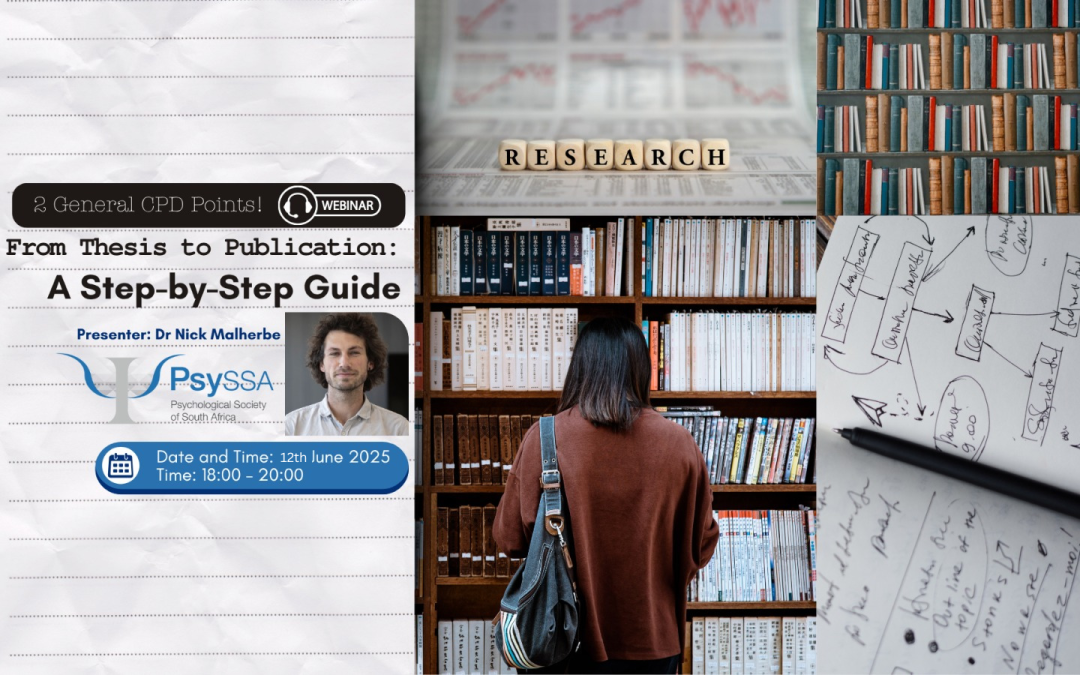
From Thesis to Publication: A Step-by-Step Guide

From Thesis to Publication: A Step-by-Step Guide

From Thesis to Publication

A Step-by-Step Guide 

In celebration of Youth Month, PsySSA is proud to present an empowering and informative webinar designed to support emerging scholars and early-career professionals.

Workshop Details:

  • Date: Thursday, 12 June 2025
  • Time: 18:00 – 20:00
  • Platform: Zoom
  • Cost: Free

This event reflects PsySSA’s commitment to advancing excellence, equity, and transformation in South African psychology. Join us as we equip the next generation of scholars with the tools to make their voices heard and their knowledge count.

Don’t miss this opportunity to gain insights and prepare for success!

About this webinar:

Publishing from your thesis might be an academic requirement, a useful step in one’s career, or simply a means by which to engage more deeply with a specific topic. However, the world of academic publishing can seem uninviting and intimidating. In this webinar, we will cover the basics of publishing from your thesis. We’ll discuss co-authorship, how and where one can submit their work, the form that a journal article can take, when to follow up with journal editors, and how to respond to reviewer feedback.