National Mentorship Programme (NMP) – Mentor and Mentee applications now open

National Mentorship Programme (NMP) – Mentor and Mentee applications now open


National Mentorship Programme (NMP) – Mentor and Mentee applications now open!


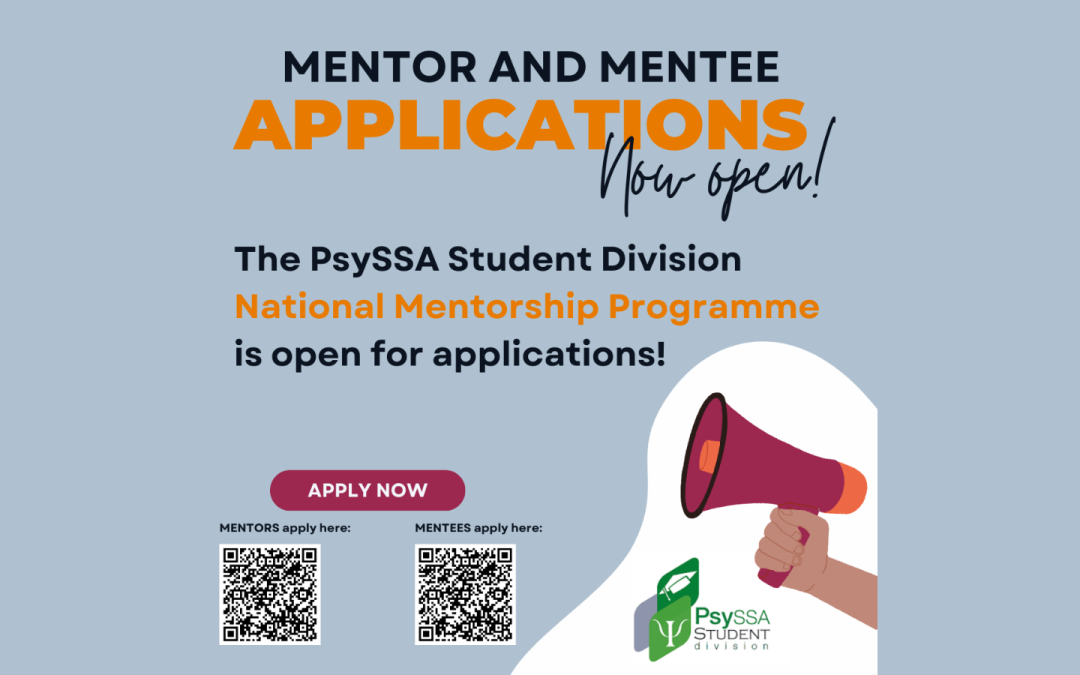
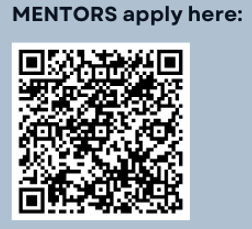
The PsySSA Student Division are excited to announce that applications for the PsySSA Student Division National Mentorship Programme (2026) are now open for both mentees and mentors! Whether you’re looking for guidance or ready to inspire others, we want you. Don’t miss out – apply by 25 March 2026 and be part of this transformative experience

The PsySSA Student Division (SD) National Mentorship Programme (NMP) is a flagship professional development initiative designed to support the academic, personal, and professional growth of psychology students and early-career professionals in South Africa.

The programme facilitates a structured mentorship relationship in which mentees are paired with experienced mentors who provide guidance, knowledge transfer, career insights, and psychosocial support throughout the duration of the programme. The programme embodies the Student Division’s broader mission of strengthening the psychology discipline by cultivating the next generation of ethical, competent, and socially conscious professionals.

Application Deadline: 25 March 2026

For any queries regarding the application process, please contact:  Zarike Gouws (psyssastudentsecretary@gmail.com)

Children’s Mental Health Week – 09 February- 15 February 2026

Children’s Mental Health Week – 09 February- 15 February 2026

Children’s Mental Health Week

This Children’s Mental Health Week, PsySSA centres the voices of its Divisions to reflect on the realities facing children’s mental health in South Africa today.

Across the week, we will be sharing contributions from the DRM, SEPSA, and SD Divisions, offering diverse perspectives on the challenges, responsibilities, and possibilities for more responsive, ethical, and just care for children.

Together, these reflections invite us to pause, listen, and consider how psychology can meaningfully respond to the complex contexts shaping children’s lives.


CHILDREN’S MENTAL HEALTH CHALLENGES

“NO END IN SIGHT”


The Children’s Mental Health Week is an appropriate time to reflect on what extent we as collegial professionals have delivered on our previous mandate which we could have eloquently articulated around this time last year. In essence during the intervening period, how relevant and responsive have we been to current needs and circumstances?

Children’s Mental Health are impinged by a multiplicity of factors. This is borne out by Bronfenbrenner (1979). His Ecological Systems Theory is wide encompassing. Space does not allow an in-depth elaboration of his valuable theory. However, his emphasis on the environmental interaction between and among family, peers and school have great significance for Children’s Mental Health. Are intersections in the Microsystem amongst these three constructs contributory factors in respect of Children’s Mental Health?

The much-desired harmonious balance is at times shattered in the home. Ordinarily a safe haven for an intact family becomes the very place that disrupts the familial bond and turns it into chaos and instability. Hostile school circumstances further diffuse mental health difficulties. Negative peer pressure also plays a vital role in mental health reduction of children.

In the meantime, according to SAMRC (2025) Mental Health concerns are growing almost unchecked at an alarming rate:
• Depressive disorder (10.1%)
• Anxiety (6.7%)
• Post-traumatic stress disorder (17.6%)
• Suicide thoughts (10.1%)
• Substance abuse (33.17%)

This is by no means exhaustive. There is a myriad of other mental conditions. However, the above merely serves to highlight the scope of the problem. Let us briefly consider the impact on education and future opportunities.

While the above are well-known, let’s posit how the school may be an indirect source of aggravating Mental Health challenges among learners. At present this is intuitive. It may possibly generate further research.

The psychological profession, no less Educational Psychologists, need to press pause and examine the inferences of TIMMS (2019) and PIRLS (2021) studies. In TIMMS (2019), South African grade five pupils ranked among the lowest. This is the group who will be writing the grade twelve examination at the end of the 2026 year. Watch this space.

In PIRLS (2021), grade four learners landed bottom of the pile. A dismal repeat performance of PIRLS (2016). Further, it was concluded that almost (80%) of the 2021 cohort were unable to comprehend the simple narrative text.

The educational repercussions and the mental health implications are far-reaching.

Back at the ranch. Department of Basic Education, 2025, records an (88%) pass rate for NSC learners. Unsuccessful learners comprised (12%) of this pool which equated to 110 520 students.

Is this something to be really proud about?

While the classrooms burn, the Officials go on ‘fiddling”.

Dr N Chetty- SEPSA- Executive Member

SPOTLIGHTING ORGANISATIONS FOR CHILDREN’S MENTAL HEALTH WEEK


PsySSA and the PsySSA Student Division stand united in support of Children’s Mental Health Week. We recognise the importance of supporting the emotional, psychological, and social wellbeing of children across South Africa, as it is both necessary and urgent. Children’s mental health does not exist in isolation, it is shaped by individual experiences, as well as the systems, communities, and forms of support that are available to them. In honour of this week, we are spotlighting some organisations that are doing vital work to support children and their psychosocial well-being. These organisations play a critical role in creating safe, supportive environments where children can thrive.

We call on students, practitioners, and community members to engage with these resources, share them, and support their work in a collaborative commitment to advance children’s mental health.

Nationwide:


Gauteng:


KwaZulu Natal:


Eastern Cape:


Western Cape:


Limpopo:

Children’s Mental Health Week


Children do not always have the words to say how they feel, but their behaviour often tells the story.

Children’s Mental Health Week reminds us that mental health matters from the very start of life. Emotional well-being shapes how children learn, relate to others, cope with stress, and see themselves in the world.

Supporting children’s mental health does not require perfect parenting or all the answers. It starts with simple, everyday actions. Listening without judgement. Making space for feelings, even the uncomfortable ones. Offering safety, consistency, and reassurance.

When children feel seen, heard, and supported, they are more likely to thrive, not just now, but throughout their lives.

This week, let us talk openly about children’s mental health. Let’s challenge stigma, encourage compassion, and remind every child that their feelings matter.

Because strong minds start with safe spaces.

#ChildrensMentalHealthWeek
#MentalHealthMatters
#EveryChildMatters
#SupportingYoungMinds


Children’s Mental Health Week provides an opportunity to raise awareness regarding the emotional and psychological well-being of children and young people.  The mental health of children is influenced by cognitive development, emotional regulation, academic and social functioning. Thus, mental health influences how children understand their emotions, cope with pressure, cope with learning, and building relationships.  Research show that early mental health promotion and prompt intervention can lower the likelihood of unfavourable consequences later in life (WHO, 2021).  

Current challenges affecting children’s mental health include but not limited to academic pressure, exposure to social media, socioeconomic equality, family dynamics, and community violence. According to UNICEF (2022), these factors are likely to increase vulnerability to depressive symptoms, anxiety, trauma related disorders, and difficulties in behavior, if not addressed in time.  Globally, one in every seven 10-19-year-olds experience a mental condition, accounting for 15% of the global burden of illness in this age group (WHO, 2025). Children’s Mental Health Week emphasises the significance of preventative measures, access to psychological and child-centred mental health services.    

In South Africa, the Teddy Bear Foundation plays an important role in the prevention of children’s mental health and offer forensic assessments, therapeutic counselling, court preparations, and advocacy services for children affected by abuse and neglect. The Teddy Bear Foundation underscores the importance of trauma-informed care by focusing on both psychological rehabilitation and child protection.

Schools, early child care centres, including families, carry shared responsibility towards the care of children in society. According to WHO (2021), safe and inclusive schooling environments, trauma-sensitive practices,  and supportive teacher-learner relations can help children feel secure and understood. 

Children’s Mental Health 2026 calls upon researchers, clinicians, educators, and policymakers to work collaboratively to strengthen child protection systems and expand access to mental health services within the communities.    

References

Department of Social Development. (2019). National child care and protection policy. Government of South Africa.

World Health Organisation. (2021). Guidelines on mental health promotive and preventive interventions for children and adolescents.

UNICEF. (2022). The state of the world’s children: On my mind-Promoting, protecting, and caring for children’s mental health.

World Health Organisation. (2025).

Compiled by: DRM Committee

Disclaimer: AI was used to research and source publications and references


Student Wellbeing Self-Care Circle for Student Division Members

Student Wellbeing Self-Care Circle for Student Division Members

Student Wellbeing Self-Care Circle for Student Division Members

Hosted by the PsySSA Student Division

Join the PsySSA Student Division for an online Wellbeing Self-Care Circle designed to support students in the healthcare professions who are experiencing rising levels of burnout and compassion fatigue. A gentle space for collective healing, mutual care, and renewed hope.

Workshop Details:

  • Date: Wednesday, 26 November 2025
  • Time: 17:30 – 19:00
  • Online Via Zoom

Contact Information: psyssastudentchair@gmail.com

Burnout and compassion fatigue of students in the healthcare profession is at an all-time high. The aim of this session is to provide participants with an opportunity to disconnect from their busy schedules, debrief, and hold space for themselves and others to restore personal balance and enhance their wellbeing. Facilitated on The Work That Reconnects spiral model, sharing circles offer safe spaces to destress, reconnect and find hope and gratitude.

This wellbeing connection circle will be facilitated online to support students to centre themselves in times of uncertainty and anxiety and to foster a sense of connectedness (to self, to others, and to our physical and spiritual environment). As we share stories of coping and self-care, we foster mutual care, collective healing and hopeful mindsets.

Note: This session is interactive and participation is required by all those attending, however sharing personal stories is voluntary, and silent reflection is welcome. To respectfully hold a safe space in the sharing circle attendees must ensure they have sufficient connectivity / data to keep videos on for the full session.

Dr Avivit Cherrington

Dr Avivit Cherrington

Presenter

Dr. Avivit (Avie) Cherrington is an educational psychologist with expertise in the design and evaluation of community programmes for mental health and social wellbeing. Her research explores the value of integrating hope-enhancing strategies and participatory visual methods to foster personal and collective agency and catalyse meaningful transformative learning and social change. She has written chapters on Hope in various books in the field of positive psychology, including the Oxford Compendium of Hope (2025) and the APA Handbook of Positive Psychology (in press). She served two terms as the Chair of the Community & Social Psychology Division where she is currently the Treasurer, and is an Executive Member of PsySSA. She is also the co-founder of the Hope Table Gathering, an international, interdisciplinary community dedicated to the advancement of hope and a research associate with Nelson Mandela University.

“As a Hope Practitioner I am passionate about working with individuals and communities to shift mindsets and transform lives. I’m on a mission to spark hope and courage in those who have dedicated themselves to serving others.”

Youth Day 2025

Youth Day 2025

Youth Day 2025: Skills for the Changing World

Empowering Youth for Meaningful Economic Participation

In commemoration of Youth Day on 16 June 2025, the Psychological Society of South Africa (PsySSA) Student Division proudly presents a comprehensive awareness campaign under the theme:

“Skills for the Changing World – Empowering Youth for Meaningful Economic Participation.”

This theme underscores the urgent need to equip South Africa’s youth with relevant, future-ready skills that empower them to thrive in an increasingly digitised, competitive, and evolving labour market.

Download our Infographics, Read the Full Blog, and Watch the Campaign Video
Explore more resources on our [Student Division Page] and follow the conversation on social media with #YouthDay2025 #SkillsForChange #PsySSAYouth

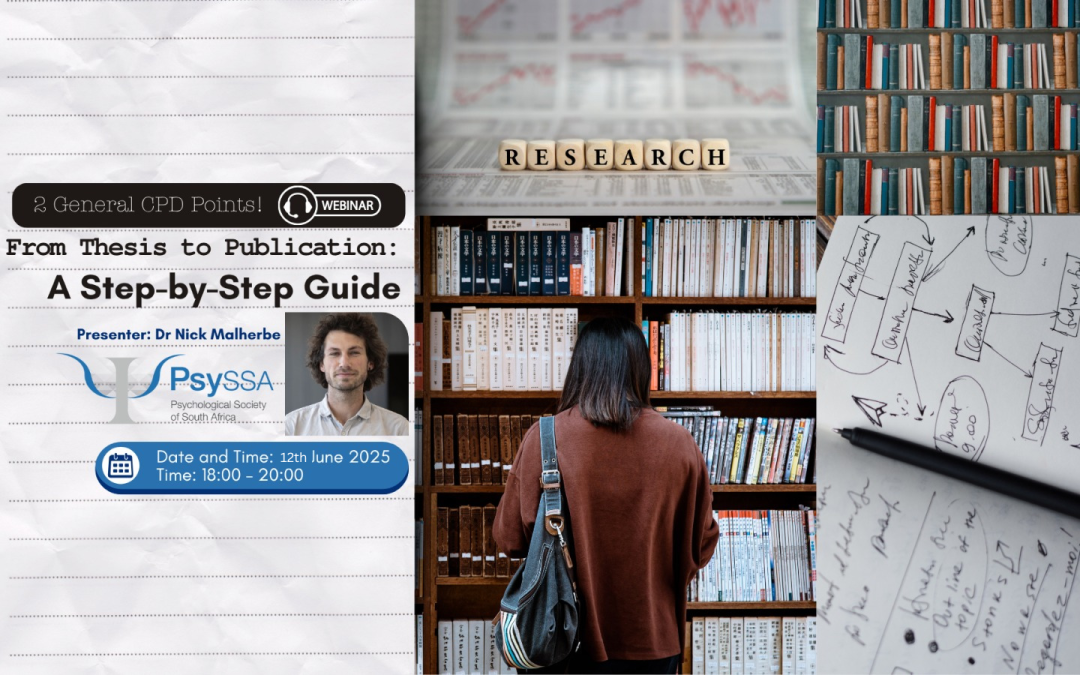
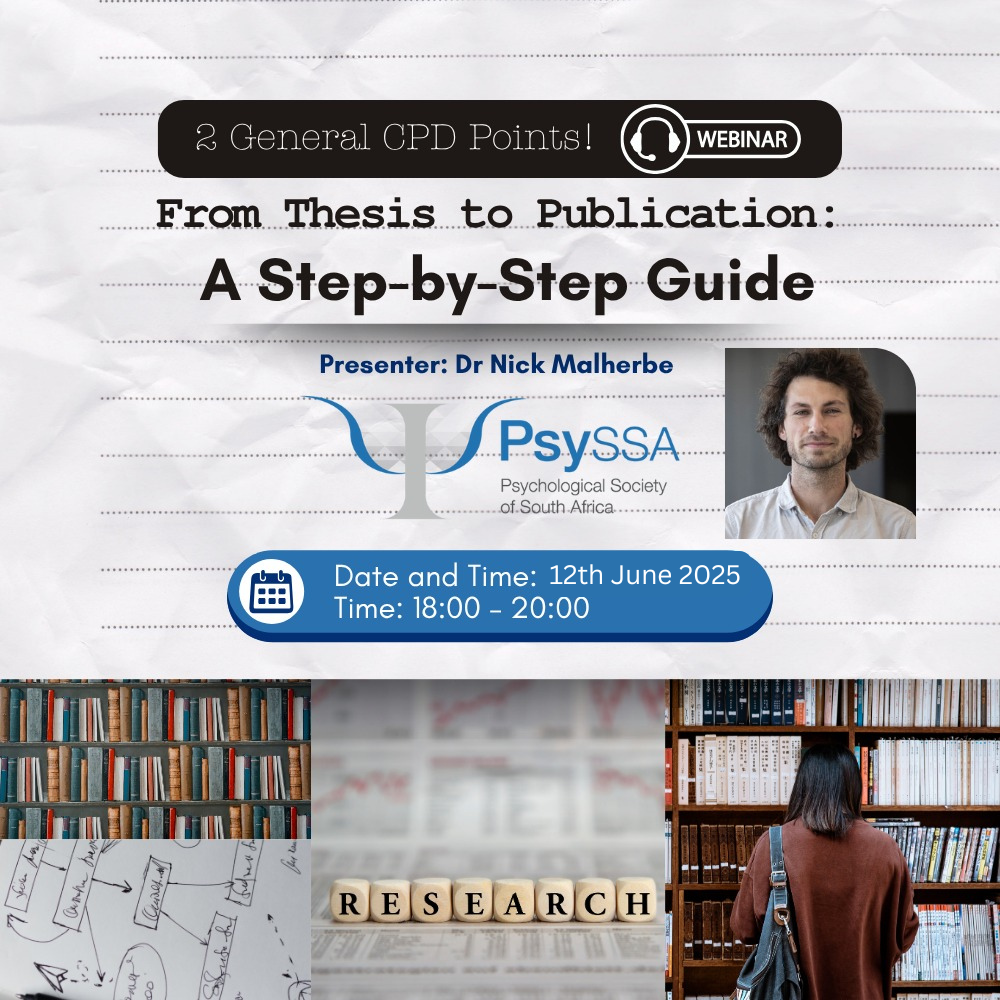
From Thesis to Publication: A Step-by-Step Guide

From Thesis to Publication: A Step-by-Step Guide

From Thesis to Publication

A Step-by-Step Guide 

In celebration of Youth Month, PsySSA is proud to present an empowering and informative webinar designed to support emerging scholars and early-career professionals.

Workshop Details:

  • Date: Thursday, 12 June 2025
  • Time: 18:00 – 20:00
  • Platform: Zoom
  • Cost: Free

This event reflects PsySSA’s commitment to advancing excellence, equity, and transformation in South African psychology. Join us as we equip the next generation of scholars with the tools to make their voices heard and their knowledge count.

Don’t miss this opportunity to gain insights and prepare for success!

About this webinar:

Publishing from your thesis might be an academic requirement, a useful step in one’s career, or simply a means by which to engage more deeply with a specific topic. However, the world of academic publishing can seem uninviting and intimidating. In this webinar, we will cover the basics of publishing from your thesis. We’ll discuss co-authorship, how and where one can submit their work, the form that a journal article can take, when to follow up with journal editors, and how to respond to reviewer feedback.

The Psychology Career Compass Series: Part 2 – Recording Out Now!

The Psychology Career Compass Series: Part 2 – Recording Out Now!

The Psychology Career Compass Series

Recording Now Available – Part 2

Recording Now Available: Psychology Career Compass Series – Part 2
Exploring Alternative Psychology Pathways Beyond Traditional Routes

PsySSA is excited to share the recording of Part 2 of our transformative Psychology Career Compass Series, held on 8 May 2025.

This session focused on the diverse, non-traditional career opportunities available to psychology graduates—particularly those navigating paths beyond Honours or following unsuccessful programme placements.

Whether you’re a student, recent graduate, or early-career professional, this workshop offers practical insights into how your psychological training can be applied across sectors like:

User experience and design
Behavioural science
Digital marketing
Corporate training
Research and innovation
…and more.

Our panel of dynamic professionals shared their unique journeys, highlighting the importance of adaptability, continuous learning, and creative career thinking in a shifting job market.

About the workshop

Not every journey in psychology follows a straight line—and for many, the path beyond Honours or unsuccessful programme placements can still lead to a fulfilling, impactful career. This workshop is designed for students and early-career graduates who are exploring how to apply their psychology skills in innovative and non-traditional contexts.

Join professionals who have transitioned into dynamic roles across industries such as user experience, digital marketing, behavioural science, corporate training, research, and more. Through engaging discussions, they will share how their psychology background positioned them for success, what additional skills or mindset shifts were needed, and how to leverage psychological training in fields outside of clinical or registered practice.

Meet the Presenters
Prof Ronelle Carolissen

Prof Ronelle Carolissen

PsySSA President

Leonie Vorster

Leonie Vorster

Chairperson: Division for Research and Methodology (DRM)

Dr Sharon Truter

Dr Sharon Truter

Neuropsychologist and Counselling Psychologist

Dr Momi Metsing

Dr Momi Metsing

PsySSA: Executive Member; Chairperson: Society for Educational Psychology of South Africa (SEPSA)

Kgomotso Sekhute

Kgomotso Sekhute

Vice-chairperson: The South African Society for Clinical Psychology (SASCP)

Barry Viljoen

Barry Viljoen

Vice-Chairperson: Psychology in Public Service (PiPS)

Dr Ewald Crause

Dr Ewald Crause

Interim Chairperson: Artificial Intelligence Division (AID)

Fatima Peters

Fatima Peters

Divisional Additional Executive Member: Climate and Environment Psychology (CEPD) & Division for Research and Methodology (DRM)

Anne Kramers-Olen

Anne Kramers-Olen

Secretary & Treasurer: Psychology in Public Service (PiPS)

Lynne Richards

Lynne Richards

Chairperson: Trauma & Violence Division