World Bipolar Day – 30 March 2025

World Bipolar Day – 30 March 2025

World Bipolar Day: Understanding Bipolar Disorder and Reintegration into Community in South Africa

By Barry Viljoen and Samke Ngcobo
 
Bipolar is a mood disorder which is characterised by clear and distinct periods of mood found on alternative poles of the mood spectrum. This means that there will be periods when a clear and visible depressed mood is present and that there will be periods of an elevated mood either being a manic or hypomanic episode. While these periods can vary in intensity, it can result in significant disruptions in daily life. 
The World Health Organisation currently estimates that 1 in 150 adults live with this disorder, equalling to approximate 40 million people. While within South Africa it is estimated that 3-4% of the population experience this disorder, with it equally affecting men and women. 
 
On this day we attempt to raise awareness about the importance of a greater understanding of bipolar, so that earlier diagnosis and treatment can be accessed by all South Africans. People living with bipolar are discouragingly being subjected to societal challenges, such as exclusion and discrimination. However, the hope is that with public education and awareness campaigns, that the tide will turn. Which will in turn allow for access to adequate treatment and support systems. So that they are able to reclaim their place within society and our communities, through the living of meaningful and fulfilling lives and making meaningful contributions to society. 
Bipolar cuts across race, class and other demographic divides. As such it is only through the embrace of a more inclusive mindset, that we can create an environment that fosters, healing, connection and opportunity for all. Steps towards achieving this goal are being paved by brave and outspoken activists, and in this specific piece the personal activist, Dr. Samke Ngcobo, that we as South Africans can challenge the stigma related to and foster open dialogues about mental health. 
I am Dr Samke Ngcobo, a medical doctor who has been navigating bipolar disorder type 1 since the early age of 14. 2025 marks 24 years of me living with this disorder and I can safely say that I am not suffering from this condition but I am thriving despite it. I have often sensed an unspoken and subtle conditioning that comes with the role of being a doctor that prohibits vulnerability and struggles. Part of my purpose of founding www.vocalmentality.com was to amplify the voice of the lived experience narrative and also to share practical insights from a professional perspective as someone who has worked in mental healthcare services. My dual perspective is my secret weapon because I choose to use it as my source of empowerment. As a doctor who has had professional exposure to interventions which provide support to mental healthcare users who live with bipolar disorder, I have been cognisant to apply the recommendations that are applicable to managing this illness. As an individual with lived experience with bipolar disorder, I believe that psycho-education has dissipated my denial and lack of insight. This happened when I finally encountered a psychiatrist and psychologist who enabled me to understand my illness comprehensively through psycho-education as their patient while embracing me as someone who is critical to the multidisciplinary team. They were and remain empathetic and are very patient with me even when I feel that I have failed myself through a relapse or the consequences thereof. 
◦Psychological support in the form of psychotherapy is part of the bedrock for my sustained mental wellbeing. My weekly Tuesday appointments with my psychologist are sacred to me. They serve as a mirror for me to face myself. At times I look forward to seeing my reflection and other times I dread it. I cannot adequately articulate how critical this intervention has been with my life. This year marks my eighth year with the same therapist who provides psychoanalytic psychotherapy. The term sounds complicated but simply put, this form of therapy has halted the vicious cycle of recurrent relapses related to my bipolar diagnosis. The intoxicating quality of being manic is no longer attractive and its consequences are not worth the short-term appeal of escapism.
 
◦Stigma comes in various forms and is motivated by various beliefs but I believe that the most difficult form stigma to process is self-stigma because of the shame attached to it, that follows like a dark cloud. I learned very early on in my illness that my condition is something that should exist in hushed conditions of secrecy and was to be hidden at all costs. This was due to the comments by people who did not know that I was diagnosed with the condition. The stereotypes of how people living with the condition look and present felt foreign to me and so I went through a painful path of denial due to lack of insight. 
◦When I overcame the self-stigma, the other types of stigma ceased to matter. Many people wonder how I overcame the self-stigma and my reasons are layered and multifaceted. Sadly, my main source of emancipation was birthed five years ago after I experienced a public bipolar episode that led to reputation damage and humiliation that left me bare in my vulnerability. 
◦A tangible reminder of the possible debilitating consequences of my illness, was the resultant cognitive impairment that was caused by the severity of my relapse. This led to 6 months of incapacity leave and an extensive rehabilitation programme with my occupational therapist which was complimented by my regular follow ups with my psychiatrist and psychologist.
◦The repercussions of an episode are undermining and the related trauma is underestimated 
◦The financial cost of maintaining sustained mental health needs to be addressed because the financial burden of it can led to impaired management of the illness. The pharmacological interventions are expensive with limited support from medical aids. The impact of the side effects needs to be considered as this may potentially lead to non-adherence if communication with the healthcare provider is poor. I recently changed my treatment regimen but unfortunately there are unwanted side effects. I know better than earlier on in my illness that I am not my own doctor but I should consult my psychiatrist to adjust my treatment.
◦My secret weapons: early intervention improves prognosis, psycho-education is critical, my mental health toolkit, disability is preventable and possible to recover from if the right support is in place.
◦Feeling like a I play an integral role in the management of my illness holds me accountable and helps me to feel empowered as opposed to being a victim.
◦We have a long way to go in breaking the stigma related to bipolar disorder but confronting it through psycho-education from people who are thriving with lived experience with the condition is a powerful tool of mental health advocacy.
 
It is through lived accounts that we humanise conditions seeing them not as definitive and defining but rather people living with a condition. As we mark this day, let us remember that mental health is just as important as physical health. Understanding and compassion are essential for the reintegration and well-being of those living with bipolar disorder, allowing them to thrive within their communities.

World Bipolar Day

Health Psychology Division

Today, on World Bipolar Day, we recognise and acknowledge the strength and resilience of people living with bipolar disorder. The experience of bipolar disorder can significantly affect a person’s sense of reality, sense of self, and can impact their relationships, employment, self-esteem, and physical health. For some, navigating life with bipolar disorder can be a strenuous and isolating journey, highlighting the need for recognition, support, and understanding.

Bipolar disorder is a chronic condition, however, with the correct treatment, people can become aware of their symptoms, manage them, and experience a fulfilling life. People living with bipolar disorder must learn about their triggers, as these can, in turn, initiate mood episodes. Some of the most common triggers include (but are not limited to) stress, conflict with others, lack of sleep, significant loss, seasonal changes, and substance use. The treatment for bipolar disorder includes medication, psychotherapy and lifestyle changes and can aid in fostering a sense of agency and control. Empowering people living with bipolar disorder to take control of their condition may enhance both treatment adherence and a sense of self-efficacy, ultimately contributing to improved well-being.

Nevertheless, it is important to recognize that, despite empowerment efforts, people with bipolar disorder may encounter stigma from their families, communities, healthcare systems, and society. This stigma can lead to barriers in accessing appropriate healthcare and receiving the necessary support. In addition, media representations of bipolar disorder contribute to misconceptions, influencing how people treat and interact with those affected by the condition. The lack of education and understanding about bipolar disorder can negatively affect the empathy and care shown towards those living with the condition. Addressing these misconceptions is important to encourage support and understanding for people living with bipolar disorder.

Equally important is adherence to treatment, which is essential for effective management. There are several strategies beneficial for individuals living with bipolar disorder, including the following:

  • Following the prescribed treatment regimen
  • Adhering to medical and psychotherapy appointments
  • Engaging in psychoeducation about the bipolar diagnosis and the symptoms
  • Creating a consistent and healthy sleep schedule
  • Learning relaxation and emotion-regulation techniques with the help of a psychologist
  • Identifying and limiting exposure to stressful situations
  • Avoiding alcohol and illicit substances and limiting (or avoiding) caffeine
  • Consulting a healthcare professional about any prescription or over the counter medication before taking them in conjunction with treatment for bipolar disorder
  • Establishing a healthy lifestyle by exercising and eating healthy
  • Monitoring symptoms by creating a journal that keeps track of mood, and symptoms
  • Informing a healthcare professional when changes occur in relation to mood and behavioural patterns.
  • Asking for support from family, friends or persons who feel trustworthy
  • Spending time with loved ones or joining a support group

To the people living with bipolar disorder

We stand in solidarity with you. While navigating life with bipolar disorder can present many challenges, always remember that your diagnosis does not define your identity. You are valued and your experiences matter.


Human Rights Day – 21 March 2025

Human Rights Day – 21 March 2025

PsySSA Commemorates Human Rights Day – 21 March 2025

Beyond Commemorations: Advancing Social Justice and Human Rights

By: Justice Desk Africa and PsySSA’s Decolonising Psychology Division

 On 21 March 1960, the township of Sharpeville became the site of one of South Africa’s darkest days. A peaceful protest against the apartheid regime’s oppressive pass laws ended in tragedy as police opened fire on an unarmed crowd of 5,000 people. Sixty-nine lives were lost, and hundreds more were wounded in what would come to be known as the Sharpeville Massacre. This event was a turning point in the struggle against apartheid, exposing the brutal nature of the regime to the international community and galvanising the fight for justice and equality. Today, we commemorate this day as Human Rights Day, not only to remember those who died but also to reflect on the state of human rights in South Africa and the unfinished work of social justice.

Since the fall of apartheid in 1994, South Africa has made considerable strides in establishing a constitutional democracy rooted in human rights. The Bill of Rights enshrined in our Constitution promises dignity, freedom, and equality for all. Yet, the realities of daily life tell a different story one where the legacies of colonialism and apartheid continue to manifest in systemic injustices. Economic inequality remains one of the most pressing issues, with wealth still largely concentrated in the hands of a few, while the majority, particularly Black South Africans, remain trapped in cycles of poverty. Racial capitalism, where economic power is still racialised, further entrenches these divides, making true social justice an elusive goal.

Gender-based violence continues to plague the country, with women and LGBTQIA2S+ individuals disproportionately affected. Despite progressive laws and policies aimed at combating gender inequality and violence, the failure of the state to implement these protections effectively has left many vulnerable. Xenophobia also rears its head repeatedly, with foreign nationals scapegoated for socio-economic hardships, undermining the principles of Pan-Africanism and Ubuntu that should be guiding our democracy.

Moreover, the very institutions meant to uphold human rights often become perpetrators of systemic violence. Police brutality, reminiscent of apartheid-era repression, continues unabated, particularly in marginalised communities. Access to basic services such as quality education, healthcare, and housing remains unequal, revealing a persistent gap between constitutional ideals and lived experiences. Corruption within government structures further erodes public trust, diverting resources away from those who need them most.

In light of these ongoing struggles, deepening a culture of social justice and human rights is more than a moral imperative – it is a necessity for South Africa’s democratic survival. Symbolic recognition of human rights is not enough; there must be a concerted effort towards structural transformation. This requires not only policy reforms but active citizen engagement in dismantling systems of oppression. The Constitution must be more than a document, it must be a living, breathing force that informs legislation, governance, and social action.

Justice is not a passive ideal bestowed from above; it is a collective struggle that must be fought for and defended daily. True human rights are realised in solidarity with the most marginalised. This means standing against economic exclusion, advocating for gender justice, challenging xenophobia, and demanding accountability from those in power. Human Rights Day must serve as more than a moment of remembrance – it must be a call to action!

Organisations like Justice Desk Africa embody this commitment by working on the ground to educate, empower, and advocate for those whose rights are often disregarded. Their work highlights that real transformation begins with grassroots movements that challenge oppressive structures and foster communities grounded in dignity and equity.

As we reflect on the Sharpeville Massacre and the sacrifices made for our freedoms, we must ask ourselves: What are we doing to uphold the values that those who came before us fought for? Are we complacent in the face of injustice, or are we actively working towards a society where human rights are not a privilege, but a lived reality for all?

The path to a just and equal South Africa remains fraught with challenges, but it is a path we must walk together. Only through collective responsibility, sustained activism, and unwavering commitment to social justice can we ensure that the horrors of the past do not define our future. Let us honour the memory of Sharpeville not just in words, but in action – by building a society that truly upholds the dignity and rights of every individual.


DRM Webinar: From Science Communication to Public Engagement

DRM Webinar: From Science Communication to Public Engagement

DRM Webinar: From Science Communication to Public Engagement

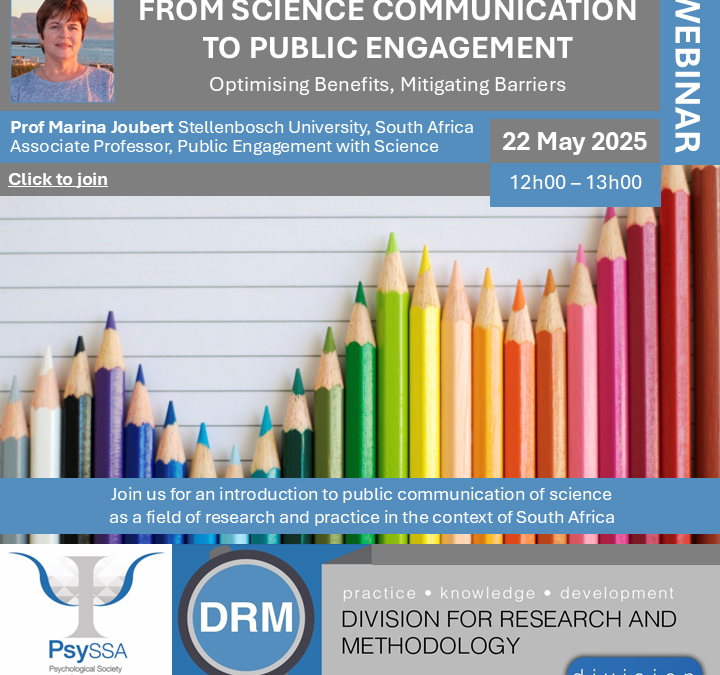
Join the PsySSA DRM and Prof Marina Joubert for an introduction to public communication of science as a field of research and practice in the context of South Africa.

From Science Communication to Public Engagement

Date: 22 May 2025

Time: 12h00 to 13h00

MS Teams Link: Click to join

About the webinar:

Professor Marina Joubert will introduce public communication of science as a field of research and practice in the context of South Africa, followed by a discussion of the rationale and drivers behind the trend from ‘public communication of science’ towards ‘public engagement with science’. She will explore the options for researchers to gain maximum benefit from public engagement while navigating the barriers and risks. Her talk will also briefly reflect on current insights from ‘the science of science communication’. She will share a curated collection of online resources with all participants.

Can’t join us live? Watch all recordings of the PsySSA DRM Webinars and Research Podcast episodes on the PsySSA DRM YouTube Channel

About the Presenter

Prof Marina Joubert

Prof Marina Joubert is an associate professor of public engagement with science at Stellenbosch University in South Africa. She leads the Public Engagement Lab, located within the Centre for Research on Evaluation, Science and Technology (CREST). Following a career of more than 20 years in science communication practice, she joined the university in 2015 to start a new teaching and research programme in public communication of science. At Stellenbosch, she is responsible for an extensive education and supervision programme and a diverse research portfolio. Her international research collaborations include the EU-funded Eco2Wine Project and the ‘Just Transitions for Anti-Microbial Resistance’ global convening funded by The British Academy. She serves as deputy editor of the Journal of Science Communication (JCOM) and is an honorary lifetime member of the global Public Communication of Science and Technology (PCST) Network. Her research focuses on scientists’ roles in public engagement with science and the motivations and challenges that shape their interactions with society. She is also interested in institutional science communication, representations of science in the mass media, the ethics of science communication, and online interfaces between science and society.

Email: marinajoubert@sun.ac.za

Online profile: https://www0.sun.ac.za/crest/staff/Joubert/

ORCID ID: orcid.org/0000-0003-0178-1796

Practice Guidelines For Psychology Professionals Working  With Sexually And Gender-Diverse People (2nd Ed.)

Practice Guidelines For Psychology Professionals Working With Sexually And Gender-Diverse People (2nd Ed.)

Coinciding with the official launch in Cape Town, 18 March 2025, herewith, the second edition of the Psychological Society of South Africa [PsySSA]. Since science and practice evolve, these guidelines are an updated consolidation of best practice evidence in South African and international psychology as it pertains to understanding sexual and gender diversity. The umbrella term of ‘sexual and gender diversity’ includes, but is not limited to, people who identify as lesbian, gay, bisexual, transgender, queer, intersex, and/or asexual (LGBTQIA+). Enjoy the read!

Suggested citation:
Psychological Society of South Africa. (2025). Practice Guidelines For Psychology Professionals Working With Sexually And Gender-Diverse People. Johannesburg: Psychological Society of South Africa (PsySSA).

Student Division: Masters in Counselling Psychology Workshop

Student Division: Masters in Counselling Psychology Workshop

Masters in Counselling Psychology Workshop

The PsySSA Student Division presents a workshop on Masters in Counselling Psychology Workshop. This will be an interactive, three-hour session, and we are excited to help participants prepare for the application, selection, and interview processes with confidence.

 Workshop Details:

  • Date: Saturday, 15 March 2025
  • Time: 09:00 – 11:00
  • Platform: Zoom
  • Cost: Free

Don’t miss this opportunity to gain insights and prepare for success!

Selina Masetle

Intern Counseling psychologist Charis Psychological Services

  • Autobiography and Motivational Letter
  • Individual Panel Interview: Possible Questions and Approach
  • Role Play

Katlego Senoelo

Intern Counselling psychologist: Charis Psychological Services

  • Self-awareness and Personal Development Preparation Strategies
  • Realistic Expectations
  • Managing Uncertainty and Exploring Alternative Pathways

Martha Moagi

Intern Counselling Psychologist: UFH

  • Category-Specific Knowledge: Counselling Psychology
  • Research Interview
  • Group Interview: Case Study and Approaches

RCP Workshop: Opening Private Practice for Registered Counsellors and Psychometrists

RCP Workshop: Opening Private Practice for Registered Counsellors and Psychometrists

RCP Division Workshop

Opening Private Practice for Registered Counsellors and Psychometrists

Are you ready to embark on an incredible journey of independence? If you’ve just aced your board exams or are contemplating the thrilling leap from employment to launching your own private practice, this workshop is tailor-made for you! Join Shaazia, an inspiring psychometrist, and Chantel, a passionate Registered Counsellor, as they guide you through the exhilarating steps to kickstart your own practice. From navigating the registration maze with entities like HPCSA and BHF to ensuring you are connected with the right medical aids, we have got you covered! Plus, discover how to create eye-catching stationery and ignite your advertising strategy to make your practice shine. Don’t miss out on this opportunity — register for this workshop today!

  • Date and Time: 27 March 2025, 16:00 -17:30 SAT
  • Online Via Microsoft Teams (link will be shared with registered participants by 26th March)
  • Speakers/Hosts: Shaazia Patel (Psychometrist) and Chantel Retter (Registered Counsellor)
  • Cost: Free for members and non-members
  • RSVP Requirements: Interested parties are to RSVP by 25 March 2025 at 10h00. Here is the RSVP link: https://forms.gle/QuNDGksnjHmRpRUd7


For further information, feel free to reach out to us at: rcp@psyssa.co.za