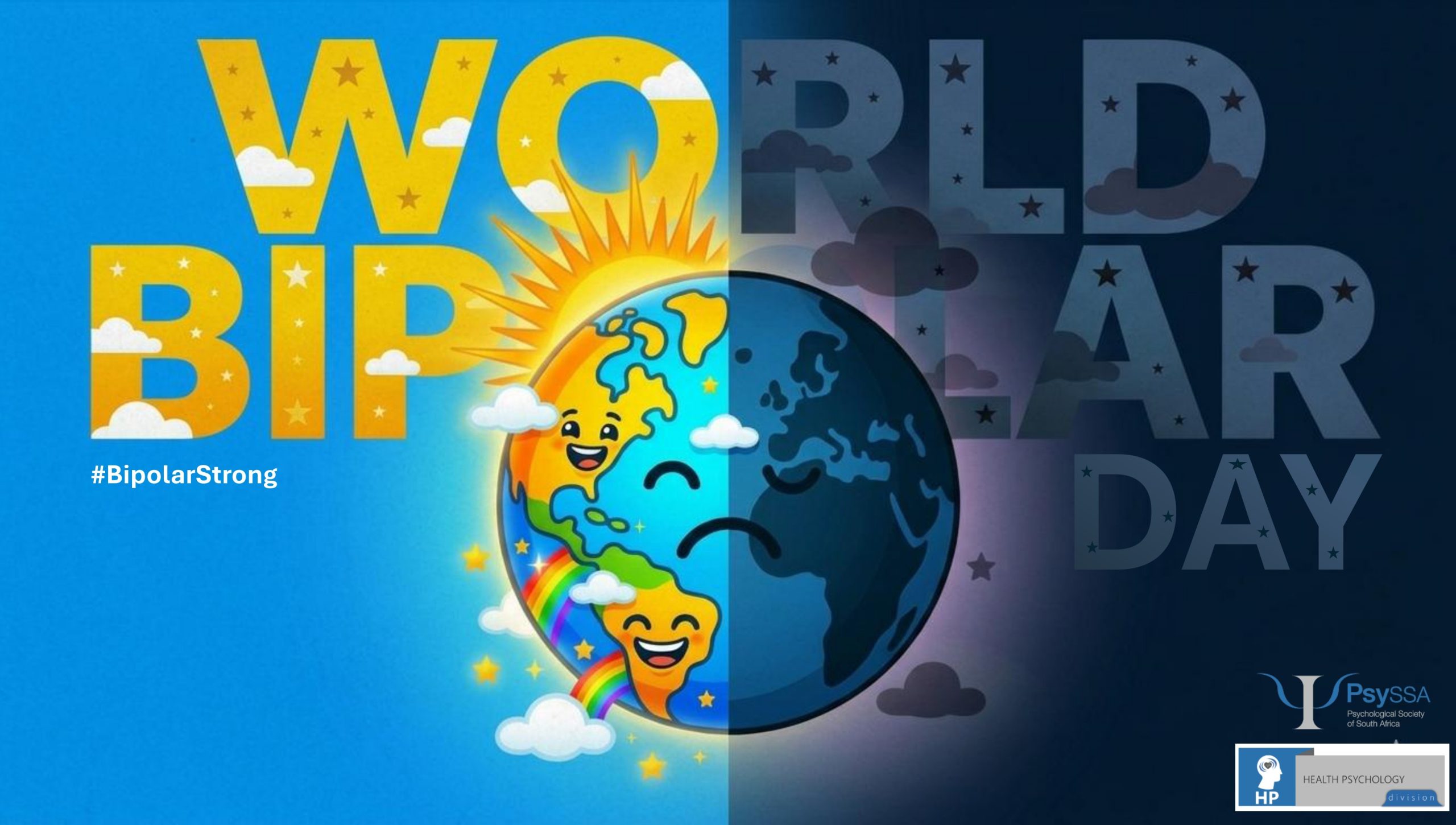
PsySSA Commemorates Bipolar Day – 30 March 2026

PsySSA Commemorates Bipolar Day – 30 March 2026

World Bipolar Day 2026 – “Bipolar Strong”


Today, PsySSA joins the global community in commemorating World Bipolar Day under the theme “Bipolar Strong.”

Living with bipolar disorder is not a weakness – it is a journey of resilience, courage, and ongoing navigation of complex emotional, cognitive, and social realities. While often misunderstood as simple “mood swings,” bipolar disorder is a serious condition involving profound shifts in energy, sleep, and emotional regulation that can deeply affect daily life.

This year, contributions from PsySSA’s Health Psychology Division (HPD) and Decolonising Psychology Division (DPD) invite us to deepen how we think about mental health.

This World Bipolar Day, we call on all sectors of society to:

  • Challenge stigma
  • Strengthen systems of care
  • Centre lived experiences
  • Advance equitable and accessible mental health support


Bipolar Disorder and Mental Health Justice: A Decolonial Reflection for World Bipolar Day
By: Kim Gabriel-Dixon

This reflection explores bipolar disorder through a decolonial lens, inviting a broader understanding of mental health that recognises the social conditions, relationships, and structural realities shaping people’s lives. It encourages compassionate awareness while highlighting the importance of dignity, justice, and community care in supporting those living with bipolar disorder.


Today we commemorate World Bipolar Day under the theme: “BIPOLAR STRONG”

World Bipolar Day is a reminder that living with bipolar disorder is not a weakness, but a journey of resilience, strength, and courage. The theme ‘Bipolar Strong’ celebrates individuals who navigate the highs and lows while continuing to lead meaningful lives, challenge stigma, and advocate for better mental health support.

Every journey with bipolar disorder is different, shaped by personal, social, and structural factors. To transform mental health care, we must look beyond the diagnosis and see the person before the patient.

Here in South Africa, research continues to strengthen our understanding of bipolar disorder care by linking policy, clinical practice, and patient realities. They highlight the importance of effective medication management, multidisciplinary support, familial support, and national treatment guidelines in shaping care and realities for those living with bipolar disorder:

This World Bipolar Day, let us stand in solidarity, challenge stigma, and support those living with bipolar disorder.

Together, we are #BipolarStrong

Decolonising Psychology Division – 16 Days of Activism Against Gender-Based Violence

Decolonising Psychology Division – 16 Days of Activism Against Gender-Based Violence

PsySSA Decolonising Division (DPD)

She sat on the clinic chair with her shoulders folded inward, as if trying to shrink from the world that had suddenly become too loud, too cruel, too invasive. “I didn’t think it would follow me home,” she whispered. “But it’s on Facebook… on TikTok… even my little cousin saw it.”

She is nineteen. Her story is one I have heard too many times in different variations the trusting conversation, the shared photo, the quiet belief that intimacy will remain intimate. But in a matter of hours, her private world became public property. Her images were stolen, edited, mocked, and circulated by strangers who would never know her name yet felt entitled to her body, her dignity, and her pain.

There were no bruises to show the nurses. There was no fracture in the X-ray machine. But her world had collapsed. Her mother said she barely left her room. She said she barely slept. She said she no longer recognised her daughter’s voice.

This is the new face of violence in South Africa: silent, borderless, and devastating.

Our country has long been haunted by the shadow of gender-based violence. Statistics South Africa (2024) confirms that one in three women will experience physical or sexual violence, a number that reflects only those who managed to speak. But the terrain has shifted. Violence now slips into digital spaces, where the assault is repeated every time someone views, shares, downloads, or laughs. In this new frontier, harm does not end when the perpetrator walks away; it lingers, replayed endlessly in the survivor’s mind.

Amnesty International (2023) notes that nearly 40% of South African women have experienced online harassment. Behind that number are real lives: the Grade 12 learner bullied by classmates after her private messages were leaked; the young professional whose career stalled when intimate images were weaponised against her; the village girl whose family shamed her instead of supporting her. Digital violence strips away safety, identity, and belonging and the psychological wounds are often deeper than what we see in therapy rooms.

As psychologists, we need to recognise that digital violence is not about technology alone. It is born from old patterns of power, gendered, cultural, and historical that have simply moved into modern spaces. A decolonial perspective reminds us that Black women, especially, carry layered vulnerabilities. Their bodies have long been sites of exploitation and scrutiny, and the digital world merely amplifies those inherited injustices.

Responding to this requires more than therapy. It requires compassion, community, and the courage to confront the systems that enable this harm. It demands that we listen without judgment, validate without hesitation, and support without condition.
To every woman and girl who has endured this unseen assault: your pain is real. Your fear is understood. Your story matters.

And to all of us, families, educators, colleagues, partners may these days urge us not into slogans, but into empathy. We urge you to stand firm for dignity, for justice, and for a digital world where freedom does not come at the cost of one’s humanity.
Let us create homes, schools, workplaces, and digital spaces where a woman’s dignity is not negotiable, where her voice is safe, and where her existence does not come with a cost.

Because violence may evolve, but so must our humanity.

“Mental Health: Racism and Psychosocial Well-Being in South Africa” – Decolonising Psychology Division (DPD)

“Mental Health: Racism and Psychosocial Well-Being in South Africa” – Decolonising Psychology Division (DPD)

The Decolonising Psychology Division (DPD) contributes a profound reflection on how racism, historical trauma, and structural inequality continue to shape the mental health landscape in South Africa.

Read more below:

“Mental Health: Racism and Psychosocial Well-Being in South Africa”

– Decolonising Psychology Division (DPD)


South Africa’s enduring legacy of slavery, colonialism, and apartheid continues to generate racialisation and associated psychosocial harms. Psychological distress, mental injury, wounding, and trauma are not only individual experiences but also collective outcomes of structural inequality and racial oppression that affect the majority of the population (Kaminer & Eagle, 2020; Kleintjes & Schneider, 2023; Manganyi, 2019; South African Federation for Mental Health, 2020; Williams et al., 2008). These historical injuries are compounded by deep economic inequality, unemployment, gender-based violence, corruption, and the inadequate provision of health, education, and other essential services. Each of these realities impacts society in racially patterned and distorted ways. The question is no longer whether South Africans face increasing psychosocial pressures, but whether psychology and its related professions are prepared to meet this urgent challenge.

In October 2021, the American Psychological Association formally acknowledged its complicity in, and failure to address, the mental injury caused by racism and racialisation (American Psychological Association, 2021). Globally—and in South Africa—racial trauma is increasingly recognised as a significant mental health issue, with terms such as race-based stress, racial wounding, and collective racial wounding and healing gaining prominence (Cénat, 2023; Chávez-Dueñas et al., 2019; Sibrava et al., 2019). Cénat (2023) proposes a framework for complex racial trauma (CoRT), emphasising that racial harm is repetitive, cumulative, vicarious, and unavoidable, affecting the mental, physical, material, and spiritual dimensions of people’s lives.

While these frameworks are valuable, there is a danger of over-pathologising, medicalising, or biologising phenomena that originate in social and structural spheres (Benoist, 2022; Rashid, 2024, 2025). Moreover, mainstream psychological healing—typically talk therapy between practitioner and client—may not provide a complete answer to collective well-being. This approach is individualised, resource-intensive, and grounded in Euro-American praxis that is often contextually inappropriate.

Racial trauma, as a collective wound, requires collective responses and awareness of the social systems that perpetuate injury. At the personal level, healing involves a movement from wounded and fragmented selves toward creativity, wholeness, and community well-being. At the systemic level, collective agency is required to expose, disrupt, and dismantle social and structural oppression. What is urgently required is a decolonial praxis for healing.

A decolonial psychology and praxis of healing offers a pathway forward. It does not reject clinical evidence nor deny the importance of care; rather, it rebalances the relationship between evidence, culture, and context. It asks who defines stress, wounding, and trauma, whose knowledge counts, and how services can be designed with—not merely for—communities most affected by oppression. Beyond individualistic approaches, a decolonial psychology and community-healing framework addresses epistemic justice, systemic racial injuries, and the transgenerational transfer of trauma (Kiounani, 2019; Mullan, 2023; Seedat, 2023; Stevens & Sonn, 2021). Its focus includes intersectional understandings of oppression, multidisciplinary collaboration, the development of critical consciousness, and a reconnection to community-centred, participatory meaning-making and agency (Chioneso et al., 2020; Clay, 2017; Kessi, Suffla, & Seedat, 2022; Malherbe & Ratele, 2022).

Indigenous knowledge, embodied healing, neurobiological understanding, and spirituality are recognised as valid and vital foundations for collective care (Benoist, 2022; Cénat, 2023; Kiounani, 2019; Rashid, 2024, 2025; Rundall, 2019). A decolonial praxis focuses not only on healing but also on growth, emancipation, and resistance. This includes community-embedded and participatory approaches such as storytelling, commemoration, restorative dialogue, ritual, arts-based practice, land- and place-based work, and the rebuilding of shared meaning and social bonds (Morkel, 2011).

For healing to gain traction, community-based programmes and knowledge creation—along with language-appropriate and culturally grounded practices—are essential. Such initiatives should involve collaboration among community practitioners, activists, traditional healers, faith leaders, and a broad referral network (Benoist, 2022; Kleintjes & Schneider, 2023; Rashid, 2024, 2025). Reflective practice is equally vital for frontline workers, enabling them to recognise and metabolise vicarious trauma, which in turn protects both practitioners and their efficacy in serving communities (Masson & Graham, 2022).

A decolonial healing approach to racial trauma in South Africa implies that psychosocial well-being cannot be separated from broader social determinants such as livelihood support, safety, education, and gender-based violence prevention. Psychosocial well-being in South Africa requires both an honest reckoning with history and decisive action to dismantle the conditions that reproduce distress. Psychology and allied professions have an ethical and social obligation to revitalise and reimagine collective, culturally rooted, and emancipatory practices of healing that decolonise existing mental health models.

PsySSA Commemorates National Women’s Day 2025

PsySSA Commemorates National Women’s Day 2025

PsySSA Commemorates National Women’s Day 2025

09 August

A critical reflection on psychology’s role in advancing gender equity in South Africa

This opinion piece has been drafted by Angeline Stephens, PhD on behalf of the Sexuality and Gender Division (SGD) of PsySSA, with input from members of the SGD.

As we commemorate Women’s month in August and Women’s Day on the 9th August in South Africa, we reflect on psychology’s role in advancing gender equity and promoting socio-economic justice for women and gender diverse communities through inclusive psychological practice.

In marking this month and day, the South African government website begins by paying tribute to the women who marched to the Union Buildings on the 9th August, 1956, in protest against the Pass Laws (https://www.gov.za/WomensDay2025). Additionally and importantly, through remembering several “pioneer” women, we are reminded that women’s participation in the political transformation of our country and, specifically, in the fight for women’s rights, predates the significant 1956 march to the Union Buildings.

Accordingly, in reflecting on psychology’s role in advancing gender equity and promoting socio-economic justice for women in South Africa, we are compelled to situate psychology’s role within the broader political and socio-historical contexts of our beloved country; ravaged by the scars of the colonial rape[1] of the land and its people, apartheid violence and deep trauma.

Quijano’s (2007) concept of the coloniality of power in the “modern/colonial gender system” (Lugones, 2023) provides an appropriately relevant and critical point from which to reflect on the role that psychology plays, in the present moment, in addressing the gendered inequalities of the past, in ways that interrogate its intersections with race, class and sexuality.

To what extent has psychology shifted from being an instrument that supported an apartheid ideology and system of hierarchical racial categorisation and divisiveness to being one of inclusive practice that recognises the diversity of gendered, classed and raced identities?

Cognisant of this history that continues to permeate the lived reality of millions of women, whose lives are systematically devalued and dehumanised, in what ways does psychology advance gender equity and promote socio-economic justice for women and gender diverse communities through inclusive psychological practice?

It is appropriate to begin by considering the kind(s) of knowledge that is/are produced in academic and professional spaces through teaching, research, professional programmes and therapeutic work, as these enactments mark very tangible ways in which psychology, as a discipline and a practice, engages with (marginalised) communities and represents an instrument of power.

Psychology’s participation in teaching, research, training, therapy and community engagement offer powerful ways in which psychology can challenge and change normative, gendered ways of doing. But this requires constant critical reflexive practice of what we do.

It is pleasing to note that there is a shift towards including content that is more African-centred and produced in the global south in professional programmes. However, such content is often offered as an elective rather than one of the core modules. For a large part, western and eurocentric theoretical and therapeutic approaches continue to dominate professional programmes. The linkage between their inclusion and advancing gender equity becomes salient when we consider how psychology is done and enacted in work with women from marginalised communities in particular.

Access to resources and ownership of resources is highly gendered and raced in South Africa. The past apartheid system has meant that, for a long time, psychology has been dominated by white males from privileged socio-economic backgrounds. To what extent has this profile changed to represent a more inclusive and gender-diverse profession? And how has such change translated to empowering women from marginalised communities?

A quick survey of the selection of candidates for the professional Masters’ programmes in psychology across various HE institutions is likely to reveal a skew towards more women candidates. While this may be regarded as progressive, and a ‘good-fit’ given that more women than men tend to access psychological services, such changes may not be adequate in addressing gender equity if the programmes themselves remain primarily individualistic and westernised in their orientation.

Hence, it is pleasing to note the shift towards including more feminist, critical and decolonial perspectives in teaching, research and practice. The Hub for Decolonial Feminist Psychologies in Africa, housed at the Department of Psychology at the University of Cape Town, is a good example.

The Psychological Society of South Africa (PsySSA) itself has seen the emergence of additional Divisions based on membership interest, which, together with the more long-standing and established Divisions, reflect a shift towards more critical approaches to psychology and the communities it serves. More importantly, in terms of the gendered focus of this article, the PsySSA divisions offer practitioners a platform for more critical engagement with the changing landscape and its impact on gender and gender diversity.

The Sexuality and Gender, the Trauma and Violence, and, the Community and Social Psychology divisions, together with more recent additions such as the Decolonial Psychology and the Climate, Environment and Psychology divisions are good examples of how psychology can interrogate issues of gender and gender diversity from multiple, intersectional perspectives.

Being mindful of the power that psychology has, is important in how that power is acknowledged and shared in work with women and gender diverse people, especially people from marginalised communities, in ways that that recognise their power and agency through inclusive psychological practice. This means a move away from individualistic ways of doing, to ways that encourage collaboration and understanding in all areas of work, including community engagement and the therapeutic space.

The recent launch of the second edition of PsySSA’s Practice Guidelines for Psychology Professionals Working with Sexually and Gender-Diverse People marked a culmination of collaboration and dialogue between psychologists, academics and community-based advocates and NGOs working with sexually and gender-diverse people. It is an excellent example of how psychology, through collaboration and engagement with community stakeholders, has made a positive impact in advancing gender equity and the rights of sexually and gender-diverse people.

While this article does not specifically focus on the crisis of sexual and gender-based violence (SGBV), which is foregrounded in the 16 Days of Activism against Gender-Based Violence campaign in the months of November and December, SGBV remains a priority area that psychology has a role to play in working with women and other stakeholders to develop and implement interventions that seek to end violence.

Sexual and reproductive health rights (SRHR) marks another important priority area for women and sexually and gender-diverse people, especially from marginalised and impoverished communities. This priority area is one in which PsySSA and the Sexuality and Gender Division (SGD) have begun engaging in with the intention to make a meaningful contribution to addressing gender equity and socio-economic justice for women and sexually and gender-diverse people within a rights-based framework.

Increasingly, psychology in South Africa has opened up the spaces for the voices of (marginalised) women to be heard, valued and appreciated through ethical and collaborative research practices and engagements. Their stories of their lived experiences form an integral component in shared knowledge creation. Working with women who share their stories to advance gender equity represents a highly empowering and inclusive practice for women and psychology practitioners.

Psychology has played an important role in challenging attitudes, perceptions and behaviour that perpetuates gender oppression. However, gender cannot be regarded as a stand-alone social category. Psychology needs to adopt a more critical stance that recognises the intersections of gender with other social categories. For example, the inclusion of women with disabilities sadly remain a peripheral afterthought in many programmes and interventions that target women.

The intersections of gender with race and class remain critical when thinking about psychology’s role in promoting socio-economic justice for women and gender-diverse communities as their vulnerability is often heightened. The release and sharing of (psychology’s) power in such contexts is a necessary requirement for work that seeks to recognise agency, heal and build resilience.

The question of psychology’s role in advancing gender equity, promoting socio-economic justice for women and gender diverse communities through inclusive psychological practice, remains a critical question of relevance that we, as ethical practitioners, must engage with on an ongoing basis.

Ultimately, advancing gender equity and promoting socio-economic justice for women and gender diverse communities is about recognising women and gender diverse communities as human – and not “less than human” (Quijano, 2007). This should be a central and foundational principle that underpins psychology’s work with women.

And finally, it is worth pointing out that while we have spoken about ‘psychology’ as a discipline and a practice, psychology does not exist in a separate realm from us. We make up ‘psychology’. We all have a collective and ethical responsibility to work in ways that advance gender equity and promote socio-economic justice for women through collaborative work with women, communities, and other stakeholders such as educators and policy makers.

[1] We acknowledge that the word “rape” may be triggering for people who have experienced sexual violence, and its use in an article with a gendered focus may be viewed as being contentious. However, the word is used to convey the brutality and violence of coloniality, what it took without consent, and specifically, its continued trauma in the lives of the people, especially women, that it violated.

Commemorating Women, Honouring Culture and Embodying Decolonial Ethics of Care Through Women’s Dialogical Spaces

By: Imbumbe Yabafazi and PsySSA’s Decolonising Psychology Division

iGwijo or songs, such as Wathint’abafazi wathint’imbokodo (isiXhosa for “You strike the women, you strike a rock”) commemorate the mass of women who marched to the Union Buildings to protest against pass laws, through the leadership of Lillian Ngoyi, Helen Joseph, Rahima Moosa and Sophia Williams in 1956. This song has since remained an anthem in Black South African women’s spaces as it carries the sentiment of advocacy for freedom, inclusion and equality not only for the benefit of women, but ultimately for all.

Today, community outreach units like Imbumbe YaBafazi draw from the tradition of igwijo, alongside communal storytelling, affective exchange, praise and dancing, during their regular grassroots dialogues aimed at addressing contemporary societal issues that affect women. Reflecting on journeying with women over the past ten years, we highlight the value of history, culture, integrity, affirmations, and togetherness in these spaces – values which are essential to a decolonised psychology.

Citing the principle that “in the communities where we operate, we map issues affecting families, with a special focus on women” and guided by the belief that women are the cornerstone in sustaining peace, stability and kindness in communities, we aim to ensure that the lived realities and of women remain central to its work. This commitment underscores the importance of recognising both the structural violence and cultural nuances that shape women’s experiences, as well as adopting a participatory approach to problem-solving.

A recurring element in these spaces is the singing of igwijo – songs such as Wathint’abafazi wathint’imbokodo referred to prior, carry sentiment and memory into the spaces where women gather. Commonly sung at Black South African gatherings, including Imbumbe’s dialogue spaces, igwijo such as Eli lizwe nge lamakhosikazi (“This is the land of women / where women reign”) invite all present to reclaim their place in the world, to remember their worth, and to reaffirm their identity. Imbumbe’s founder notes that Africans sing – whether in celebration or in sorrow. iGwijo thus become oral testaments to struggle, triumph, and hope and serve not only as affective expressions, but also as living archives of indigenous modes of knowing, healing, and relating.

At the heart of Imbumbe’s commitment to creating and facilitating these spaces of reconnection lies the belief that well-supported women and youth are the foundation of strong communities. Drawing from the African proverb, ugotshwa usemanzi (isiZulu for “You have to bend the branch while it is still wet”), we prioritise intergenerational dialogue to ensure that futures are shaped before the challenges of life harden potential. This approach ensures communal participation in reshaping narratives which restore dignity, learning and unlearning perspectives, and the transfer of practical tools for both individual and community capacity-building. Ultimately, it encourages young women to take up space in a patriarchal society marked by hegemonic masculinity – one that works to minimise and marginalise them.

Beyond offering a safe space where women can authentically be, grassroots dialogue spaces cultivate shared humanity, transmit local and intergenerational knowledges, and provide cultural grounding. They become spaces of collective consciousness, solidarity-building and community well-being, nurtured through practices of remembrance, resistance, relational accountability, introspection, action, and collective healing in the pursuit of justice. These practices reveal what mainstream psychology, in its Euro-American form, so often misses: that healing is cultural, relational, and more impactful when approached collectively.

Offering a model of embodied collective healing, Imbumbe Yabafazi’s work examples a living praxis of decolonial mental health care and serves as an exemplar for decolonial ethics of care, which are critical to an African-centred decolonised psychology. The honouring of story, song, and ritual in women’s dialogue spaces should thus not be seen as merely performative; rather, these are methodologies of healing –psychosocial, political, cultural, and spiritual interventions – forms of praxis that psychology should engage with seriously in its own transformation, particularly in the African context.

A culturally rooted, community-based approach that values the recognition of historical trauma and the structural conditions shaping mental health, indigenous knowledge systems, and oral traditions, thus positions communal healing as a valid and vital form of psychological practice.  Embracing Ubuntu (a Nguni philosophy underpinned by the sentiment that “I am, because we are” or shared humanity) in this way shifts the therapeutic process from an individualised, expert-driven model to one that is collective, participatory, and culturally grounded. Such an approach would also enable local psychology professionals to forge deeper connection and critically engage with the situated experiences, knowledges, and practices that offer healing in communities – often without formal recognition.

Human Rights Day – 21 March 2025

Human Rights Day – 21 March 2025

PsySSA Commemorates Human Rights Day – 21 March 2025

Beyond Commemorations: Advancing Social Justice and Human Rights

By: Justice Desk Africa and PsySSA’s Decolonising Psychology Division

 On 21 March 1960, the township of Sharpeville became the site of one of South Africa’s darkest days. A peaceful protest against the apartheid regime’s oppressive pass laws ended in tragedy as police opened fire on an unarmed crowd of 5,000 people. Sixty-nine lives were lost, and hundreds more were wounded in what would come to be known as the Sharpeville Massacre. This event was a turning point in the struggle against apartheid, exposing the brutal nature of the regime to the international community and galvanising the fight for justice and equality. Today, we commemorate this day as Human Rights Day, not only to remember those who died but also to reflect on the state of human rights in South Africa and the unfinished work of social justice.

Since the fall of apartheid in 1994, South Africa has made considerable strides in establishing a constitutional democracy rooted in human rights. The Bill of Rights enshrined in our Constitution promises dignity, freedom, and equality for all. Yet, the realities of daily life tell a different story one where the legacies of colonialism and apartheid continue to manifest in systemic injustices. Economic inequality remains one of the most pressing issues, with wealth still largely concentrated in the hands of a few, while the majority, particularly Black South Africans, remain trapped in cycles of poverty. Racial capitalism, where economic power is still racialised, further entrenches these divides, making true social justice an elusive goal.

Gender-based violence continues to plague the country, with women and LGBTQIA2S+ individuals disproportionately affected. Despite progressive laws and policies aimed at combating gender inequality and violence, the failure of the state to implement these protections effectively has left many vulnerable. Xenophobia also rears its head repeatedly, with foreign nationals scapegoated for socio-economic hardships, undermining the principles of Pan-Africanism and Ubuntu that should be guiding our democracy.

Moreover, the very institutions meant to uphold human rights often become perpetrators of systemic violence. Police brutality, reminiscent of apartheid-era repression, continues unabated, particularly in marginalised communities. Access to basic services such as quality education, healthcare, and housing remains unequal, revealing a persistent gap between constitutional ideals and lived experiences. Corruption within government structures further erodes public trust, diverting resources away from those who need them most.

In light of these ongoing struggles, deepening a culture of social justice and human rights is more than a moral imperative – it is a necessity for South Africa’s democratic survival. Symbolic recognition of human rights is not enough; there must be a concerted effort towards structural transformation. This requires not only policy reforms but active citizen engagement in dismantling systems of oppression. The Constitution must be more than a document, it must be a living, breathing force that informs legislation, governance, and social action.

Justice is not a passive ideal bestowed from above; it is a collective struggle that must be fought for and defended daily. True human rights are realised in solidarity with the most marginalised. This means standing against economic exclusion, advocating for gender justice, challenging xenophobia, and demanding accountability from those in power. Human Rights Day must serve as more than a moment of remembrance – it must be a call to action!

Organisations like Justice Desk Africa embody this commitment by working on the ground to educate, empower, and advocate for those whose rights are often disregarded. Their work highlights that real transformation begins with grassroots movements that challenge oppressive structures and foster communities grounded in dignity and equity.

As we reflect on the Sharpeville Massacre and the sacrifices made for our freedoms, we must ask ourselves: What are we doing to uphold the values that those who came before us fought for? Are we complacent in the face of injustice, or are we actively working towards a society where human rights are not a privilege, but a lived reality for all?

The path to a just and equal South Africa remains fraught with challenges, but it is a path we must walk together. Only through collective responsibility, sustained activism, and unwavering commitment to social justice can we ensure that the horrors of the past do not define our future. Let us honour the memory of Sharpeville not just in words, but in action – by building a society that truly upholds the dignity and rights of every individual.