Shaping a Healthier Future Through Mental Health Awareness – Division of Registered Counsellors & Psychometrists

Shaping a Healthier Future Through Mental Health Awareness – Division of Registered Counsellors & Psychometrists

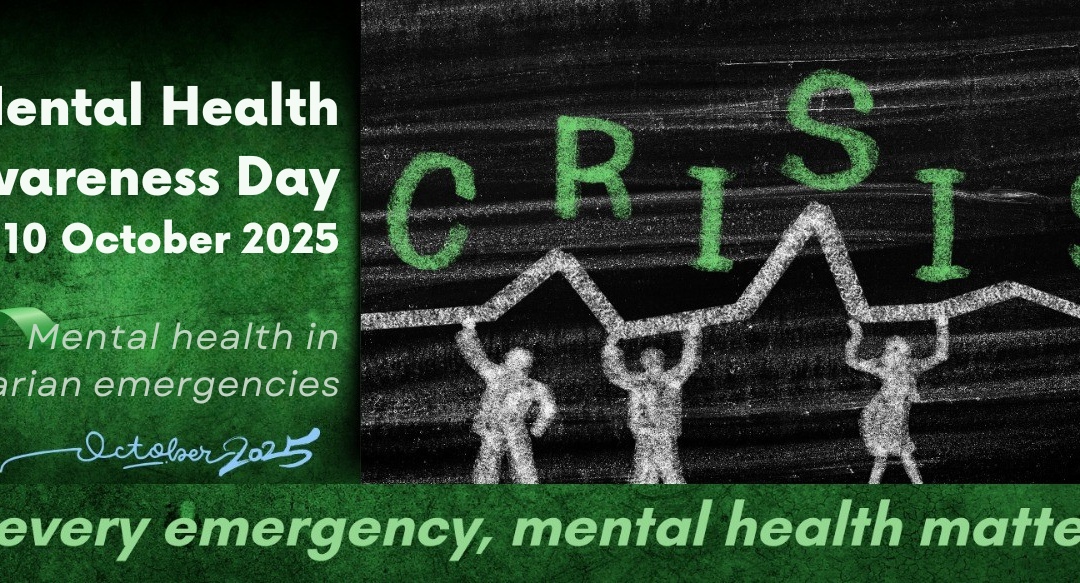
As we mark Mental Health Awareness Month and World Mental Health Day (10 October), we are reminded that mental health is not a privilege — it’s a right. This year’s theme, “Access to Services – Mental Health in Catastrophes and Emergencies,” highlights the urgent need for inclusive, accessible care, even in times of crisis.

In her article, Ntombikanina Mboniswa explores how crises — from floods and pandemics to conflict and displacement — magnify mental health challenges, and why building resilient systems that prioritise psychological support is essential.

Read the article below:

“Shaping a Healthier Future Through Mental Health Awareness”

Division of Registered Counsellors & Psychometrists (Written by: Ntombikanina Mboniswa)

Every year, World Mental Health Day (10 October) and Mental Health Awareness Month serve as vital reminders that mental health is as essential as physical health. These observances raise public awareness, fight stigma, promote early intervention, and  mobilise collective action.

Significance & Why It Matters:
Mental health conditions affect people across all ages, backgrounds, and walks of life. Without awareness, many suffer in silence. Observance days and months help bring conversations into the open, highlight structural gaps, and push for policy change and
resource allocation.

This Year’s Theme: Access to Services in Crises
For 2025, the World Federation for Mental Health has selected the theme “Access to services – mental health in catastrophes and emergencies.” This theme underscores that in moments of crisis — whether natural disasters, pandemics, conflict, displacement, or economic collapse — mental health often suffers dramatically, yet access to care is often cut or neglected. The message is that mental health support must be resilient and included in emergency response planning. In many communities, emergencies compound risk factors like trauma, loss, displacement, and isolation. Highlighting access means advocating for robust systems that remain functional when they’re needed most.

How the Public Can Engage:
Here are practical ways people can get involved:

  • Share awareness materials: Use toolkits, posters, social media graphics, and hashtags (e.g. from World Mental Health Day) to spark conversation.
  • Host or attend events: “Talk cafés,” listening circles, webinars, and panel discussions on mental health in emergency settings can create meaningful community engagement.
  • Get trained: Enrol in Mental Health First Aid or similar training so you can support someone in distress.
  • Advocacy: Engage with local or national government to push for policies that embed mental health into disaster-response frameworks.
  • Support organisations: Volunteer or donate to mental health NGOs, especially those active in crisis zones or frontline settings.

Useful Resources & Practical Tools:

  • The World Mental Health Day campaign toolkit (posters, messaging guides) is made publicly available.
  • SADAG’s Mental Health Awareness Month toolkit provides social media content and engagement ideas.
  • Many mental health organisations also host online screening tools, helplines, and peer support networks.

Division-Specific Insights / Contributions:

If you represent a department, branch, or division (e.g. a school, company, public health unit, NGO), consider these tailored ideas:

  • Internal awareness campaign: Use newsletters, posters and internal webinars to promote mental wellbeing and destigmatize seeking help.
  • Emergency planning: Ensure your division’s disaster response protocols include mental health support (e.g. crisis counselling, referral pathways).
  • Partnerships: Collaborate with local mental health services, Registered Counsellors, or NGOs to provide workshops or outreach services.
  • Monitoring & feedback: Use surveys or suggestion boxes to gauge mental health needs in your constituency or staff, to drive responsive programming.

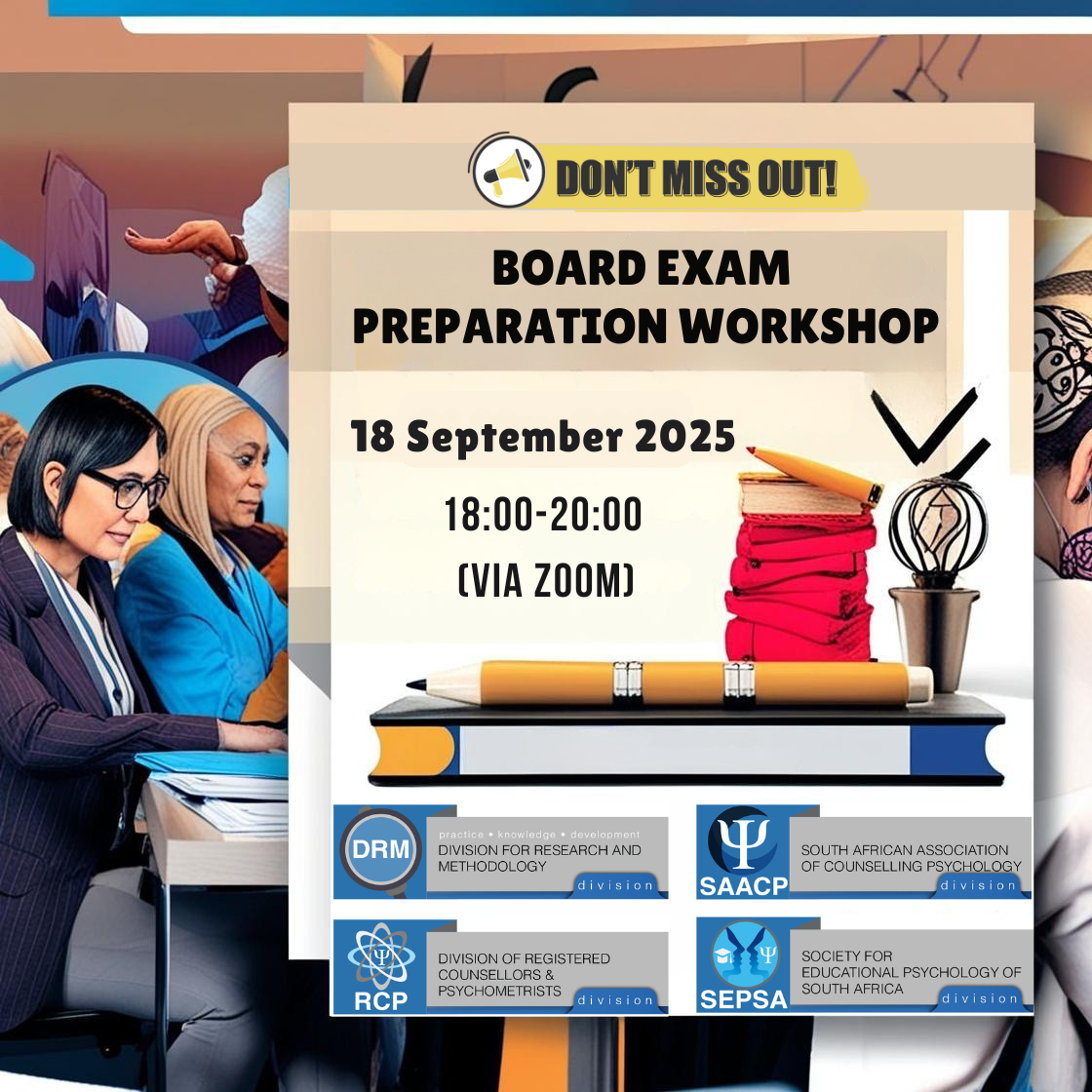
Board Exam Preparation Workshop – 18 September 2025

Board Exam Preparation Workshop – 18 September 2025

Board Exam Preparation Workshop – 18 September 2025

About this workshop

Join us on Zoom as we unpack the Board Exam!

The journey to becoming an HPCSA-registered psychologist entails navigating through rigorous academic training and practical experiences. However, one pivotal milestone stands between aspiring professionals and their goals: the HPCSA board exam. This exam serves as a comprehensive evaluation of theoretical knowledge, clinical skills, and ethical understanding essential for competent practice in the field. For those on the brink of undertaking this examination, the stakes are high, and the need for thorough preparation is paramount.

This underscores the necessity of a specialized board exam workshop tailored to the unique needs of prospective exam takers. Recognizing the complexities and challenges inherent in preparing for such a pivotal assessment, this workshop aims to provide invaluable clarity and guidance to participants.

The workshop will encompass multifaceted approaches to bolstering exam readiness for students in psychometry, counselling, research, educational and clinical psychology. Through interactive sessions, participants will delve into the intricacies of the exam format, content domains, and requisite competencies.

In essence, this workshop serves as a pivotal resource in equipping student and exam candidates with the tools, knowledge, and support necessary to navigate the challenges of the board exam successfully. By fostering clarity, confidence, and competence, the workshop endeavours to empower individuals to embark on their professional journeys with assurance and readiness to make meaningful contributions to the field of psychology.

Join the workshop at no cost!

Meet The Facilitators
Dr Pakeezah Rajab

Dr Pakeezah Rajab

Presenter

Bio

Dr Pakeezah Rajab is the Senior Researcher at JVR Psychometrics and a PsySSA 2024-25 Additional Executive Member. Her PhD topic was “Non-intellectual factors that influence mathematics performance in South Africa.” She has experience applying psychometric results to a variety of contexts, including schools, private practice, higher education, and corporate environments. Pakeezah has worked on numerous projects that developed, validated and/or standardised assessments for use by the South African population – including aptitude, personality, values, career guidance and emotional intelligence. Her research interests include cognitive functioning, student performance and assessment development.

Ms Genevieve Burrow

Ms Genevieve Burrow

Presenter

Bio

Genevieve Burrow is a registered counsellor and chairperson of the PsySSA Division of Registered Counsellors and Psychometrists. Genevieve is the manager of The Youth Hub, based at Groote Schuur Hospital Adolescent Centre of Excellence, where she counsels, and manages students and the counselling centre. She has hosted several board exam workshops previously, and enjoys working with students to enlighten them about the upcoming HPCSA board exam. Genevieve Burrow is committed to driving excellence and innovation in the practice of counselling, and promoting the visibility and importance of this field. Genevieve is passionate about youth upliftment and collaborates with a medically-informed multidisciplinary team to provide comprehensive and holistic care to adolescents facing diverse challenges in under-provided areas.

Dr Kemoneilwe Momi Metsing

Dr Kemoneilwe Momi Metsing

Presenter

Bio

Dr. Kemoneilwe Momi Metsing is a registered Educational Psychologist with a PhD in Psychology. She is a Senior Lecturer in the Department of Psychology of Education at the University of South Africa (UNISA) and Chairperson of the Society for Educational Psychology of South Africa (SEPSA). Dr. Metsing has a private practice and consults for government and private companies on relational and organizational transformation. She is an expert witness and member of the South African Medico-Legal Association (SAMLA). Dr. Metsing has held various leadership positions, including Chief Education Specialist in the Department of Education and board member of the South African Professional Society on the Abuse of Children (SAPSAC). She is an External examiner and clinical supervisor for MEd Educational Psychology at UJ. She serves on the Executive Committee of Decolonising Psychology at the Psychological Society of South Africa (PsySSA) and is a Critical Reader for UNISA’s Department of Adult Community and Continuing Education. With expertise in developing community-based programs, Dr. Metsing has successfully brought together individuals and organizations to address social issues, fostering partnerships and sustainable solutions. She is committed to inspiring and educating the next generation of leaders and change-makers, and her appointment at UNISA marks an exciting new chapter in her journey.

Dr Matome Jack Mashiapata

Dr Matome Jack Mashiapata

Presenter

Bio

Dr Mashiapata is a registered Educational Psychologist with the Health Professions Council of SA with over three decades of experience as a lecturer college for teacher training, high school teacher, a school psychologist in the department of basic education, manager of services for students with disabilities as well as student counselling. Currently working as the Director for Counselling and Career Development at UNISA, he has presented papers and workshops locally and internationally in the areas of career counselling, pastoral counselling, mentorship, career development, ethics, students with disabilities, etc. He holds active membership and leadership roles the Psychological Society of SA (PSYSSA), Society for Education Psychology of SA (SEPSA), South African Federation of Student Affairs (SAFSAS), International Association of Student Affairs and Services (IASAS) serving as the Africa regional director, deputy chairperson of Council for Pastoral and Spiritual Counsellors (CPSC), and Higher and Further Education Disability Services Association (HEDSA). He is the past president of the Southern African Association of Counselling and Development in Higher Education (SAACDHE). Dr Mashiapata has authored a chapter on Trauma Debriefing in a book titled “Life skills – my journey, my destiny”. He presents accredited CPD workshops on ethics in counselling services.


Deneo Sekese

Deneo Sekese

Presenter

Bio

Deneo Sekese started her career in Human Resources specifically training and development and organisational development. Her passion for people and therapy led to a midlife career change into psychology. Deneo completed her masters in Counselling Psychology at Rhodes University and internship at the student counselling centre at the Durban University of Technology. She has had the privilege of presenting her masters research at the 27th Annual South African Psychology Congress. Deneo’s areas of interest are African Psychology, Wellbeing and Salutogenesis and Community psychology. She recently registered with the Board of Psychology HPCSA and is in the process of setting up a private practice.

Arianna Fadda

Arianna Fadda

Presenter

Bio

My name is Arianna Fadda. I hold a Bachelor of Arts and a Bachelor of Social Science Honours in Psychology both from the University of Pretoria as well as a professional master’s degree (by coursework and research report) in Social and Psychological Research from the University of the Witwatersrand. My research report focused on the perceptions of health professionals regarding an online depression screening tool adapted for South Africans. Following my master’s, I completed a year-long Research Psychology internship at the Africa Unit for Transdisciplinary Health Research (AUTHeR) at the North-West University, during which I worked on various qualitative and quantitative research projects. I subsequently wrote and passed the Research Psychology Board Examination with the Health Professions Council of South Africa earlier this year and I am now a registered Research Psychologist. I am currently working as a research assistant for AUTHeR and planning further studies towards a PhD.


Rekha Kangokar

Rekha Kangokar

Presenter

Bio

Mrs Rekha Kangokar Rama Rao is a Registered Counsellor and has completed Masters in Community-Based Counselling Psychology. Working with a person centered approach she is passionate about fostering mental well-being. She integrates evidence-based practices with a holistic approach to nurture growth and healing within both individuals and communities. She has been associated with various NGOs and has supported them closely, Rekha has served a Secretary and Treasurer before and currently serves as an additional member in the RCP division.

Zakiyah Hoosen

Zakiyah Hoosen

Presenter

Bio

Zakiyah Hoosen is a dynamic individual with a deep love for Psychology. She completed her undergraduate degree at the University of Pretoria majoring in Psychology and Languages; later obtaining her Honor’s degree from SACAP and went on to become a qualified registered counsellor. She is active in the field and works across multiple organizations, working within a trauma-informed focus to facilitate counselling and psychoeducation to children, adolescents, and adults. Zakiyah is currently advancing her knowledge and training on her journey of master’s in Clinical Psychology, and she aspires to foster psychosocial wellbeing across all spheres of life through meaningful and efficient psychological services for all.

RCP Webinar: What Makes A Good Assessment – Recording Out Now!

RCP Webinar: What Makes A Good Assessment – Recording Out Now!

Did you miss the RCP Webinar: “What Makes a Good Assessment?”

Catch up on this insightful, ethics-focused session designed for psychology and HR professionals.

Guest Speaker: Dr Pakeezah Rajab

Gain practical insights into what defines a high-quality assessment in professional practice.

Abstract

Not all assessments are created equal — and as registered HPCSA professionals, it’s our responsibility to know the difference. Join us for a practical webinar exploring what makes an assessment scientifically sound and ethically usable. We’ll cover key criteria like theoretical grounding, reliability, validity, and fairness — plus discuss the role of independent review models like those from ASSA and EFPA. Perfect for psychology and HR professionals who want to make informed, responsible choices in test use.

About the Presenter
Dr Pakeezah Rajab

Dr Pakeezah Rajab

PsySSA & RCP Executive Member

Pakeezah Rajab is a HPCSA-registered Research Psychologist and Psychometrist, employed as the Senior Researcher at JVR Psychometrics. Her PhD topic (University of Pretoria) was non-intellectual factors that influence mathematics performance in South Africa. She has experience applying psychometric results to a variety of contexts, including schools, private practice, higher education, and corporate environments. Pakeezah has worked on numerous projects that developed, validated and/or standardised assessments for use by the South African population – including aptitude, personality, values, career guidance and emotional intelligence. Her research interests include cognitive functioning, student performance and assessment development.

RCP Webinar: What Makes A Good Assessment

RCP Webinar: What Makes A Good Assessment

RCP Webinar: What makes a good assessment

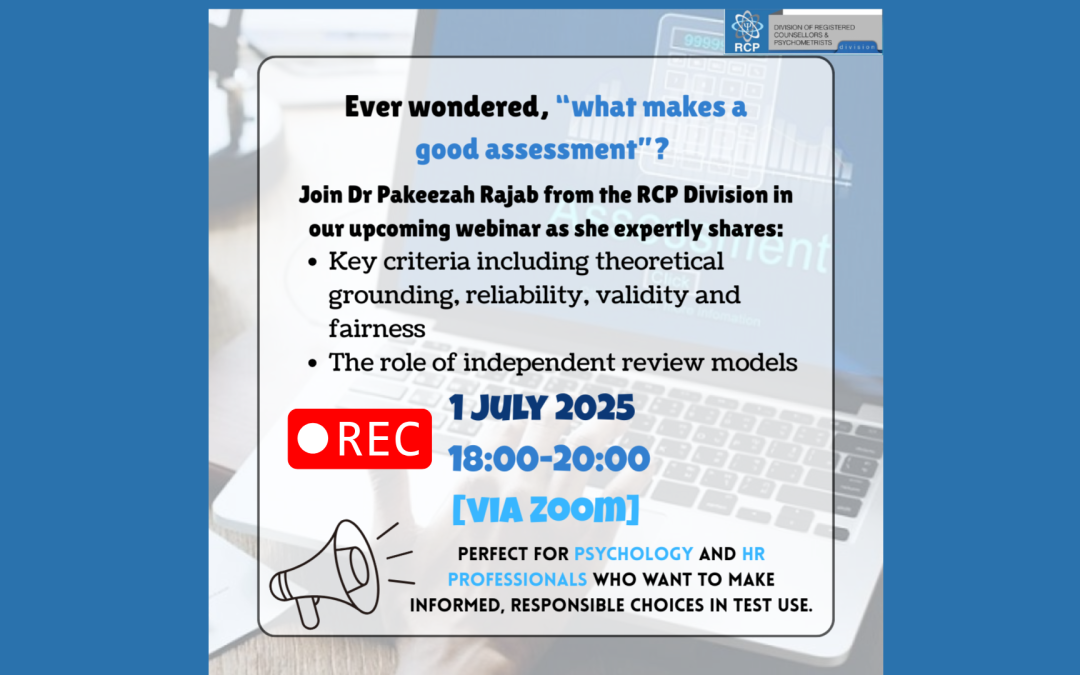
You’re invited! Join us on 1 July 2025 for a free RCP Webinar: “What Makes a Good Assessment?” — a practical, ethics-focused session for psychology and HR professionals.

  • 01 July 2025
  • 18:00 – 20:00
  • Venue: Zoom
  • Guest Speaker: Dr Pakeezah Rajab
Abstract

Not all assessments are created equal — and as registered HPCSA professionals, it’s our responsibility to know the difference. Join us for a practical webinar exploring what makes an assessment scientifically sound and ethically usable. We’ll cover key criteria like theoretical grounding, reliability, validity, and fairness — plus discuss the role of independent review models like those from ASSA and EFPA. Perfect for psychology and HR professionals who want to make informed, responsible choices in test use.

About the Presenter
Dr Pakeezah Rajab

Dr Pakeezah Rajab

PsySSA & RCP Executive Member

Pakeezah Rajab is a HPCSA-registered Research Psychologist and Psychometrist, employed as the Senior Researcher at JVR Psychometrics. Her PhD topic (University of Pretoria) was non-intellectual factors that influence mathematics performance in South Africa. She has experience applying psychometric results to a variety of contexts, including schools, private practice, higher education, and corporate environments. Pakeezah has worked on numerous projects that developed, validated and/or standardised assessments for use by the South African population – including aptitude, personality, values, career guidance and emotional intelligence. Her research interests include cognitive functioning, student performance and assessment development.

The Importance of Peer Support Amongst Psychology Professionals

The Importance of Peer Support Amongst Psychology Professionals

The Importance of Peer Support Amongst Psychology Professionals

Authors: Shaazia Patel (Additional member; The Division of Registered Counsellors and Psychometrists)
Editor: Zakiyah Hoosen (Vice chairperson; The Division of Registered Counsellors and Psychometrists)

Peer support has become an essential component in health and social care, particularly within the mental health sector (Kalina Mikolajczak-Degrauwe et al., 2023). It serves as a non-hierarchal support system in which individuals with similar experiences provide informative, empathetic, emotional and evaluative support to other professionals facing similar challenges (Kalina Mikolajczak-Degrauwe et al., 2023). This provides a space to construct a community based on the connections shared between mental health professionals navigating similar circumstances (Joo et al., 2022). In this article, we will explore the significance of peer support programmes for psychological professionals, their role in addressing mental health challenges in various contexts, and the implications for mental health care globally.

The Role of Peer Support programmes for Mental Health Professionals

As mental health professionals, establishing a sense of connection and comfort in challenging times can be difficult, particularly when managing intense emotions and life-changing circumstances (Distress Centre, 2024). Joining a peer support group can be valuable as it offers a safe environment to explore your thoughts and feelings openly without judgment (Distress Centre, 2024). Therefore, these peer support programmes tailored for psychological professionals can serve as invaluable contributors to the mental health field (Joo et al., 2022). These initiatives create a supportive network where mental health workers can share their experiences, challenges, and coping strategies associated with their roles (Joo et al., 2022). By connecting with peers who understand the unique pressures of the same profession, these programmes can alleviate feelings of isolation and stress that often accompany mental health work (Joo et al., 2022; Grouport, 2025). Moreover, this can promote a sense of belonging among professionals, by enhancing job satisfaction and resilience (Joo et al., 2022). However, these programmes are not without their challenges (Kalina Mikolajczak-Degrauwe et al., 2023). The success of peer support initiatives largely depends on ensuring a good fit between peers, as well as maintaining appropriate boundaries to safeguard the profession to which practitioners belong (Joo et al., 2022). However, there are several peer support programmes which have implemented strategies to navigate and address these hurdles, ultimately improving the quality of support provided within these spaces (Kalina Mikolajczak-Degrauwe et al., 2023).

Peer Support in Community Mental Health Services

Peer support plays an important role in low to middle-income countries’ (LMICs) mental health services, such as South Africa, where there is a significant treatment gap in the mental health sector (Sorsdahl et al., 2023). Peer support can create an understanding and empower those in need, enhancing the overall effectiveness of community-based mental health initiatives (Joo et al., 2022). Reflecting on one’s experiences to improve support strategies has emerged as a key facilitator in managing life stressors within peer support frameworks (Poremski et al., 2022). To further enhance these programmes, a support group entitled #SpacesforListening is put forth as a peer-support network for mental health professionals. The #SpacesforListening initiative was developed in 2020 by two psychologists based in the United Kingdom, Brigid Russell and Charlie Jones (Russell, 2024). The initiative offers a confidential structured process where mental health professionals are equally encouraged to share thoughts and feelings, and “to experience an equality of listening” (Russell & Jones, 2022). This approach could further enrich the peer support landscape within the South African context (Poremski et al., 2022). Peer support represents an effective form of assistance in the mental health sector, addressing both the emotional needs of individuals and the professional challenges faced by mental health professionals (Post Eye, 2024). The executive members of PsySSA’s Division for  Registered Counsellors and Psychometrists will be participating in a #SpacesforListening and aim to implement this initiative for RCP members in the second half of 2025. As we continue to strengthen peer support frameworks, it is essential to navigate the associated challenges to enhance their effectiveness and impact on mental health care systems in the South African context.

References

Embracing Uncertainty with DBT Skills: A Guide to Navigating Life’s Challenges | Grouport Journal. (2025). Grouporttherapy.com. https://www.grouporttherapy.com/blog/dialectical-behavior-therapy-uncertainty

Joo, Y., Kwon, J., & Lee, H. (2022). The effectiveness of peer support programs for mental health professionals: A review. Journal of Clinical Psychology, 78(2), 234-247.

Kalina Mikolajczak-Degrauwe, A., Goffin, K., & Martin, A. (2023). Support through peer engagement: A comprehensive overview of peer support in health and social care. Health Engagement Review, 15(1), 45-62.

Poremski, D., O’Neil, M., & D’Arcy, C. (2022). Reflexivity as a facilitator in peer support programs: Enhancing the effectiveness of mental health support. International Journal of Mental Health Systems, 16(1), 12-25.

Sorsdahl, K., Lund, C., & Stein, D. J. (2023). Bridging the treatment gap: The role of peer support in mental health services in South Africa. African Journal of Psychiatry, 26(1), 54-66.

Russell, B. (2024, November). Spaces for listening. Resurgence.org. https://www.resurgence.org/magazine/article6397-spaces-for-listening.html

Tips for Handling Stress and Mental Health in Today’s Busy World (2024). Post Eye. https://posteyes.com/tips-for-handling-stress-and-mental-health-in-todays-busy-world-2024/


PsySSA Commemorates Hospice Week 2025

PsySSA Commemorates Hospice Week 2025

PsySSA Commemorates Hospice Week 2025

4 – 10 May 2025

Passion for Compassion: Psychological Insights into Palliative Care in South Africa

By: PsySSA’s Division of Registered Counsellors and Psychometrists.

Hospice Week 2025, observed from May 5–11, underscores the vital role of compassionate care in palliative services. In South Africa, where palliative care is predominantly provided by non-governmental organizations, understanding the psychological dimensions of caregiving is essential. This article explores evidence-based psychological research to illuminate palliative care professionals’ challenges and coping mechanisms, aligning with this year’s theme, “Passion for Compassion”, a call to recognize the deep emotional investment and resilience required to care for the terminally ill.

Psychological Challenges in Palliative Care

Palliative care professionals in South Africa face multifaceted stressors that impact their psychological well-being. A qualitative study by Smith et al. (2020) identified key stress domains: Professionals may experience compassion fatigue, vicarious trauma, or burnout due to ongoing emotional demands.

  • Nature of Work: Regular exposure to death and dying can lead to emotional exhaustion and existential distress (Smith et al. 2020). Caregivers operating in under-resourced townships often confront high rates of HIV/AIDS, tuberculosis, and cancer, increasing both caseloads and emotional burden.
  • Community Engagement: Working in diverse communities presents challenges, including safety concerns and resource limitations.
  • Patient and Family Interactions: Managing complex family dynamics and patient expectations requires emotional resilience. The cultural diversity of South Africa also necessitates sensitivity to varied beliefs around death, dying, and caregiving.
  • Organisational Factors: Limited resources, staff shortages, and administrative burdens contribute to work-related stress (Smith et al. 2020). Public-sector underfunding and dependency on donor funding often lead to job insecurity and limited professional development. The psychological impact is compounded in rural areas, where access to mental health support is particularly scarce (Skeen et al., 2019).

These stressors are exacerbated by broader socio-economic factors, such as poverty and healthcare disparities, intensifying the emotional labour required in palliative care settings.

Coping Mechanisms and Resilience

Despite these challenges, palliative care professionals employ various coping strategies to maintain their psychological health (Smith et al., 2020):

  • Social Support: Engaging with colleagues, friends, and family provides emotional sustenance. Peer debriefing and team cohesion have been shown to buffer against burnout.
  • Self-Care Practices: Activities like exercise, meditation, and hobbies help reduce stress. Mindfulness-based interventions have effectively reduced emotional fatigue among healthcare workers (Irving et al., 2009).
  • Professional Boundaries: Setting clear work-life boundaries prevents burnout and promotes well-being. Encouraging work-life balance is particularly crucial in hospices where 24-hour on-call duties are common.
  • Positive Reframing: Focusing on the meaningful aspects of caregiving enhances job satisfaction. Many staff report a sense of purpose and spiritual fulfilment through their work, which helps counterbalance the emotional demands (Meier et al., 2016).

These strategies underscore the importance of organizational support systems that foster a culture of compassion and resilience among healthcare workers.

Integrating Spiritual Care

Spiritual care is a critical component of holistic palliative services. A study conducted in Soweto found that patients receiving spiritual support experienced less pain and were more likely to die in their preferred setting, often at home (Ratshikana-Moloko et al., 2020). However, a national survey revealed significant gaps in spiritual care training among hospice staff, highlighting the need for standardised curricula and resources (Mahilall & Swartz, 2021). This is particularly relevant in a culturally diverse nation like South Africa, where spiritual beliefs significantly shape end-of-life decisions.

Integrating spiritual care into routine practice requires collaboration with chaplains, traditional healers, and community leaders. Formal guidelines by the Hospice Palliative Care Association of South Africa (HPCA) recommend such inclusive approaches, yet implementation remains inconsistent.

Educational Imperatives

Education and training are pivotal in equipping healthcare professionals with the skills necessary for effective palliative care. Despite including palliative care in undergraduate programs across South African universities, the depth and consistency of training vary. Only one university met the recommended 40-hour training benchmark set by the European Association of Palliative Care (McMillan et al., 2024). Enhancing educational frameworks is essential to prepare practitioners for the complexities of palliative care delivery.

The theme “Passion for Compassion” encapsulates the dedication of palliative care professionals who navigate psychological challenges with resilience and empathy. Addressing systemic issues, enhancing training, and fostering supportive work environments are crucial to sustaining compassionate care in South Africa’s palliative services. By investing in caregivers’ psychological well-being, we uphold the dignity of those they serve.

Authors: Ms Genevieve Burrow and Ms Rekha Rao Kangokar

Beyond the Textbook: Empathy, Palliative Care, and Digital Support

By: PsySSA’s Student Division

Palliative care is often treated as a niche topic in psychology — something reserved for specialists, quietly acknowledged but rarely explored. It’s not often considered by students,
perhaps because it isn’t a core focus in most training programmes, or because it seems distant from the kinds of roles we imagine ourselves stepping into. But by not engaging with it, we risk narrowing our understanding of what psychological support can involve — particularly in contexts where the focus shifts from treatment to comfort, and from fixing to accompanying.

This is part of what makes the work of Azizoddin and Thomas (2022) so compelling. In their article “Game Changer: Is Palliative Care Ready for Games?”, they explore how palliative
support can be reimagined through digital tools — specifically “serious games” designed with clinical intent. These games are not created for entertainment, but rather as structured interventions that help patients with advanced illness manage pain, navigate emotional challenges, and feel a greater sense of agency in their experience.

What makes this especially relevant for students is that it challenges how we tend to think about psychological practice. Serious games in palliative care show that support doesn’t have to follow the traditional model of therapy. Instead, care can be reframed as something flexible, creative, and responsive to the needs of people in profoundly vulnerable situations. Engaging with these kinds of tools invites us to reflect not only on what we do as psychologists, but on how we relate to people who are facing uncertainty, loss, and transition — even if we never work directly in that space.

As students, we might never specialise in palliative care. But that doesn’t mean we should disengage. Reflecting on interventions like these pushes us to question the assumptions we
carry about psychological support:

● Must care be face-to-face to be meaningful?
● Can technology offer more than convenience — perhaps even comfort?
● What other areas of psychology have we overlooked because they feel too far removed?

This Hospice Week, we encourage students not just to learn about palliative care, but to engage with what it represents. Even if this isn’t your field, it’s still part of the broader landscape of human experience we all study. And in exploring unconventional tools like serious games, we might find unexpected ways to grow our empathy, our understanding, and our sense of what it means to care.