8th Southern African Students’ Psychology Conference – PSYCH-LINK: Meet & Greet with the PsySSA Student Division

8th Southern African Students’ Psychology Conference – PSYCH-LINK: Meet & Greet with the PsySSA Student Division

8TH SOUTHERN AFRICAN STUDENTS’ PSYCHOLOGY CONFERENCE 

PSYCH-LINK: Meet & Greet with the PsySSA Student Division


Join us on 9 July 2025 at UNISA’s Muckleneuk Campus for an inspiring afternoon of networking, learning, and connection!

Meet fellow psychology students, engage with academics, and stand a chance to win an exciting prize — just for RSVPing and attending.

Light refreshments will be provided.

Let’s build our network, share our journeys, and grow together.

Scan the QR code to RSVP, or click the link below!

We can’t wait to see you there!

8th Southern African Students’ Psychology Conference – PSYCH-LINK: Meet & Greet with the PsySSA Student Division

Call for Volunteers – 8th Southern African Students’ Psychology Conference

CALL FOR VOLUNTEERS

8TH SOUTHERN AFRICAN STUDENTS’ PSYCHOLOGY CONFERENCE 

Be part of something impactful — the 8th Southern African Students’ Psychology Conference is looking for volunteers! This is your chance to:

• Gain hands-on experience
• Build meaningful connections
• Contribute to the psychology community across Southern Africa

Volunteer Requirements:

  • You need to be a registered member of the PsySSA Student Division.
  • Not a member yet? You can still sign up — join our growing network of psychology students across the region! Click here to become a member now!

Application Deadline: 15 May 2025

To volunteer, email your expression of interest to: psyssastudentsecretary@gmail.com

Let’s come together to make this conference a success!

#psyssastudentdivision #unisa #psyssa #volunteeropportunities #saspc2025 #studentpsychology #southafricanpsychology

PsySSA Commemorates Hospice Week 2025

PsySSA Commemorates Hospice Week 2025

PsySSA Commemorates Hospice Week 2025

4 – 10 May 2025

Passion for Compassion: Psychological Insights into Palliative Care in South Africa

By: PsySSA’s Division of Registered Counsellors and Psychometrists.

Hospice Week 2025, observed from May 5–11, underscores the vital role of compassionate care in palliative services. In South Africa, where palliative care is predominantly provided by non-governmental organizations, understanding the psychological dimensions of caregiving is essential. This article explores evidence-based psychological research to illuminate palliative care professionals’ challenges and coping mechanisms, aligning with this year’s theme, “Passion for Compassion”, a call to recognize the deep emotional investment and resilience required to care for the terminally ill.

Psychological Challenges in Palliative Care

Palliative care professionals in South Africa face multifaceted stressors that impact their psychological well-being. A qualitative study by Smith et al. (2020) identified key stress domains: Professionals may experience compassion fatigue, vicarious trauma, or burnout due to ongoing emotional demands.

  • Nature of Work: Regular exposure to death and dying can lead to emotional exhaustion and existential distress (Smith et al. 2020). Caregivers operating in under-resourced townships often confront high rates of HIV/AIDS, tuberculosis, and cancer, increasing both caseloads and emotional burden.
  • Community Engagement: Working in diverse communities presents challenges, including safety concerns and resource limitations.
  • Patient and Family Interactions: Managing complex family dynamics and patient expectations requires emotional resilience. The cultural diversity of South Africa also necessitates sensitivity to varied beliefs around death, dying, and caregiving.
  • Organisational Factors: Limited resources, staff shortages, and administrative burdens contribute to work-related stress (Smith et al. 2020). Public-sector underfunding and dependency on donor funding often lead to job insecurity and limited professional development. The psychological impact is compounded in rural areas, where access to mental health support is particularly scarce (Skeen et al., 2019).

These stressors are exacerbated by broader socio-economic factors, such as poverty and healthcare disparities, intensifying the emotional labour required in palliative care settings.

Coping Mechanisms and Resilience

Despite these challenges, palliative care professionals employ various coping strategies to maintain their psychological health (Smith et al., 2020):

  • Social Support: Engaging with colleagues, friends, and family provides emotional sustenance. Peer debriefing and team cohesion have been shown to buffer against burnout.
  • Self-Care Practices: Activities like exercise, meditation, and hobbies help reduce stress. Mindfulness-based interventions have effectively reduced emotional fatigue among healthcare workers (Irving et al., 2009).
  • Professional Boundaries: Setting clear work-life boundaries prevents burnout and promotes well-being. Encouraging work-life balance is particularly crucial in hospices where 24-hour on-call duties are common.
  • Positive Reframing: Focusing on the meaningful aspects of caregiving enhances job satisfaction. Many staff report a sense of purpose and spiritual fulfilment through their work, which helps counterbalance the emotional demands (Meier et al., 2016).

These strategies underscore the importance of organizational support systems that foster a culture of compassion and resilience among healthcare workers.

Integrating Spiritual Care

Spiritual care is a critical component of holistic palliative services. A study conducted in Soweto found that patients receiving spiritual support experienced less pain and were more likely to die in their preferred setting, often at home (Ratshikana-Moloko et al., 2020). However, a national survey revealed significant gaps in spiritual care training among hospice staff, highlighting the need for standardised curricula and resources (Mahilall & Swartz, 2021). This is particularly relevant in a culturally diverse nation like South Africa, where spiritual beliefs significantly shape end-of-life decisions.

Integrating spiritual care into routine practice requires collaboration with chaplains, traditional healers, and community leaders. Formal guidelines by the Hospice Palliative Care Association of South Africa (HPCA) recommend such inclusive approaches, yet implementation remains inconsistent.

Educational Imperatives

Education and training are pivotal in equipping healthcare professionals with the skills necessary for effective palliative care. Despite including palliative care in undergraduate programs across South African universities, the depth and consistency of training vary. Only one university met the recommended 40-hour training benchmark set by the European Association of Palliative Care (McMillan et al., 2024). Enhancing educational frameworks is essential to prepare practitioners for the complexities of palliative care delivery.

The theme “Passion for Compassion” encapsulates the dedication of palliative care professionals who navigate psychological challenges with resilience and empathy. Addressing systemic issues, enhancing training, and fostering supportive work environments are crucial to sustaining compassionate care in South Africa’s palliative services. By investing in caregivers’ psychological well-being, we uphold the dignity of those they serve.

Authors: Ms Genevieve Burrow and Ms Rekha Rao Kangokar

Beyond the Textbook: Empathy, Palliative Care, and Digital Support

By: PsySSA’s Student Division

Palliative care is often treated as a niche topic in psychology — something reserved for specialists, quietly acknowledged but rarely explored. It’s not often considered by students,
perhaps because it isn’t a core focus in most training programmes, or because it seems distant from the kinds of roles we imagine ourselves stepping into. But by not engaging with it, we risk narrowing our understanding of what psychological support can involve — particularly in contexts where the focus shifts from treatment to comfort, and from fixing to accompanying.

This is part of what makes the work of Azizoddin and Thomas (2022) so compelling. In their article “Game Changer: Is Palliative Care Ready for Games?”, they explore how palliative
support can be reimagined through digital tools — specifically “serious games” designed with clinical intent. These games are not created for entertainment, but rather as structured interventions that help patients with advanced illness manage pain, navigate emotional challenges, and feel a greater sense of agency in their experience.

What makes this especially relevant for students is that it challenges how we tend to think about psychological practice. Serious games in palliative care show that support doesn’t have to follow the traditional model of therapy. Instead, care can be reframed as something flexible, creative, and responsive to the needs of people in profoundly vulnerable situations. Engaging with these kinds of tools invites us to reflect not only on what we do as psychologists, but on how we relate to people who are facing uncertainty, loss, and transition — even if we never work directly in that space.

As students, we might never specialise in palliative care. But that doesn’t mean we should disengage. Reflecting on interventions like these pushes us to question the assumptions we
carry about psychological support:

● Must care be face-to-face to be meaningful?
● Can technology offer more than convenience — perhaps even comfort?
● What other areas of psychology have we overlooked because they feel too far removed?

This Hospice Week, we encourage students not just to learn about palliative care, but to engage with what it represents. Even if this isn’t your field, it’s still part of the broader landscape of human experience we all study. And in exploring unconventional tools like serious games, we might find unexpected ways to grow our empathy, our understanding, and our sense of what it means to care.

The Psychology Career Compass Series – Part 2

The Psychology Career Compass Series – Part 2

The Psychology Career Compass Series

On the 25th of March 2025, PsySSA proudly announced the launch of the Psychology Career Compass Series—a timely initiative recognising the need for accessible, practical, and contextually relevant career guidance. This series was developed as a trusted platform to support the professional growth of psychology students and graduates across South Africa, in line with PsySSA’s commitment to transformation, empowerment, and lifelong learning.

Launched with two foundational workshops—Post-Honours/Masters Pathways and Alternative Career Paths—the series offered in-depth insights into both HPCSA-accredited registration routes and innovative, non-traditional career opportunities where psychological expertise is highly valued. The sessions featured experienced professionals and academics who shared their career trajectories, practical advice, and key considerations for those looking to take their next steps with confidence.

Part 1 of the series was successfully hosted on 3rd April 2025, drawing significant engagement and positive feedback from attendees. Did you miss part 1? Watch the recording here. 

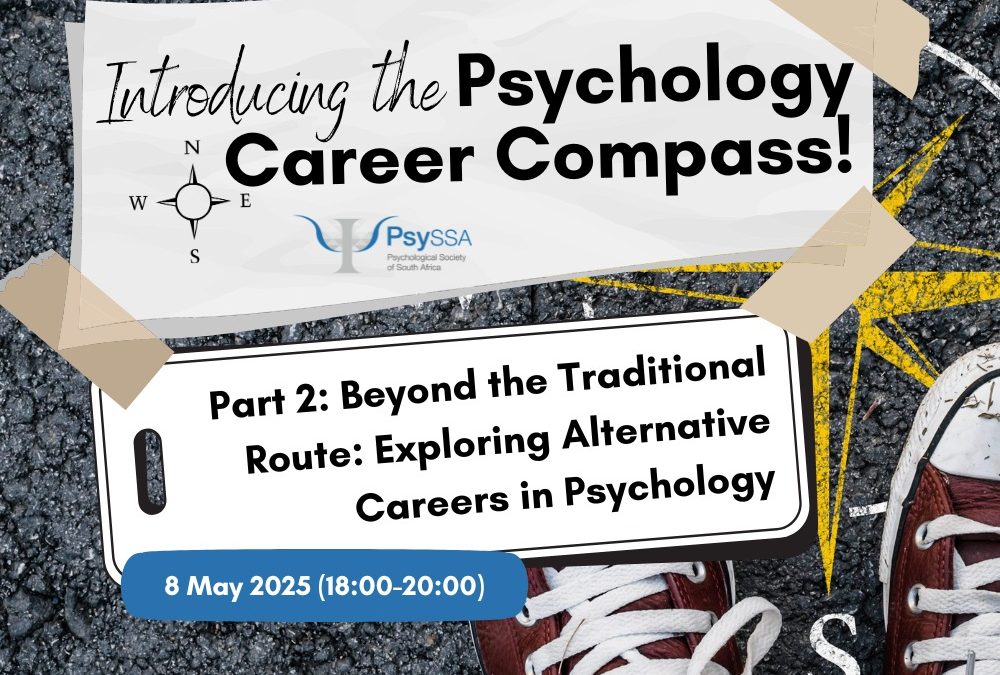
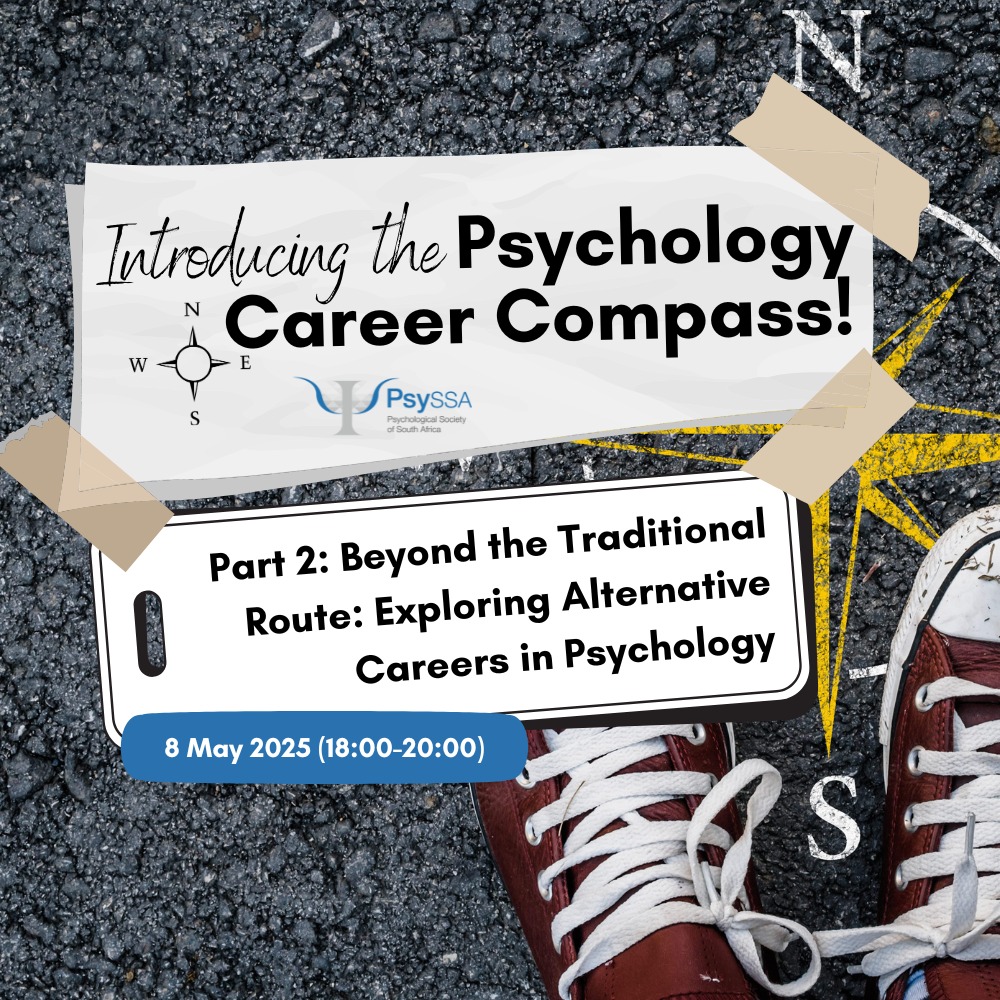
Part 2 is just 6 days away, scheduled for 8th May 2025 from 18:00 to 20:00, and promises to further enrich participants’ understanding of the evolving landscape of psychology careers.

Part 2 will highlight that not every journey in psychology follows a straight line—and for many, the path beyond Honours or unsuccessful programme placements can still lead to a fulfilling, impactful career. This upcoming workshop is designed for students and early-career graduates who are exploring how to apply their psychology skills in innovative and non-traditional contexts.

Attendees will hear from professionals who have transitioned into dynamic roles across industries such as user experience, digital marketing, behavioural science, corporate training, research, and more. Through engaging discussions, these speakers will share how their psychology background positioned them for success, what additional skills or mindset shifts were needed, and how to leverage psychological training in fields outside of clinical or registered practice.

Part 2:

Beyond the Traditional Route: Exploring Alternative Careers in Psychology (8 May 2025)

Workshop Details

  • Date: 8 May 2025
  • Time: 18:00 – 20:00
  • Cost: Free
  • Online via Zoom

Not every journey in psychology follows a straight line—and for many, the path beyond Honours or unsuccessful programme placements can still lead to a fulfilling, impactful career. This workshop is designed for students and early-career graduates who are exploring how to apply their psychology skills in innovative and non-traditional contexts.

Join professionals who have transitioned into dynamic roles across industries such as user experience, digital marketing, behavioural science, corporate training, research, and more. Through engaging discussions, they will share how their psychology background positioned them for success, what additional skills or mindset shifts were needed, and how to leverage psychological training in fields outside of clinical or registered practice.

Meet the Presenters
Prof Ronelle Carolissen

Prof Ronelle Carolissen

PsySSA President

Leonie Vorster

Leonie Vorster

Chairperson: Division for Research and Methodology (DRM)

Dr Sharon Truter

Dr Sharon Truter

Neuropsychologist and Counselling Psychologist

Dr Momi Metsing

Dr Momi Metsing

PsySSA: Executive Member; Chairperson: Society for Educational Psychology of South Africa (SEPSA)

Kgomotso Sekhute

Kgomotso Sekhute

Vice-chairperson: The South African Society for Clinical Psychology (SASCP)

Barry Viljoen

Barry Viljoen

Vice-Chairperson: Psychology in Public Service (PiPS)

Dr Ewald Crause

Dr Ewald Crause

Interim Chairperson: Artificial Intelligence Division (AID)

Fatima Peters

Fatima Peters

Divisional Additional Executive Member: Climate and Environment Psychology (CEPD) & Division for Research and Methodology (DRM)

Anne Kramers-Olen

Anne Kramers-Olen

Secretary & Treasurer: Psychology in Public Service (PiPS)

Lynne Richards

Lynne Richards

Chairperson: Trauma & Violence Division

8th Southern African Students’ Psychology Conference – PSYCH-LINK: Meet & Greet with the PsySSA Student Division

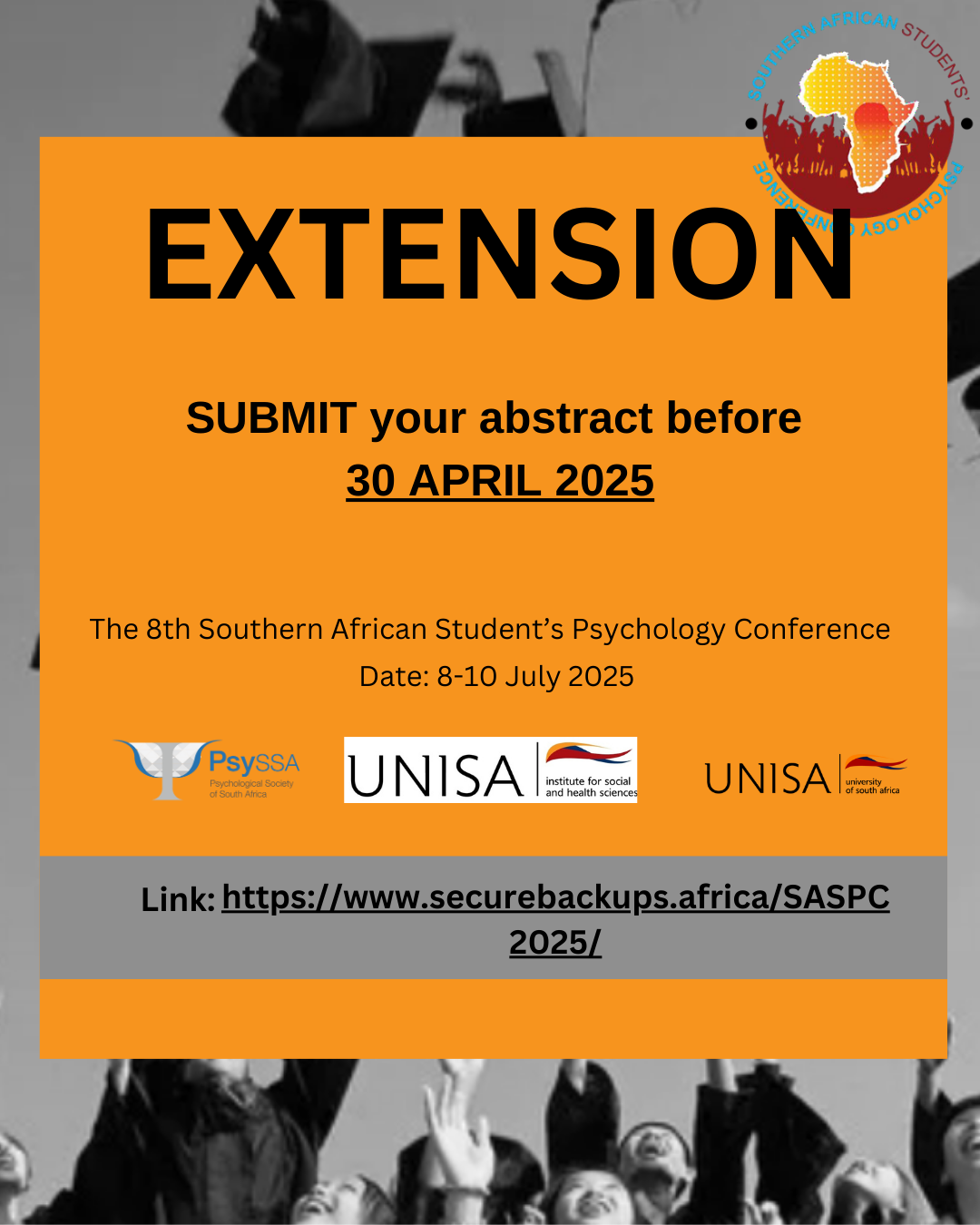
8th Southern African Students’ Psychology Conference – Abstract Submissions Extended- 30 April 2025

Attention Students!

Great news! We’ve heard your requests and are excited to let you know that the abstract submission deadline for the upcoming Student Conference has been extended to 30 April.

If you haven’t submitted your abstract yet, now’s your chance to be part of this inspiring event. Don’t miss the opportunity to share your work and connect with fellow students and professionals in the field!

Check out the submission details below and get yours in before the new deadline.

PsySSA & UNISA ARE PROUD TO PRESENT:

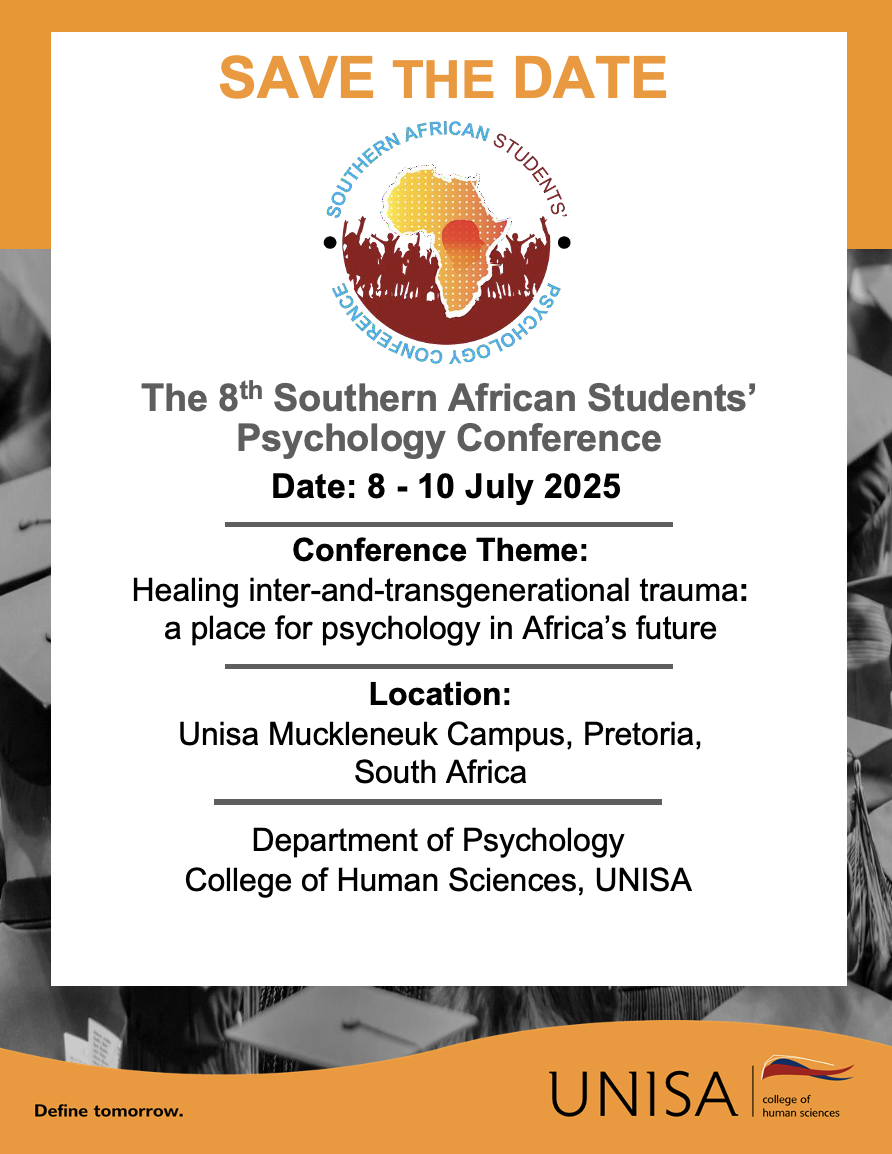
8TH SOUTHERN AFRICAN STUDENTS’ PSYCHOLOGY CONFERENCE 

The Psychological Society of South Africa (PsySSA), in partnership with the University of South Africa (UNISA), is excited to invite students, researchers, and emerging scholars to the 8th Southern African Students’ Psychology Conference 2025. This exciting event provides a dynamic platform for students to showcase their research, engage in intellectual discourse, and connect with fellow psychology enthusiasts and professionals.

Conference Theme: Healing inter-and-transgenerational trauma: A Place for psychology in Africa’s future
Date: 8 – 10 July 2025
Venue: Kgorong building, Unisa Muckleneuk Campus, Pretoria, South Africa.

This conference aims to explore the psychological challenges faced by today’s youth, with a focus on the impacts of intragenerational trauma and pressing social issues, while emphasising psychology’s critical role in healing the trauma. The approach is to integrate both indigenous knowledge systems and western psychological perspectives. The conference aims to propose culturally relevant interventions to tackle the psychosocial impacts of past and ongoing inequalities. The focus will be on the current state of the field and looking ahead, examining the future of psychology in Africa and how it can evolve to foster healing and resilience in the generations to come.

Call For Abstracts Are Now Open!

We welcome submissions from undergraduate and postgraduate students across diverse psychology-related disciplines. Whether you have original research, case studies, or innovative theoretical contributions, this is your chance to contribute to meaningful discussions shaping the future of psychology.

Abstract submissions close on 15 April 2025.


Student Division: Masters in Counselling Psychology Workshop

Student Division: Masters in Counselling Psychology Workshop

Masters in Counselling Psychology Workshop

The PsySSA Student Division presents a workshop on Masters in Counselling Psychology Workshop. This will be an interactive, three-hour session, and we are excited to help participants prepare for the application, selection, and interview processes with confidence.

 Workshop Details:

  • Date: Saturday, 15 March 2025
  • Time: 09:00 – 11:00
  • Platform: Zoom
  • Cost: Free

Don’t miss this opportunity to gain insights and prepare for success!

Selina Masetle

Intern Counseling psychologist Charis Psychological Services

  • Autobiography and Motivational Letter
  • Individual Panel Interview: Possible Questions and Approach
  • Role Play

Katlego Senoelo

Intern Counselling psychologist: Charis Psychological Services

  • Self-awareness and Personal Development Preparation Strategies
  • Realistic Expectations
  • Managing Uncertainty and Exploring Alternative Pathways

Martha Moagi

Intern Counselling Psychologist: UFH

  • Category-Specific Knowledge: Counselling Psychology
  • Research Interview
  • Group Interview: Case Study and Approaches