

PsySSA Commemorates Men’s Mental Health Month
PsySSA joins the global community in reflecting on this year’s theme: “Partners in Care: Advancing Men’s Health Through Connection, Education, & Advocacy Across the Lifespan – for Better Lifespans.”
To commemorate the month, PsySSA shares contributions from the PiPS, DRM, SD and SAACP. Together, these contributions explore men’s mental health across different life stages and contexts, highlighting the importance of supportive relationships, help-seeking, emotional wellbeing, and collective responsibility.
As we mark Men’s Mental Health Month, we are reminded that promoting men’s wellbeing is not solely the responsibility of individuals. It requires partnerships across families, healthcare systems, workplaces, educational settings, communities, and society as a whole.
By fostering connection, education, and advocacy, we can help create environments where men are empowered to seek support, prioritise their wellbeing, and thrive throughout the lifespan.
Read the full contributions:
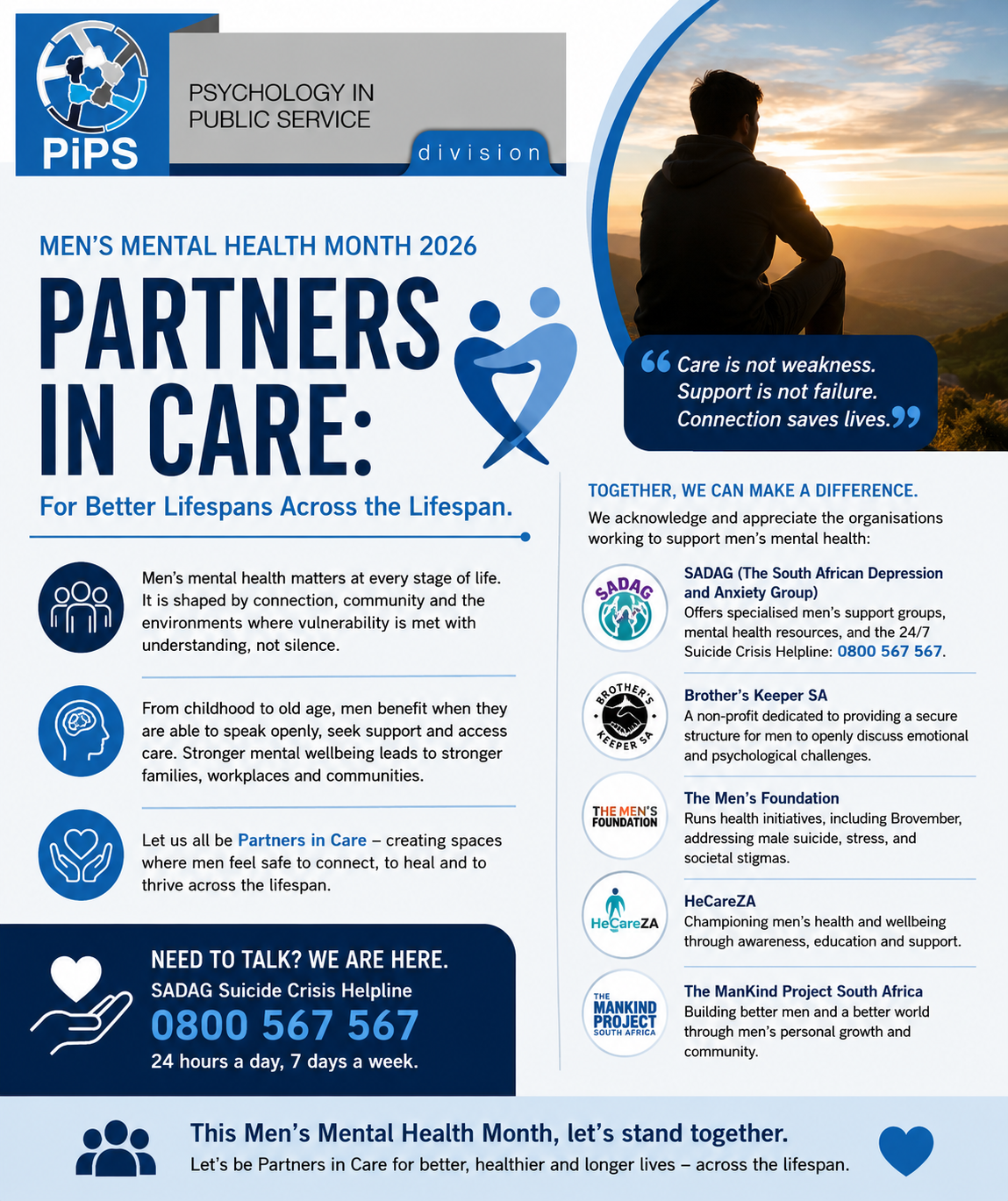
Partners in Care: For Better Lifespans Across the Lifespan
By the PsySSA PiPS Division (B. Viljoen)
Once a year in the month of June, we shift our focus to Men’s Mental Health.
Currently within the South African context, men are less likely to seek psychological support, and as such are less likely to disclose emotional distress. One of the arguments for this has been that distress may present differently, such as through expressed irritability, being withdrawn or through physical complaints, as opposed to directly naming challenges such as sadness and or anxiety. It should also be considered that men are more likely to engage in maladaptive coping strategies such as substance use, overworking and or risk-taking behaviours. These points can result in difficulties only being identified later or interpreted differently or incorrectly.
Here are some sobering indicators that have driven growing attention internationally and in South Africa:
• Men account for a disproportionately high number of deaths by suicide in many countries.
• Men often access mental healthcare later and may have lower rates of sustained engagement.
• Certain groups of men face additional pressures—unemployment, social isolation, expectations around masculinity, caregiving roles, trauma exposure, or barriers to help-seeking.
Men’s mental health matters across every stage of life, as we are reminded by this year’s theme. This is not an individual responsibility to be carried alone, but rather nurtured though relationships, communities, systems of care and opportunities for meaningful connections.
Collectively we need to pushback against perceptions that self-reliance, endurance and silence are more desirable that emotional expression and help-seeking. While not detracting from the importance of reliance, we know that wellbeing is strengthened when we are able to speak openly about uncertainty, loss, identity, distress, caregiving, relationships and life changes without fear of judgement. This is equally important across childhood, adolescence, adulthood and older age. If we can create space for accessible support this can contribute to not only improved mental health outcomes but to a healthier society.
As PiPS, we acknowledge the organisations working to create these spaces of connection and care. SADAG (The South African Depression and Anxiety Group) offers specialised men’s support groups, mental health resources, and a 24-hour Suicide Crisis Helpline (0800 567 567). Brother’s Keeper SA provides spaces for men to engage openly with emotional and psychological challenges. The Men’s Foundation, including initiatives such as Brovember, continues to address issues including male suicide, stress, and the impact of social stigma. We also recognise the contributions of HeCareZA and The ManKind Project South Africa in strengthening conversations around men’s wellbeing, connection, and personal growth.
This month serves as an invitation to professionals, families, colleagues, friends, and communities, to become partners in care. By fostering environments where men are supported to seek help, build relationships, and care for themselves and others, we contribute not only to better mental health, but to fuller and healthier lives across the lifespan.