“Cultivating Mental Health” The South African Association for Counselling Psychology (SAACP)

“Cultivating Mental Health” The South African Association for Counselling Psychology (SAACP)

As part of Mental Health Awareness Month, The South African Association for Counselling Psychology (SAACP) invites us to pause, reflect, and intentionally cultivate our mental well-being.

In their contribution, “Honouring Mental Health: A Thought Piece with Resources,” SAACP reminds us that mental health is not a given — it requires ongoing care, investment, and compassion. From recognising the value of rest and boundaries, to integrating holistic approaches that include the physical, spiritual, and social dimensions of health, this reflection encourages both practitioners and the public to nurture resilience and balance.

To support continued growth, SAACP, with SACAP Global are offering a 50% discount on the “How to Have Critical Conversations” short course, valid for the October–December 2025 intake (voucher code: VOU_PSYSSA2025, expires 31 October 2025).

Read more about how we can honour mental health — for ourselves, our clients, and our communities below:

“Cultivating Mental Health”

The South African Association for Counselling Psychology (SAACP)

Honouring Mental Health: A Thought Piece with Resources

Mental health is a journey. Invest in it. Honour it. And remember, it belongs to us all.

Taking Mental Health for Granted

  • Similar to our physical health, we often overlook our mental health – until it is compromised. Only then do we realise how truly valuable it is. World Mental Health Day is a reminder to all of us, mental health professionals included, to honour ourselves by paying attention to our wellbeing.

The Wounded Healer and Shared Humanity

  • In my coaching practice, I hold space for clients as they alchemise their journey, remembering their connection, beauty, and power. Many mental health professionals -some resonating with the wounded healer archetype – know better than most that mental health is not a given.
  • There are times when we all feel fragile, overwhelmed, and unsure of ourselves. Mental health requires regular investment through practices unique to each of us – whether through rest, boundaries, exercise, or soul work.

Beyond the Mind: A Holistic View of Health

  • For centuries, health has been divided among specialists. While expertise has deepened, perspective has narrowed. Yet, mental health does not exist only in the mind:
    • Physical state: Exercise, sleep, and nutrition play a vital role.
    • Spiritual connection: Meaning, purpose, and listening to the heart sustain us.
    • Social environment: Systems we engage with often laced with prejudice or misogyny send powerful messages that shape our self-perception.

The real question is: how harmonised and integrated are we as practitioners and as people?

Supporting Clients in Their Becoming

  • Helping professionals work across a spectrum: from healing to empowerment. Along the way, we identify skills gaps together, whether learning assertiveness, building resilience, or coping with grief.
  • In my coaching practice, I’ve found that short courses accelerate development, offering practical tools that complement coaching.

Short Course 50% Discount:
Short courses can be a powerful ingredient in cultivating mental health.

  • Course: “How to Have Critical Conversations”
  • Discount: 50% off with voucher code VOU_PSYSSA2025
  • Valid for: Oct–Dec 2025 Class of 2025
  • Register at: SACAP Global
  • Voucher expires: 31 October 2025
Karolyne Williams is an ICF Professional Certified Coach and COMENSA Credentialed Practitioner. She has been developing leaders for the past fifteen years, helping them shape a future that embodies what they care about most. She is Head of Strategic Innovation at the South African College of Applied Psychology (SACAP) and leads the design and development of their coaching, human resource management and business management qualifications. Karolyne currently leads SACAP Global, their online short course division.

“Building Resilience in South Africa” – The South African Society for Clinical Psychology (SASCP)

“Building Resilience in South Africa” – The South African Society for Clinical Psychology (SASCP)

The South African Society for Clinical Psychology (SASCP) reminds us that mental health is not a luxury — it is the foundation for thriving individuals and communities. Let’s break the stigma, build resilience, and create a South Africa where psychological well-being is a shared priority. Read the full reflection from SASCP below:

“Building Resilience in South Africa”

The South African Society for Clinical Psychology (SASCP) – Barry Viljoen

Every year on 10 October, World Mental Health Day reminds us of the urgent need to prioritise psychological well-being. In South Africa, this call is especially critical. Our nation faces the intersecting burdens of poverty, trauma, violence, unemployment, and health inequities—factors that heighten vulnerability to mental health difficulties. Yet, amidst these risks, South Africans also display remarkable resilience and adaptability.

The SASCP recognises both the adversities and strengths that our citizens within our communities are faced with on a daily basis. Our members, based in hospitals, clinics and in private practise, in working daily with survivors of trauma, people living with the effects of brain injury, and living with various emotional and psychological conditions, to mentoring young professionals, recognise one truth that stands out: mental health is not a luxury. It is the foundation upon which individuals, families, and societies thrive.

Too often, however, stigma prevents people from seeking help. This is where awareness and education play a powerful role. By recognising early signs of distress—sleep disruption, fearfulness, withdrawal, or memory difficulties—and encouraging supportive interventions, we can prevent suffering from escalating into long-term impairment.

World Mental Health Day is not only about highlighting need; it is also about fostering hope. South Africa has the talent, knowledge, and compassion to strengthen systems of care. Schools, workplaces, and health institutions can all integrate practical, culturally relevant approaches that build resilience and promote recovery.

This year, let us commit to conversations that normalise mental health, to services that are accessible, and to policies that protect the vulnerable. Together, we can transform awareness into action and build a healthier, more resilient South Africa.

Health Psychology & Mental Health Day – Health Psychology Division

Health Psychology & Mental Health Day – Health Psychology Division

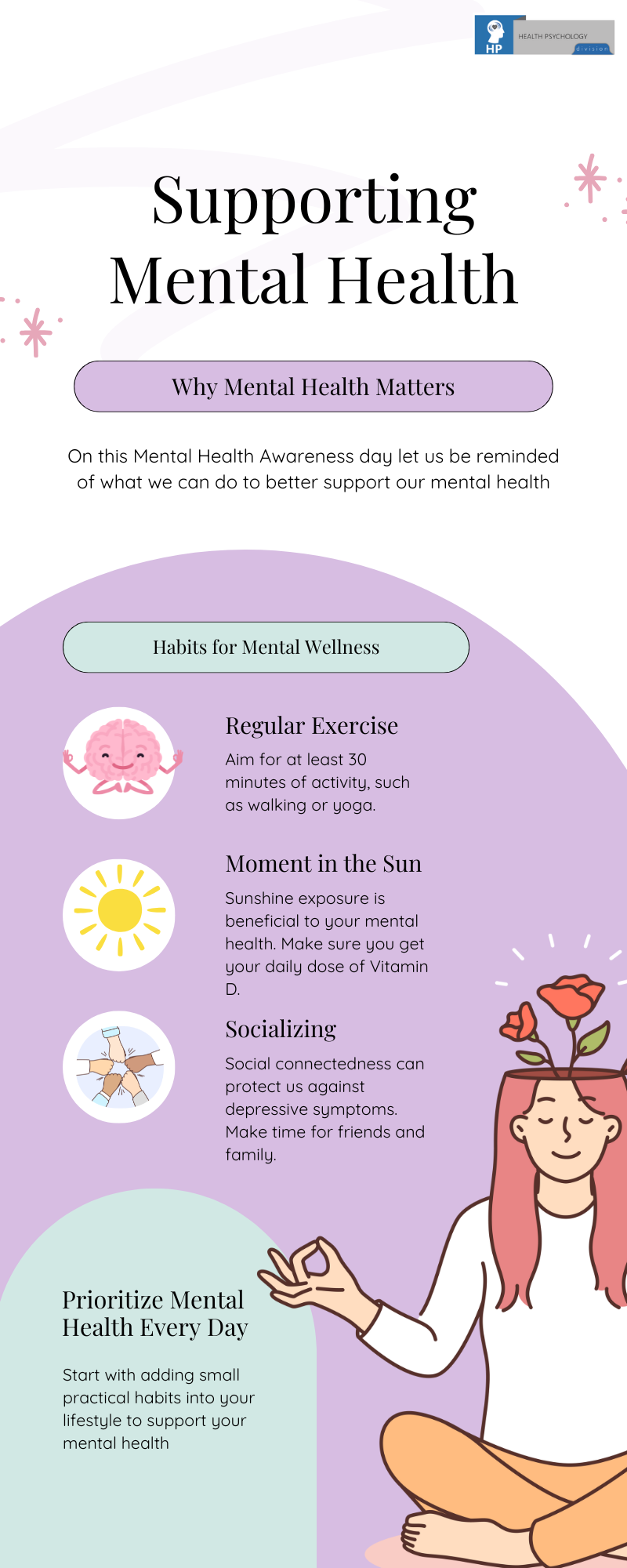
Health psychology and World Mental Health Day are closely linked through their shared focus on promoting psychological well-being and understanding the relationship between mental and physical health. Health psychology provides the scientific framework for examining how factors such as stress, behaviour, and social support influence both mental and physical health outcomes. Similarly, World Mental Health Day serves as a global platform to raise awareness, reduce stigma, and advocate for improved access to mental health care. Together, they highlight the importance of prevention, early intervention, and education in fostering resilience and healthier lifestyles. By translating health psychology’s research and insights into public awareness campaigns, World Mental Health Day bridges the gap between scientific knowledge and real-world impact, ensuring that mental health is recognized as an essential component of overall health.

PsySSA COMMEMORATES WORLD MENTAL HEALTH AWARENESS DAY – 10 OCTOBER 2025

PsySSA COMMEMORATES WORLD MENTAL HEALTH AWARENESS DAY – 10 OCTOBER 2025

PsySSA COMMEMORATES WORLD MENTAL HEALTH AWARENESS DAY – 10 OCTOBER 2025

“Access to Services: Mental Health in Catastrophes and Emergencies”

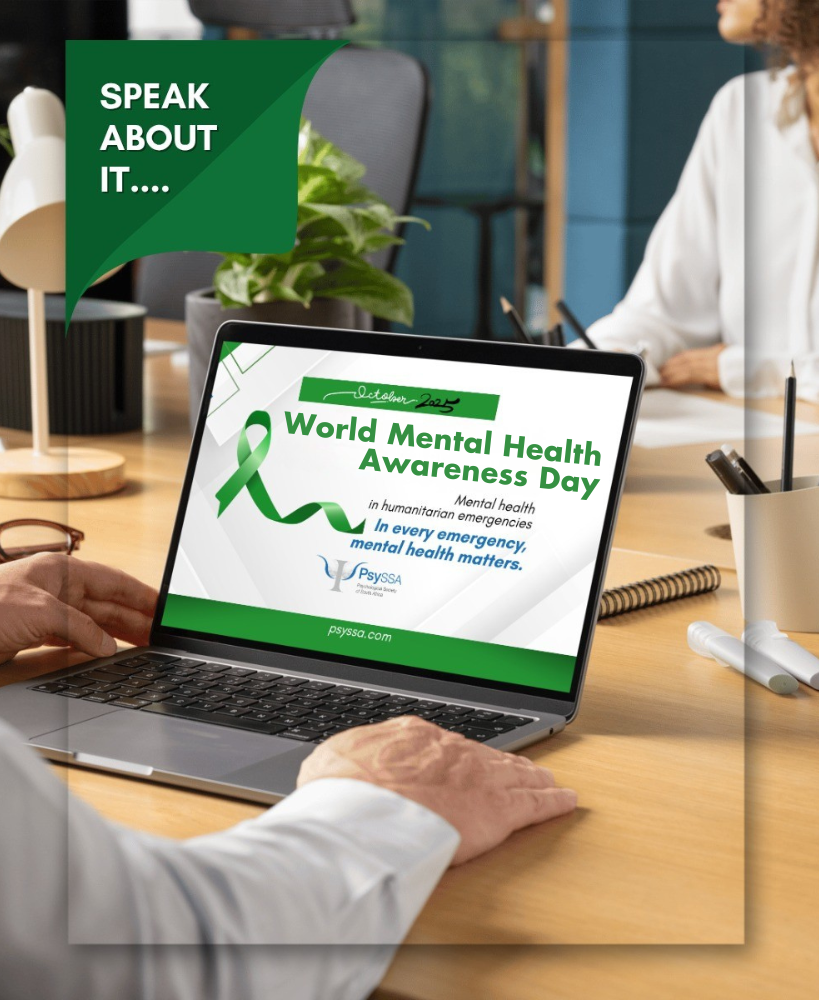
Today, on World Mental Health Day, the Psychological Society of South Africa (PsySSA) joins the global community in reaffirming our collective commitment to mental health as a universal human right.

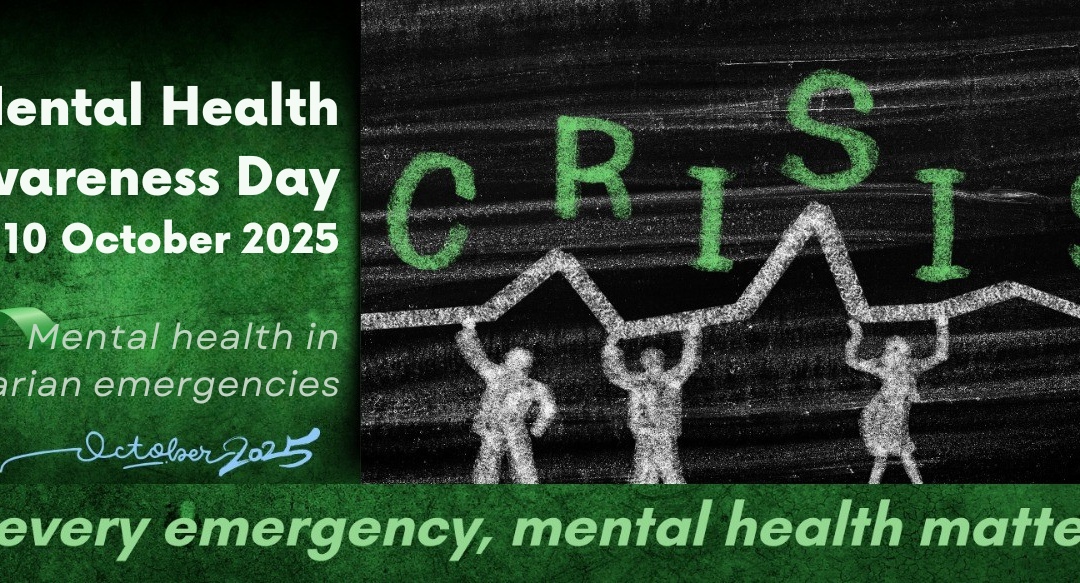
The 2025 theme — “Access to Services: Mental Health in Catastrophes and Emergencies” — calls for urgent attention to the psychological impact of disasters, crises, and emergencies that continue to shape the lives of individuals and communities across the world. Whether through conflict, climate disasters, pandemics, or social upheaval, access to timely, compassionate, and culturally responsive psychological care can mean the difference between despair and resilience.

A Call to Action for a Responsive and Inclusive Psychology

In South Africa, the legacy of inequality continues to manifest in unequal access to mental health care — gaps that are most painfully exposed during times of crisis. PsySSA, as the representative body of psychologists in the country, stands firmly for a psychology that is responsive, inclusive, and transformative, grounded in human rights and social justice.

Our vision remains clear: to advance psychology as a science and profession of global stature, relevant and responsive to South Africa’s diverse social realities. Our mission is to promote psychological praxis that upholds dignity, compassion, and equity, ensuring that mental health care is available to all — especially those most affected by catastrophe and emergency.

From Commitment to Collective Action: The 2024 Pledge Continues

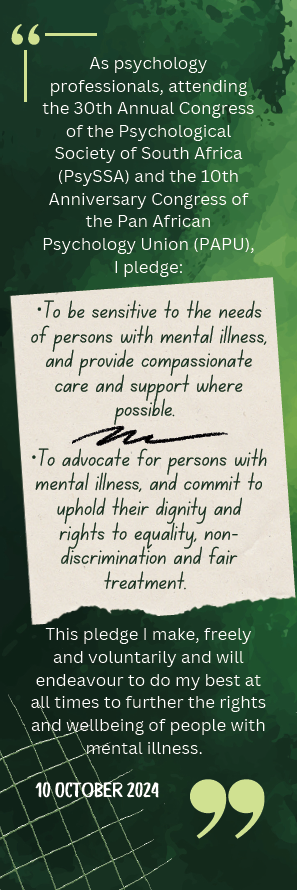
Last year, during the 30th Annual PsySSA Congress and the 10th Anniversary Congress of the Pan African Psychology Union (PAPU) at Emperor’s Palace, Johannesburg, psychology professionals across Africa united in a shared pledge:

  • “To be sensitive to the needs of people with mental illness, and provide compassionate care and support where possible.
  • To advocate for people with mental health problems, and to take a stand to uphold their dignity and rights to equality, non-discrimination, and fair treatment by all.”

This pledge remains as relevant today as it was then. It continues to guide our professional and ethical responsibility — to respond with empathy, to advocate for justice, and to uphold the mental health and dignity of all people.

Towards Our 29th Annual PsySSA Congress: A Future of Collaboration and Hope

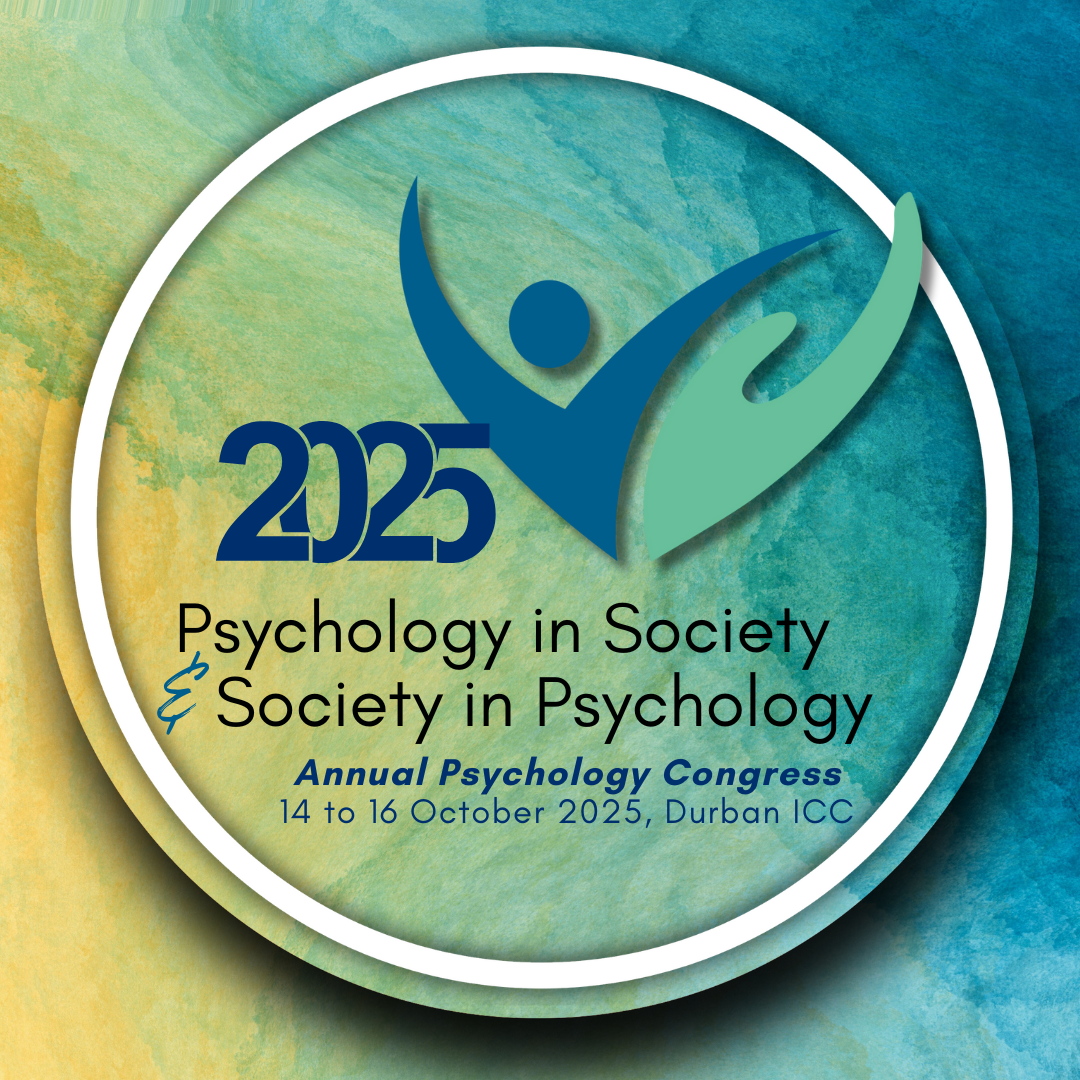
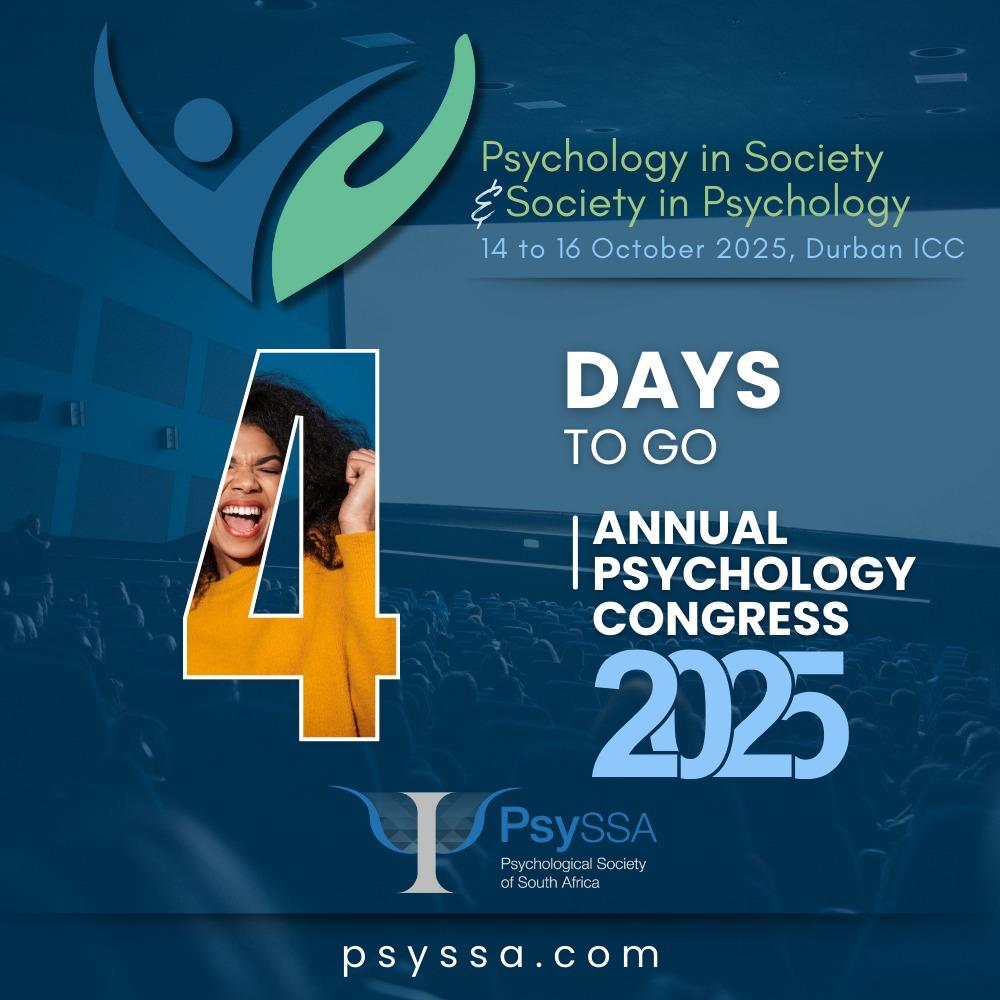
Next week, PsySSA will host its 29th Annual Psychology Congress, where psychology professionals, researchers, students, and practitioners from across South Africa and beyond will gather under the theme:

“Psychology in Society and Society in Psychology.”

This theme reminds us that psychology does not exist in isolation — it is deeply interwoven with the social, cultural, political, and economic fabric of our nation. Society shapes psychology, just as psychology has the power to shape society.

This year’s Congress will serve not only as a space for academic and professional exchange but as a platform for reflection and action — a forum to examine how our discipline can continue to address societal challenges such as inequality, trauma, mental health crises, and community resilience.

As we engage with the theme, we are reminded that the well-being of our society depends on the accessibility, inclusivity, and responsiveness of psychological services — especially in moments of catastrophe and emergency.

The Congress will offer an opportunity to deepen our collective understanding of how psychology can continue to serve, heal, and empower in times of both crisis and calm.

Call to Engage & Share

  • Join the conversation at our upcoming Congress — follow proceedings, share insights, and commit to action.
  • Share your story or initiative using #PsySSA4MH and #WorldMentalHealthDay — show how psychology is stepping up in disaster, crisis, and everyday challenge.
  • Download and share our pledge poster / social graphics (linked here) to spread awareness among colleagues, communities, and stakeholders.
  • Explore and share all of PsySSA’s Mental Health Awareness Month contributions, available throughout October on our website — a collection of thought pieces and resources designed to strengthen psychological well-being across South Africa.
“Building Resilience in South Africa” – The South African Society for Clinical Psychology (SASCP)

Shaping a Healthier Future Through Mental Health Awareness – Division of Registered Counsellors & Psychometrists

As we mark Mental Health Awareness Month and World Mental Health Day (10 October), we are reminded that mental health is not a privilege — it’s a right. This year’s theme, “Access to Services – Mental Health in Catastrophes and Emergencies,” highlights the urgent need for inclusive, accessible care, even in times of crisis.

In her article, Ntombikanina Mboniswa explores how crises — from floods and pandemics to conflict and displacement — magnify mental health challenges, and why building resilient systems that prioritise psychological support is essential.

Read the article below:

“Shaping a Healthier Future Through Mental Health Awareness”

Division of Registered Counsellors & Psychometrists (Written by: Ntombikanina Mboniswa)

Every year, World Mental Health Day (10 October) and Mental Health Awareness Month serve as vital reminders that mental health is as essential as physical health. These observances raise public awareness, fight stigma, promote early intervention, and  mobilise collective action.

Significance & Why It Matters:
Mental health conditions affect people across all ages, backgrounds, and walks of life. Without awareness, many suffer in silence. Observance days and months help bring conversations into the open, highlight structural gaps, and push for policy change and
resource allocation.

This Year’s Theme: Access to Services in Crises
For 2025, the World Federation for Mental Health has selected the theme “Access to services – mental health in catastrophes and emergencies.” This theme underscores that in moments of crisis — whether natural disasters, pandemics, conflict, displacement, or economic collapse — mental health often suffers dramatically, yet access to care is often cut or neglected. The message is that mental health support must be resilient and included in emergency response planning. In many communities, emergencies compound risk factors like trauma, loss, displacement, and isolation. Highlighting access means advocating for robust systems that remain functional when they’re needed most.

How the Public Can Engage:
Here are practical ways people can get involved:

  • Share awareness materials: Use toolkits, posters, social media graphics, and hashtags (e.g. from World Mental Health Day) to spark conversation.
  • Host or attend events: “Talk cafés,” listening circles, webinars, and panel discussions on mental health in emergency settings can create meaningful community engagement.
  • Get trained: Enrol in Mental Health First Aid or similar training so you can support someone in distress.
  • Advocacy: Engage with local or national government to push for policies that embed mental health into disaster-response frameworks.
  • Support organisations: Volunteer or donate to mental health NGOs, especially those active in crisis zones or frontline settings.

Useful Resources & Practical Tools:

  • The World Mental Health Day campaign toolkit (posters, messaging guides) is made publicly available.
  • SADAG’s Mental Health Awareness Month toolkit provides social media content and engagement ideas.
  • Many mental health organisations also host online screening tools, helplines, and peer support networks.

Division-Specific Insights / Contributions:

If you represent a department, branch, or division (e.g. a school, company, public health unit, NGO), consider these tailored ideas:

  • Internal awareness campaign: Use newsletters, posters and internal webinars to promote mental wellbeing and destigmatize seeking help.
  • Emergency planning: Ensure your division’s disaster response protocols include mental health support (e.g. crisis counselling, referral pathways).
  • Partnerships: Collaborate with local mental health services, Registered Counsellors, or NGOs to provide workshops or outreach services.
  • Monitoring & feedback: Use surveys or suggestion boxes to gauge mental health needs in your constituency or staff, to drive responsive programming.

“Cultivating Mental Health” The South African Association for Counselling Psychology (SAACP)

“Your Mental Health Matters” – Division for Research and Methodology

“Your Mental Health Matters”

– Division for Research and Methodology (DRM)

This Mental Health Awareness Month, the Division for Research and Methodology (DRM) reminds us that caring for our mental health is not a sign of weakness — it’s an act of strength and self-awareness.

Their video, “Your Mental Health Matters,” calls on each of us to pause, reflect, and prioritise our well-being.

Prof Coetzee also shares valuable insights in her recent Cape Times article — “Schools Should Be the First Stop for Mental Health Prevention and Early Support.”

Her contribution highlights the vital role schools play in early identification, prevention, and intervention, ensuring that young people receive the support they need long before crises emerge.

Let’s continue to raise awareness, break the silence, and affirm that every person’s mental health truly matters.

Watch the full video below:

“Schools should be first stop for mental health prevention,
early support”

– Division for Research and Methodology (DRM) – Bronwyne Coetzee

As part of Mental Health Awareness Month, Dr Bronwyn [Surname] from PsySSA’s Division of Research and Methodology (DRM) shares valuable insights in her recent Cape Times article — “Schools Should Be the First Stop for Mental Health Prevention and Early Support.” Her contribution highlights the vital role schools play in early identification, prevention, and intervention, ensuring that young people receive the support they need long before crises emerge.

Read more in the full article below: