16 Days of Activism for No Violence Against Women & Children – 2022

16 Days of Activism for No Violence Against Women & Children – 2022

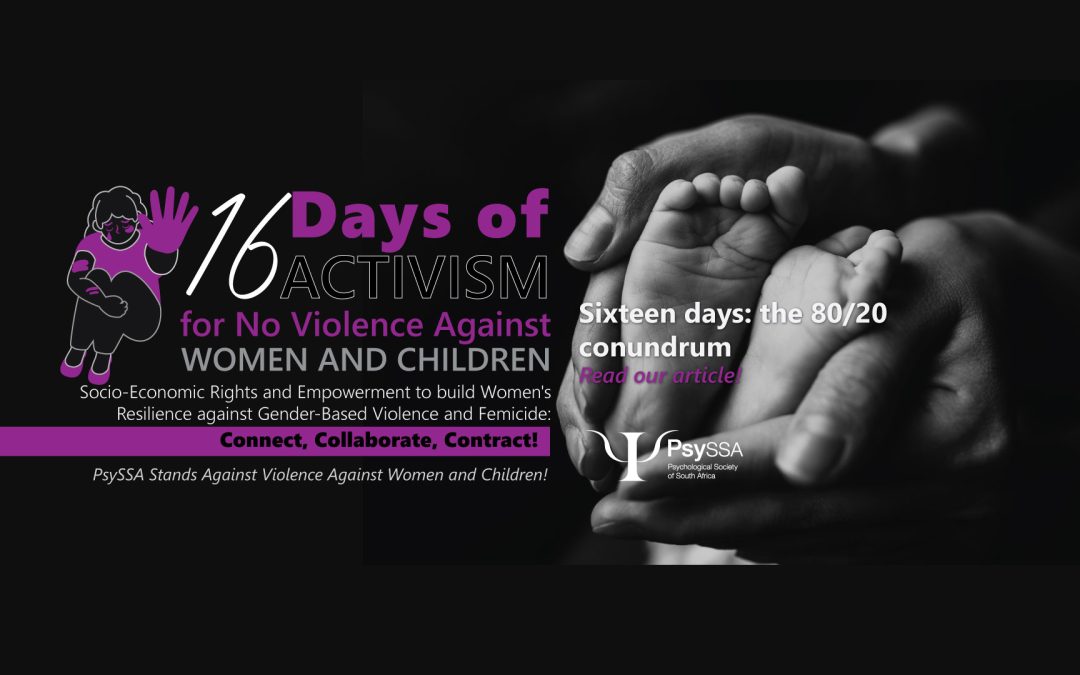
It is that time of the year again in South Africa, where the 16 Days of Activism for No Violence against Women and Children Campaign takes up the media space, allowing, most would say, the very necessary focus on sexual and gender-based violence against women and children in South Africa.

Our government is trying to send all the right signals as it looks for ways to bring to life (some would say bring back from the dead) the Emergency Response Action Plan on Gender-Based Violence and Femicide, which was announced by President Cyril Ramaphosa in September 2019.

Writing in September 2022 in the Mail & Guardian, Sibongile Ndashe, who is the co-chair of the Presidential Summit on GBV and Femicide, seemed despondent. The first summit was in November 2018 and the second took place recently in early November; Ndashe said there was no demand for this summit and that there was, in effect, summit fatigue.

Her comments are pretty scathing: there has been inadequate commitment and accountability; a “glowing report” on actions achieved “is not even a remote possibility”; the government, she says, has failed to “co-ordinate, account for and lead the response”; and “this costly exercise” has been, in effect, a public relations disaster.

No doubt there will be much spin about the State’s actions and promises, and earnest reflection on barriers and challenges. And there will be plenty of opinion-making on how we, as a country, can do better.

This is correct, but in this reflection we wish to articulate a more complex, and perhaps even controversial, view, alongside the critique of State inertia. And that is, we have failed as a country to get to grips with broader violence, and particularly male on male violence, which is a crucial part of our social fabric.

We are not speaking only here of men and boys as victims of sexual assault, domestic violence and child sexual abuse. This is, of course, a critically important part of the violence puzzle in South Africa. Loise du Toit’s chapter in the forthcoming book Intimacy and Injury speaks eloquently on the topic. Activists must rethink their neglect of male victims, she said, and we should “resist creating victim hierarchies”.

There are three reasons why feminist activists should take up the cause of male victims of sexual violence, Du Toit says: if we are serious about gender justice, ignoring male victims is discrimination; what unites sexual violence against men and women [and indeed all genders] is the violence of patriarchy; and recognising male victims is an opportunity for important solidarities, “exposing the delusion that it [sexual violence] is a woman’s problem”.

In fact, she argues, including male victims of sexual violence in our work “threatens patriarchy much more than it threatens feminist aims”.

So, our final argument, building on this, is that we need also to think about the impact of male-male violence which is not sexual.

Violence expert David Bruce (and gender activist Lisa Vetten has also made this point), has laid bare some stark statistics on this. Bruce clarifies that a focus on violence against women and children is objectively necessary. Women and teenage girls are the overwhelming majority of victims of sexual violence; 90% of rape victims over the age of 10 are female; in violence experienced by women the perpetrators are often current or former intimate partners; and in killings of women, roughly 50% are carried out by intimate partners.

But there is a silence about the victimisation of men, he says.

Men constitute a large proportion of victims of homicide and other types of violence where weapons are used to inflict serious injury. Men and male children account for 85% of victims of murder, 80% of victims of attempted murder, and more than 70% of victims of assault with grievous bodily harm.

Men are a large majority of victims of serious assaults and, unlike women, much of the violence they experience is from people outside the family and their closest relationships.

Building on this data he asks some pertinent questions:

  • Does a single-minded focus on violence against women suggest that violence against men is more acceptable?
  • Can violence against women be addressed without addressing violence against [and between] men?

Surely it makes sense that toxic and problematic forms of masculinity, underpinned by the system of patriarchy, are the golden thread that links violence against women to violence against men?

When men hurt each other it is often because their masculinity feels threatened, when they feel they need to prove something “as a man”, when they need to assert a particular orientation to the world that they are strong, can stand their ground. It is often a matter of pride for people who have learnt violence as a form of communication.

As men “become habituated to violence through violence from other men”, they will also hurt women, girls and anyone who challenges the cis-het norm. We are marinated in violence in South Africa; we cannot look away from violence between men and seriously argue that it does not bleed into the rest of our lives.

The violence matrix is complicated, has historical roots, and it’s a daunting task to tackle it. But piecemeal approaches cannot work. It’s legitimate to put our energies where we feel politically, morally and ethically drawn, but is it ethical to turn to a blind eye to male-male violence, which in fact makes up most of the violence in our country?


PsySSA Commemorates World Suicide Prevention Day 2022 – Hope Campaign 2022

PsySSA Commemorates World Suicide Prevention Day 2022 – Hope Campaign 2022

HOPE CAMPAIGN 2022:

The 10th of September 2022 has been declared World Suicide Prevention Day, by the International Association for Suicide Prevention in conjunction with the World Health Organization. On this day, attention is focused on reducing stigma and raising awareness of suicide prevention among organisations and within the public sphere to inspire creating hope through action.

PsySSA is joining in this international initiative through releasing our Hope Campaign. The Hope Campaign comprises of a series of videos which will be released throughout the day on our social media channels. We encourage our community of PsySSA members to help spread these releases through sharing them on your own social media pages.

A special thank you to all the contributors of the project:

Nicky Newman Photography (https://www.nickynewmanphotography.com), Alice den Hollander Photography (insta:alice_den_hollander), Nonhlanhla Maubane, Gavaza Shingange, and the SASCP and the PiPS divisions

PsySSA will being posting media throughout the day.

Watch our social media to see this campaign, lead by Executive Member, Daniel den Hollander, develop!

#Hope #WorldSuicidePreventionDay #CreatingHope #ThroughAction


You’re Invited: SPSSI’s New Webinar Series on “Decolonial Approaches to the Psychological Study of Social Issues

You’re Invited: SPSSI’s New Webinar Series on “Decolonial Approaches to the Psychological Study of Social Issues

This webinar series (“Decolonial Approaches to the Psychological Study of Social Issues”) features 15 presentations (organized into 5 installments) based on contributions to a special issue of the Journal of Social Issues (JSI) devoted to decolonial perspectives in/on psychology. The first two installments feature 6 presentations that consider the psychology of colonial violence.  Decolonial approaches propose that colonial violence is not confined to the distant past (i.e., colonialism) but instead persists as coloniality: racialized ways of thinking and being that have their roots in colonial violence, are inherent in the Eurocentric modern order, and are inseparable from modern individualist development. An important implication is that colonial violence extends beyond physical space to psychological space, such that complete liberation requires forms of psychological decolonization. The last three installments feature 9 presentations that consider the coloniality of knowledge in hegemonic psychology. Researchers are not innocent bystanders observing effects of colonial violence from some neutral position. Instead, epistemic violence in psychology occurs via epistemic exclusion of racialized others from the knowledge production process, imperialist imposition of white-washed knowledge products as universal standards, pathologizing forms of explanation that construct racial others as deviants in light of white-washed standards (i.e., epistemological violence; Teo, 2010), and forms of harm (e.g., zero-point epistemology and individualist lifeways) associated with hegemonic psychology’s modern/colonial roots. An important implication is that a decolonial approach may require epistemic disobedience and refusal of the discipline of psychology.

SPSSI’s new webinar series, “Decolonial Perspectives on the Psychological Study of Social Issues,” launches in just two weeks. All webinars are free and open to SPSSI members and non-members alike. Please join the SPSSI for their first webinar in their series, entitled… 

THE PSYCHOLOGY OF COLONIAL VIOLENCE, I: Bodies and Space

Wednesday, September 14, 16:00 UTC (12:00 PM EDT, 9:00 AM PDT)

Convener/Discussant: Kopano Ratele

Presenters:

Melissa Tehee, Erika Ficklin, Devon Isaacs, Racheal Killgore, & Sallie Mack
Fighting for our sisters: Community advocacy and action for missing and murdered Indigenous women and girls

Johanna Lukate
Space, race and identity: An ethnographic study of the Black hair care and beauty landscape and Black women’s racial identity constructions in England

Anjali Dutt
Refugee experiences in Cincinnati, Ohio: A local case study in the context of global crisis