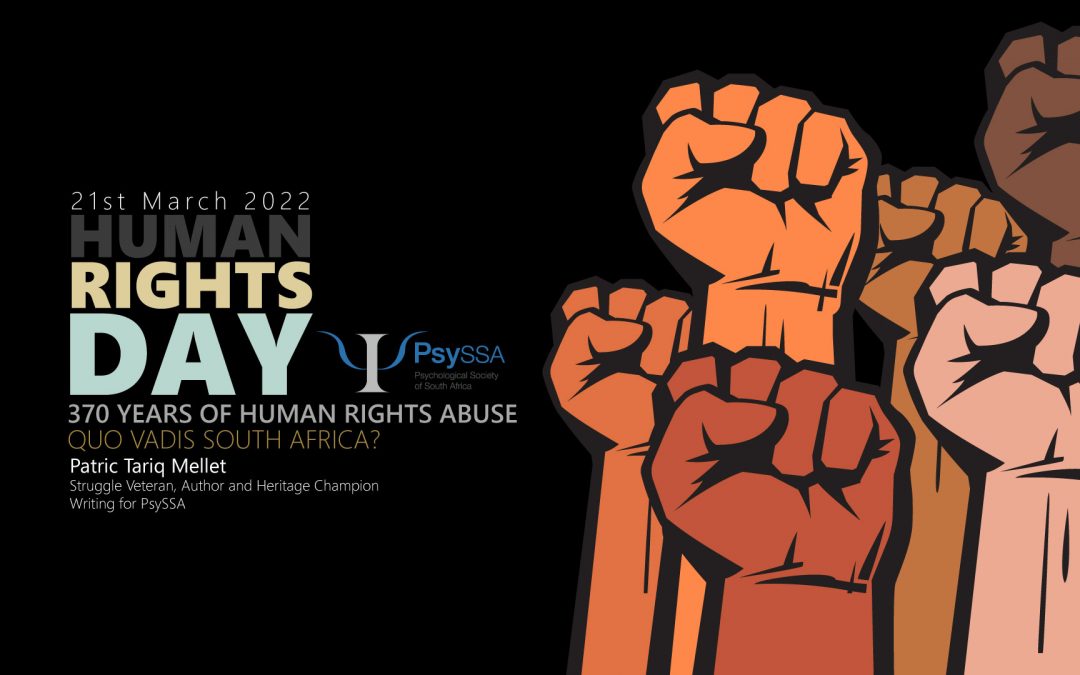
370 YEARS OF HUMAN RIGHTS ABUSE – QUO VADIS SOUTH AFRICA?

370 YEARS OF HUMAN RIGHTS ABUSE – QUO VADIS SOUTH AFRICA?

370 YEARS OF HUMAN RIGHTS ABUSE – QUO VADIS SOUTH AFRICA?

Over 370 years South Africans experienced 19 wars of land dispossession. San populations were reduced to just a few thousand people with most social formations totally wiped out through genocide. Among others, the Khoe and AmaXhosa peoples’ social, economic, and cultural life was severely disrupted by ethnocide.

For over 200 years we had the system of slavery where over 78 000 people were relocated from over 105 locations in Africa and Asia. Their successive generations of descendants were also enslaved, dehumanised, exploited, and subjected to violent abuse. Following this was indentured labour, migrant labour and labour brokering systems – new forms of trafficking and slavery.

A devastating war between two colonial factions negatively impacted the majority black population, and a new country – the Union of South Africa – was declared without consultation with 90% of the population. Social engineering resulted in over 140 African societies being forced to assimilate into 10 national groups classified as Natives or Bantu/Black, and 7 groups classified as Coloured, which still have negative polarising effects today.

The system of Apartheid followed. It declared that those classified as Black had no citizenship of South Africa, only of Bantustans in 13% of the territory. Those classified as Coloured were stripped of their African birth-rights and relegated to sojourner citizenship sans rights. An Apartheid police and militarised state terrorised people into submission – including continuous massacres – Sharpeville in the 1960s, the killings in the national youth protests in 1976/77, and brutal suppressions of protest in the 1980s. Banning of opposition political organisations, detention without trial, imprisonment of political opponents, death squad murders, and torture and death in detention, as well as widespread military aggression in neighbouring states defined over 30 years into the early 1990s.

Today the generationally transmitted trauma of past crimes against humanity, the highest forms of human rights abuse, still haunts and ravages our society. It is this chain of human rights abuses, still denied by the economically powerful white minority, together with the post 1994 continued use of Apartheid frameworks, which challenges us today. Pouring new wine into old Apartheid wineskins, and endemic corruption by a new Political Estate, resulting in atrocities like the Marikana Massacre, Life Esidimeni tragedy, Xenophobic attacks, politicians stealing finances meant to reduce poverty, and politicians’ actions that resulted in 342 deaths in the July 2021 social explosion – gives cause to reflect.

Astronomical unemployment, social depravation, homelessness, and ghetto built-environments next to palatial personal infrastructure and bling lifestyles of a new elite demands new thinking on human rights abuse in 21st century South Africa. The vortex of current human rights abuses and trauma, built on the old, has many asking – “Quo Vadis South Africa?”

In celebrating Human Rights Day, 21st March 2022, we have much cause to reflect, but even greater cause to act to halt cultures perpetuating human rights abuse. A direct corelation exists today between behaviours of the political and corporate elite, and the state of the poor whose basic human rights are being violated on a grand scale.

PATRIC TARIQ MELLET

STRUGGLE VETERAN, AUTHOR, AND HERITAGE CHAMPION

PsySSA Roundtable: Suicide in South Africa: An Intersectional Dialogue

PsySSA Roundtable: Suicide in South Africa: An Intersectional Dialogue

Meet our Facilitator & Panellists!

Mr Suntosh Pillay – Facilitator 

Suntosh R. Pillay is a clinical psychologist at King Dinuzulu Hospital Complex, in Durban, where he has run individual and group psychotherapy services for over ten years. He is affiliated to the College of Health Sciences at the University of KwaZulu-Natal and is involved in a diverse range of academic projects related to psychosocial health, using a critical, decolonial, and community psychology lens. He is a researcher in the African LGBTI+ Human Rights Project and serves on the Council of the Psychological Society of South Africa (PsySSA). In 2015, he co-founded the KwaZulu-Natal Mental Health Advocacy Group, an open and collaborative space that continues to host an annual symposium, free community forums, and an anti-stigma awareness walk in the province. He is on Twitter @suntoshpillay.

Ms Cassey Chambers – Operations Director, SADAG

Cassey started at The South African Depression and Anxiety Group (SADAG) as a volunteer telephone counsellor in the call center helping to man the Suicide Crisis Helpline over 15 years ago. Later she ran the Call Center and Press, and currently is Operations Director and Board Member. Cassey represents SADAG at national and international conferences, various press and media interviews, workshops and advocacy projects to help fight for patients’ rights and destigmatize mental health across the country. Focusing on various projects including Teen Suicide Prevention School Programme, Rural Outreach Projects, Support Groups, Responsible Reporting initiatives with press and media, Mental Health in the Workplace and recent advocacy projects including the Life Esidimeni crisis and Medical Aids.

Ms Glynis HorningFreelance Writer

Glynis Horning is an award-winning freelance writer whose assignments have taken her from the townships of apartheid South Africa to the Rwandan refugee camps in Zaire, from the Amazon jungle to ice floes in Patagonia. Horning is the recipient of the Discovery Health Journalism Award for Best Health Consumer Reporting and Feature Writing, the Pfizer Mental Health Journalism Award and a Rosalynn Carter Fellowship for Mental Health Journalism. She was Galliova Health Writer of the Year in 2017, 2019, 2020 and 2021. Nothing could have prepared her for the loss of her son at 25. She lives in Durban with her husband Chris and son Ewan.

Mx Saya Pierce-JonesJournalist

Saya Pierce-Jones is an award-winning Cape Town based journalist, a queer activist and environmental campaigner. Her passion is in social justice, ending period poverty and promoting sexual and mental health awareness for all South Africans. Following nearly a decade of covering some of the most gruesome incidents of crime, sexual abuse, oppression and failures within government entitites, she has now also become a law student and hopes to one day practice in the field of social justice. Personally, she is also a survivor of GBV and has been diagnosed with clinical depression and anxiety, and is a survivor of suicidal ideation/experimentation. Saya believes in honest discourse around these issues, so as to address the shortfalls, end the stigma and promote access to life-saving health care

Dr Sebo SeapeSASOP President

Dr Seape is the first Female Black Psychiatrist in South Africa, she is currently in Private Practice in Johannesburg (Parktown), with nearly 30 years of experience; and in that time,
she has had significant contributions in the increase in mental health awareness and comprehension in both marginalised communities and the private sector. She has a passion for community education and raising cognizance surrounding mental health issues and has been an enabler of the growth observed in Soweto Private clinics; wherein hospital beds grew from accommodating 18 to 50 patients. She has also been involved in various media platforms including Media Talks, and engagements with the government and the Council of Medical Schemes; to improve the structuring of health services and benefits. She was appointed as the first Psychiatrist at Tshepo Themba Private Clinic. She is the past chair of the Psychiatry Management Group and president of the South African Society of Psychiatry (SASOP).

Send your work to PSPR

Send your work to PSPR

Personality and Social Psychological Review (PSPR), the top-ranked journal in those subfields for the past decade, is beginning a new chapter.  While we will continue to publish impactful, integrative theory, we hope to usher in an era of publication aimed at socially-engaged work that expands the kinds of topics (and the kinds of authors!) who have typically published in the journal in the past.  In particular, we are seeking integrative theoretical scholarship that builds connections between personality and social psychology with other approaches across the broad field of psychology as well as approaches across the social sciences, other STEM fields, the humanities and arts, and to insights gleaned from applied work in the real world.  If you develop theory but haven’t thought of publishing in PSPR in the past, we hope you will give us another look.

For more information, please check out the editorial philosophy guiding this new chapter at the journal (https://spsp.org/publications/personality-and-social-psychology-review/editorial-philosophy) and the excellent work of our diverse editorial team (https://tinyurl.com/PSPRteam).


T-AP Recovery, Renewal, and Resilience Call Awards Announced

T-AP Recovery, Renewal, and Resilience Call Awards Announced

Congratulations to Professor Floretta Boonzaier, PsySSA President-Elect, the principal researcher for the Unsettling Knowledge Production on gendered and sexual violence project in South Africa for being 1 of the 19 international awardees of the T-AP Recovery, Renewal and Resilience in a Post-Pandemic World (RRR) call.

View the project title, ‘En Route to recovery: Diversity and vulnerability in care work during and after the COVID-19 pandemic’, a research project that Professor Boonzaier and 3 colleagues from Finland, Scotland/ UK and Canada will be undertaking from March 2022.

Click here to view the details: https://www.transatlanticplatform.com/rrr-awards/

Second Pan-African Psychology Congress 28-30 March 2022

Second Pan-African Psychology Congress 28-30 March 2022

The 2nd Pan-African Psychology Congress – fully online and CPD accredited – will feature global, continental and country leaders in their fields.

You are invited to submit abstracts in all areas of psychology to celebrate psychology as a science and practice in Africa.

Early bird and Abstract submission have been extended to 6 March 2022!