Building a Unified, Relevant, and Responsive Psychology

Psychology in Public Service (PiPS)

Save the Date: Charting the Road to NHI: What Psychologists Need to Know Now

Save the Date: Charting the Road to NHI: What Psychologists Need to Know Now

Save The Date: 3 February 2026

Charting the Road to NHI: What Psychologists Need to Know Now

As South Africa moves closer to the implementation of the National Health Insurance (NHI), it is essential for psychologists to understand the implications for practice, service delivery, and professional roles within the public health system.

The Psychology in Public Service (PiPS) Division of PsySSA invites members to an important engagement that will provide clarity on the current NHI landscape, anticipated developments, and what psychologists need to know and prepare for at this stage.

Date: Tuesday, 3 February 2026

Time: 17:00

Save the date and join this critical conversation as we collectively chart the road ahead. Details to follow soon – watch this space!


Psychology in Public Service Division (PiPS) – 16 Days of Activism Against Gender-Based Violence

Psychology in Public Service Division (PiPS) – 16 Days of Activism Against Gender-Based Violence

As our lives, learning, work and relationships increasingly move online, technology-mediated violence has become one of the most urgent fronts in the fight against gender-based violence. From online harassment and stalking to image-based abuse and hate speech, digital violence threatens the safety, dignity and rights of women and girls in South Africa and across the world.

In this powerful contribution, PsySSA’s PiPS Division reflects on the 2025 UN Women theme — UNITE to End Digital Violence Against All Women and Girls — and explores how digital safety, gender equality and human rights are deeply interconnected. The piece highlights the need for stronger policy implementation, safer technology design, improved digital literacy, and coordinated, trauma-informed responses across sectors.

Read the full contribution below:

PsySSA Psychology in Public Service Division (PiPS)

16 Days Of Activism: UNITE to End digital Violence Against All Women and Girls

The 16 Days of Activism Against Gender-Based Violence runs from 25th November to 10th December. It is a global call to action to prevent and eliminate all forms of violence against women and children. Although the campaign is observed for 16 days, its success rests on our daily and individual actions to safeguard our society against this cycle of abuse.

The 2025 global campaign, led by UN Women under its’ UNiTE initiative, is themed “UNITE to End Digital Violence Against All Women and Girls.” In the digital sphere, online harassment, abuse, stalking, non-consensual sharing of images or personal data, hate speech and other forms of technology-facilitated violence need to be eradicated in order to advance gender equality and human rights.

Technology must become a force for equality and not harm. The campaign calls on governments, private sector platforms, civil society and individuals to act to improve policies and laws; to design safer technologies; to equip women and girls with digital literacy and safety tools; to shift social norms and to hold perpetrators and platforms accountable.

In the South African and global context, the campaign reinforces that gender-based violence is never acceptable. By extending the reach of activism into the digital sphere, the 2025 campaign acknowledges the evolving ways in which violence and harassment manifest, especially as our lives, workplaces, learning, socialising and relationships move online. Gender-based violence does not occur in isolation. It is shaped by unequal power dynamics, harmful gender norms, historical and intergenerational trauma, socio-economic inequalities and attitudes that normalise violence.

Across its 16 days, the campaign provides an opportunity to create awareness, generate policy momentum, amplify survivors’ voices, share resources, shift culture, and foster solidarity. The campaign underscores women’s and girls’ digital safety as a fundamental part of their human rights, their freedom of expression, access to economic and social life and their dignity and bodily autonomy.

Every person has a role in ending GBVF. This collective vision can only be realised when every sector plays its part: Government must strengthen policy implementation, resource frontline services and ensure accountability across the justice and security systems and health services must provide trauma-informed and compassionate care. Intersectoral collaboration between social development, education, policing, health, civil society and community leaders is essential to creating a coordinated, survivor-centred response. When institutions work together and communities remain actively engaged, South Africa takes meaningful steps toward a society grounded in safety, dignity, healing and justice for all women and children.

Resources
https://www.unwomen.org/en/get-involved/16-days-of-activism
ChatGPT used for generative AI purposes & all Instagram squares were generated by ChatGPT

World AIDS Day – 1 December 2025

World AIDS Day – 1 December 2025

World AIDS Day – 1 December 2025 

“Overcoming Disruption, Transforming the AIDS Response”

Today we honour the resilience of communities, practitioners, and health systems responding to HIV in the face of global funding cuts, service disruptions, and persistent inequities. As highlighted in contributions from our HPD and PiPS divisions, protecting the gains made in South Africa’s HIV response requires renewed commitment to both biomedical advances and psychosocial care.

We reflect on the continued psychological burden carried by people living with HIV, the impact of stigma and trauma, and the essential role of mental-health professionals in strengthening continuity of care, integrating mental-health screening, and championing trauma-informed, person-centred, and rights-based approaches.

This World AIDS Day, we stand with communities, researchers, and health workers who persist with dedication, empathy, and hope.

Read the PiPS and HPD contributions below:


Psychology in Public Service (PiPS) Division – Overcoming Disruption and Transforming the AIDS Response

On the first of December, we commemorate World AIDS Day, and this year in 2025, we actively reflect. Reflect on how we as communities, practitioners and even healthcare systems have adapted and continue to adapt and innovate, in the face of adversity and disruption. Our response to the HIV epidemic, has been one of the most ambitious in the world. However, this is not to say that it hasn’t been without challenges. This year the focus is on a renewed effort and sustainable commitments to revitalising not only our biomedical responses but also psychosocial interventions.

As psychologists working within the public service, we are reminded and attempt to remind all, that HIV is both a medical and mental health condition. Disruptions to care, amplify the psychological vulnerabilities of an already vulnerable group. Sadly, stigma remains a challenge faced all too often, while heightened anxiety, depression and trauma exposure are common.

Yet when faced with these challenges we as South Africans have found opportunities for transformation. We as mental-health professionals have the ability to shape a response, that is more dynamic, person-centred, equitable and resilient. However, this does mean that we are going to have to strengthen continuity of care, by integrating mental-health screening and brief interventions into HIV services. While actively addressing stigma and discrimination, including internalised stigma. Which impacts on adherence and wellbeing. We have to champion trauma-informed care, which can only take place effectively in the context of interdisciplinary collaboration. Leading to advancements in treatment literacy, community empowerment, and hopefully advances in prevention. While of course, looking after ourselves and colleagues, who face the reality of burnout, moral distress and secondary trauma.

In marking World AIDS Day, PiPS would like to acknowledge the continued psychological burden carried by people living with HIV, as well as their families, and the teams who treat and support them. We wish to pay tribute to the resilience of communities that continue to advocate for, organise and provide care for, in the face of adversity.

Overcoming disruption isn’t just possible, rather it’s been continuously underway in every interaction when practitioners engage with empathy, expertise and the facilitation of hope.

Health Psychology Division (HPD) – World AIDS Day

Today we commemorate World AIDS Day under the theme: “Overcoming disruption, transforming the AIDS response.”

We highlight a global funding crisis that is threatening decades of progress on HIV/AIDS prevention and treatment. This disruption is disproportionately affecting marginalized communities and leaving them behind. Despite these global setbacks, community-led organisations, researchers, and health workers continue to defend vital gains and push for a stronger, more equitable HIV/AIDS response.

Here in South Africa, researchers continue to produce vital evidence that guides policy and strengthens services for communities affected by HIV:

  • Securing our HIV response: The PEPFAR crisis in South Africa.
  • Structural determinants of HIV inequities in South Africa: Policy analysis of the national strategic plan for HIV 2023–2028.

Ending AIDS is possible. But only if we protect communities, fund the response, and uphold human rights.

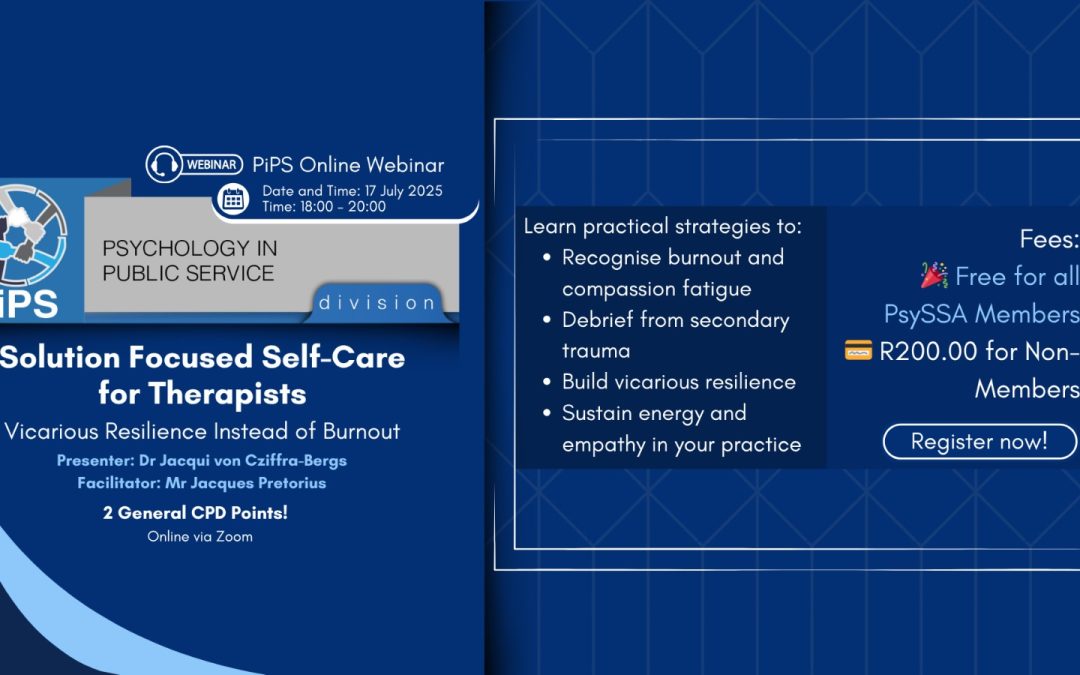
PiPS Webinar: Solution Focused Self-Care for Therapists

PiPS Webinar: Solution Focused Self-Care for Therapists

Solution Focused Self-Care for Therapists
Vicarious Resilience Instead of Burnout

17 July 2025
18:00–20:00
Online via Zoom
2 General CPD Points

Fees:

Free for all PsySSA Members

R200.00 for Non-Members

Presenter: Dr Jacqui von Cziffra-Bergs
Facilitator: Mr Jacques Pretorius

  • Recognise burnout and compassion fatigue
  • Debrief from secondary trauma
  • Build vicarious resilience
  • Sustain energy and empathy in your practice
Abstract

As psychologists we listen to stories of trauma, pain, hurt and struggle on a weekly basis. Being at the receiving end of emotional turmoil is draining and leads to therapist burnout and compassion fatigue. We all know that self-care is necessary however, we never seem to get the time to do it. This webinar invites you to some Solution Focused ideas on how to do self-care on the go and help you to regain some of your energy and passion. This webinar offers you the opportunity to debrief from the secondary trauma you might be carrying, experience vicarious resilience, and introduce you to a set of Solution Focused questions that you can ask yourself to rebrief your strengths and continue working in a healthy way.

About the Presenter
Dr Jacqui von Cziffra-Bergs

Dr Jacqui von Cziffra-Bergs

Dr Jacqui von Cziffra-Bergs is a psychologist in Johannesburg and the director of the Solution Focused Institute of South Africa. She teaches Solution Focused Therapy and Solution Focused thinking to psychologists, social workers, schools and organisations.  Dr Jacqui von Cziffra-Bergs was an associate professor at the University of Johannesburg and still teaches at universities across the country on a consultancy basis. She has lectured extensively on Solution Focused Therapy throughout South Africa, the United States, Europe, South America and Dubai. Dr Jacqui has written 5 books and her latest two books:  “Solution Focused Brief Therapy and clients managing trauma” for Oxford University Press and “Women’s perspectives on the Solution Focused Approach” for Routledge are highly acclaimed in the field. Dr Jacqui is married and has two sons that keep her feet firmly on the ground.


Mr Jacques Pretorius

Mr Jacques Pretorius

Jacques Pretorius is a clinical psychologist and Chairperson of the Psychology in Public Service (PiPS) Division. He has worked across both public and private mental health sectors and currently serves as a full-time lecturer in the Department of Clinical Psychology at Sefako Makgatho Health Sciences University (SMU). In this role, he teaches and supervises students in clinical psychology, psychiatry, dentistry, and general medicine, with a particular focus on integrating psychological theory into health sciences education. His academic and clinical interests include postmodern epistemology, the philosophy and ethics of mental health, and ecological approaches that advance the interdisciplinary integration of health and well-being. Jacques has published in peer-reviewed journals and presented at national and international conferences. As a facilitator, he brings a collaborative, reflective style that encourages critical engagement and inclusive dialogue across diverse professional audiences.

PiPS Online Workshop: Demystifying the POPIA Act – Recording Out Now!

PiPS Online Workshop: Demystifying the POPIA Act – Recording Out Now!

PiPS Online Workshop: Demystifying the POPIA Act – Recording Out Now!

We are pleased to announce that the recording of the PiPS Online Workshop: Demystifying the POPIA Act is now available!

Presented by Barry Viljoen, this practical session offers a psychologist-focused guide to understanding the Protection of Personal Information Act (POPIA)—South Africa’s essential data privacy law.

In this workshop, Barry explores:

  • How POPIA applies in psychological practice, particularly in public service settings

  • Practical steps to protect client data and ensure compliance

  • Navigating ethical dilemmas in relation to data privacy

  • Key responsibilities of practitioners under the Act

This recording is a valuable resource for psychologists seeking to strengthen their understanding of POPIA and uphold best practices in data protection and ethical care.

Abstract

This presentation will provide an in-depth introduction to the Protection of Personal Information Act (POPIA), a key piece of legislation in South Africa designed to protect individuals’ personal data and ensure privacy rights. The POPIA Act regulates the collection, use, storage, and sharing of personal information by organizations and sets out the legal framework for how businesses must handle personal data. Throughout the presentation, we will explore the core principles of POPIA, including the conditions for lawful processing of personal information, the rights of data subjects, and the responsibilities of data controllers and processors. We will also discuss the practical application of the Act in various organizational settings, emphasizing how businesses can comply with its requirements through effective data protection measures and risk management strategies. Key topics will include obtaining consent, safeguarding data, ensuring transparency, and understanding the role of the Information Regulator in overseeing compliance. Furthermore, we will examine the potential consequences of non-compliance, including penalties and reputational damage, and the steps organizations can take to implement a robust data protection program. This presentation will equip attendees with a foundational understanding of POPIA, its implications for data privacy, and how to navigate the complexities of personal data protection in the digital age.

About the Presenter
Mr Barry Viljoen

Mr Barry Viljoen

Barry Viljoen is a Clinical Psychologist working in the public sector. He is involved in academics in terms of training. His areas of interests are child and adolescent psychology, psychology within forensic settings, assessment, and critical disability studies. He is currently completing his Dpsych in Child and Adolescent Psychology.


PiPS Online Workshop: Demystifying the POPIA Act – Recording Out Now!

PiPS Online Workshop: Demystifying the POPIA Act

PiPS Online Workshop: Demystifying the POPIA Act

FREE CPD WORKSHOP

24 June 2025
18:00 – 20:00

Demystifying the POPIA Act – a practical and psychologist-focused guide to understanding South Africa’s data privacy law.

Join Barry Viljoen as we unpack how POPIA impacts psychological practice in public service settings—equipping you with the tools to stay compliant, protect client data, and navigate ethical dilemmas confidently.

2 General CPD Points!

Abstract

This presentation will provide an in-depth introduction to the Protection of Personal Information Act (POPIA), a key piece of legislation in South Africa designed to protect individuals’ personal data and ensure privacy rights. The POPIA Act regulates the collection, use, storage, and sharing of personal information by organizations and sets out the legal framework for how businesses must handle personal data. Throughout the presentation, we will explore the core principles of POPIA, including the conditions for lawful processing of personal information, the rights of data subjects, and the responsibilities of data controllers and processors. We will also discuss the practical application of the Act in various organizational settings, emphasizing how businesses can comply with its requirements through effective data protection measures and risk management strategies. Key topics will include obtaining consent, safeguarding data, ensuring transparency, and understanding the role of the Information Regulator in overseeing compliance. Furthermore, we will examine the potential consequences of non-compliance, including penalties and reputational damage, and the steps organizations can take to implement a robust data protection program. This presentation will equip attendees with a foundational understanding of POPIA, its implications for data privacy, and how to navigate the complexities of personal data protection in the digital age.

About the Presenter
Mr Barry Viljoen

Mr Barry Viljoen

Barry Viljoen is a Clinical Psychologist working in the public sector. He is involved in academics in terms of training. His areas of interests are child and adolescent psychology, psychology within forensic settings, assessment, and critical disability studies. He is currently completing his Dpsych in Child and Adolescent Psychology.