HPSIG Podcast: The prejudice and discrimination experienced by people living with disabilities in South Africa
EPISODE 16
HPSIG Podcasts
HPSIG Podcast: The prejudice and discrimination experienced by people living with disabilities in South Africa



Building a Unified, Relevant, and Responsive Psychology
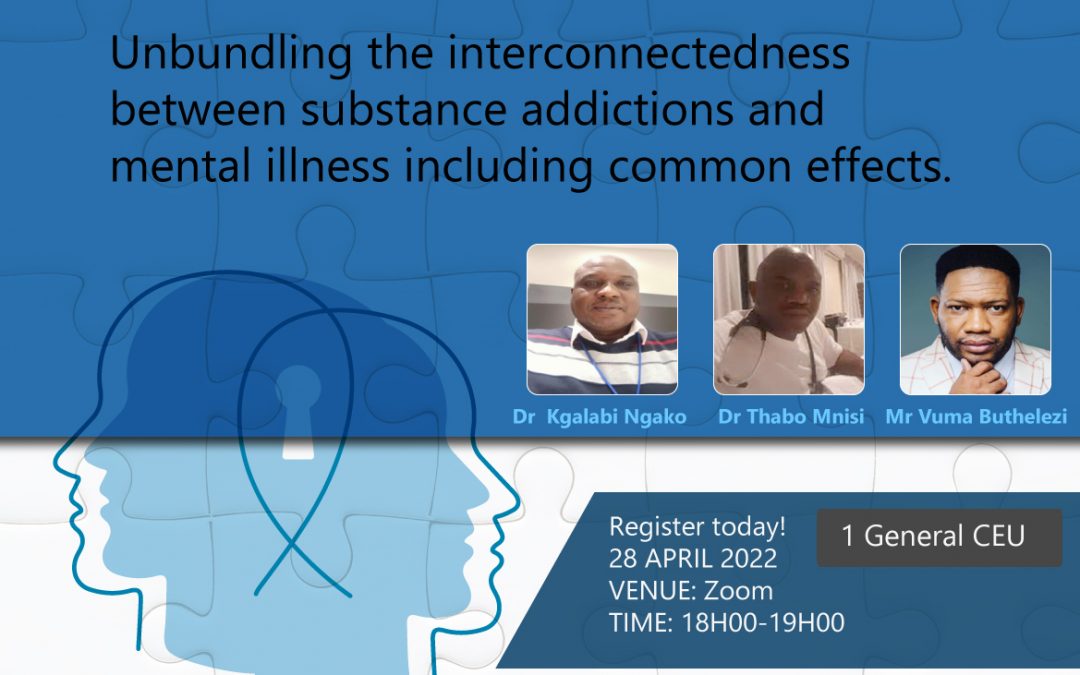
Purpose: To have a roundtable discussion that explores the interrelatedness and the network effects of substance abuse and mental illness. Mental illness and addiction both result in manifestation of behavioural, psychological, or bio-neurological dysfunction in an individual. In an article by Hanna Ritchie (2018), it is estimated that around one billion people globally have a mental or substance use disorder. Mental health can incorporate a range of different but sometimes connected disorders such as depression, anxiety, bipolar, eating disorders, schizophrenia, and alcohol and drug use disorders.
Problem Statement: The subtleties of signs and symptoms of mental illness and addiction might lead to misdiagnosis or dual diagnosis in psychotherapy as they both present with cognitive and psychoneurological impairments. A need to understand dual diagnosis and systematic review of outcomes in therapeutic settings.
Motivation for the Discussion: The dialogue seeks to create a discourse for mental health discussion on psychological, biological and neurological effects of substance abuse. The prevalent use of over the counter prescriptions/ medications to hard-core street drugs such as “woonga and nyaope” has created a dangerous ground for mental health problems in both urban and rural areas in South Africa. The effects of substance dependency have a resultant susceptibility to personality, cognitive, mood and mental health disorders including death. These addictions alter brain composition and function, genetic vulnerabilities, cause psychosocial dysfunction and exposure to stress or trauma. Furthermore an upsurge to substance excess use/abuse lead to psychological ill health, anxiety, criminal activities, violent behaviour and suicide. There is a need for contemporary clinical psychologists to raise the standard in treatment modalities. The rising epidemic and the indications of abusers getting younger and younger, makes an opportunity for clinical psychologists in South Africa to engage and bring about diverse treatment modalities. The ripple effects of substance abuse from individual to families and communities calls for an empirical focus and adaptation for practitioners to have a broader therapy focus.

Dr Kgalabi Ngako is a Deputy Director at National Department of Health dealing with Policy for substance abuse. Previously a deputy director responsible for monitoring and evaluation and as a project manager in South African Medical Research Council ( Alcohol , Tobacco and other drug Research Unit. He had publications on substance abuse in peer reviewed scientific journals Mr Ngako has a Doctorate in Health studies from UNISA and Certificate on media based prevention science from Claremont Graduate university

Dr Thabo Mnisi is a Specialist Family Physician at 1Military Hospital. He holds the following qualifications: MBChB, FCFP, M. Med (Fam Med). PGDDS, PSc. Med Law. MBL. Dr Mnisi is involved in research unit on HIV. He is also teaching and doing private clinical work. He has been involved with communities on mental health, substance abuse, youth development and a speaker in different forums covering diverse topics.

Mr Vuma Buthelezi has been a radio presenter and on air presenter since 2008 to date; from Durban youth Radio to Gagasi FM. He is also a lecturer at Creative Arts College Digify Africa media and a vice tutor. An artist , DJ, master of ceremonies, Magazine editor and radio presenter for diverse sessions: Breakfast; midday; sundowner; mix, urban; and eclectic drive. His interest involve engaging with listeners on topics that affects communities. He create awareness on many issues including mental illness.
This year’s World Autism Day comes on the heels of changes made in the newly published Diagnostic Statistical Manual-Fifth Edition-Text Revision (DSM-5-TR), to clarify, amongst other things , that “persistent deficits in social communication and social interaction across multiple contexts, as manifested by the following: deficits in social-emotional reciprocity, in nonverbal communicative behaviors used for social interaction, and in developing, maintaining and understanding relationships” are all integral to the diagnosis of Autism Spectrum Disorders.
The use of the puzzle piece has been heavily criticised within as reinforcing negative views of people on the spectrum . These negative views of Autism Spectrum Disorders are often driven by the curative approach to Autism Spectrum Disorders , rather than focusing on increasing strengths for people who have been diagnosed with Autism Spectrum Disorders. This is historically linked with the biomedical model which focuses on ameliorating disease then psychosocial adjustment.
For many psychologists, our role is usually early in the life cycle of treatment often being that of diagnoses. However, psychologists can, and should have a role beyond the diagnostic stage, fundamentally in assisting parents adjust to ways in which they could assist their children who have been diagnosed with Autism Spectrum Disorders. This moves away from only focusing on diagnosis towards equipping parents with ways that enhance child’s skills, removes the focus on the child towards their social environment. In addition, focusing on naturing the skills of the child, rather than the curative approach that has dominated Autism Spectrum Disorder treatment.
Beyond the parental assistance and the focus on strengths for people on the spectrum, there is much misinformation about Autism Spectrum Disorders especially during the Covid-19 pandemic, with a rise in the anti-vax movements having sparked renewed anti-vax movements linked to autism. Psychologists are well positioned to mitigate the spread of misinformation and even falsehoods about the vaccines and Autism Spectrum Disorders.
On this world Autism Awareness Day, it is important that psychologists rise to the challenge of tackling misinformation that continues to cause harm to families and people on the spectrum, including the deficit discourses around people on the spectrum. The role of psychologists should be taken outside the therapy rooms to influence policy about how best to offer treatment for people on the Autism Spectrum Disorders.

The CaSP Division invites its members to apply for the Seed Grant competition – which seeks to fund ONE innovative, practical, and sustainable community engagement project (R5000).
Do you have an idea to promote mental health and psychosocial well-being during and beyond the pandemic?
You are invited to submit a community project proposal aimed at improving mental health within a particular community group. Your concept should epitomise the essence or values of Community Psychology In other words, we are not simply looking for an ‘outreach’ community project – but a project that really demonstrates Community Psychology in action.
You can apply on behalf of your students.
Hurry, Entries close the 10th of May, 2022!
Queries: casp@psyssa.co.za

I would like to focus on three seemingly simple but core approaches to doing grant proposals in general, and the CaSP seed grant specifically:

I was thrilled when I saw the CASP seed grant advertised in 2020. I had done some previous work with an informal settlement educational project in Cape Town – the South
African Educational Project (SAEP) – and knew they were hoping to expand their creative writing classes for youth, but lacked support and resources. What a perfect opportunity
to try and help!
I did several things which I think contributed to my successful application;
So
(a) I had a close read of the CASP grant criteria before rushing into applying, as I knew I could optimise my chances of success, if I paid close attention to *all* of the information contained within the Seed grant call, especially the terms and conditions.
(b) I made a note that the community project aim had to have a mental health and psychosocial impact AND needed to be sustainable beyond the initial seed funding.
(c) I discussed it with the organisation to make sure it was what THEY wanted.
(d) I then addressed *every* section as best I could, in the application form, including what I thought was ‘novel’ or different, about my proposed project.
The funding supported a Facing Covid through Creative Writing Project with the SAEP and resulted in a week of socially distanced group writing tasks and discussions. This
was often moving and difficult, as attendees revealed personal, familial and community struggles to survive, but much shared help and supportive resilience as well as laughter
was shared too. We finished each workshop with a discussion on African Speculative Fiction (SF) and attendees were tasked with writing a story of what a ‘better South Africa in 2040’ might look like. Winning stories were adjudicated by an independent SAEP ‘judge’ and awarded a cash prize, certificates – and the best story A South African Coffee Shop Scene was published in The Mail & Guardian ‘Thought Leader.’
Here is my article on Covid in Science Fiction Writing.

The CaSP inaugural Seed Grant Competition caught my eye at a time when I sought to engage in work that would be beneficial for mental health and impact positively on the lives of young people. I had just joined PsySSA and the CaSP division as a student member and was eager to apply for the grant. Despite the daunting thought of coordinating an intervention, I let my heart lead the way and applied for the opportunity. The competition’s ethos of fostering mental health through community projects, inspired me to make a difference.
The grant requirements of a novel and sustainable initiative aimed at community mental health and psychosocial wellbeing stood out for me. The criteria aided in further reflection on my idea of a poetry and essays club. I envisioned the implementation of the club within a context where there was a need for the intervention. I aimed to empower students to take ownership of the initiative and determine the form it would take and how to improve in the future. Fortunately, Speak the Word was the winning application for the 2019 Seed Grant Competition.
The funding enabled the project to commence as the beneficiaries received resources such as pens, journals and book vouchers. The students showed great interest and commitment. After several sessions, they became comfortable, led the meetings and were able to share their thoughts, emotions and hopes. And looking back at the positive outcomes, the inception of Speak the Word was worthwhile