

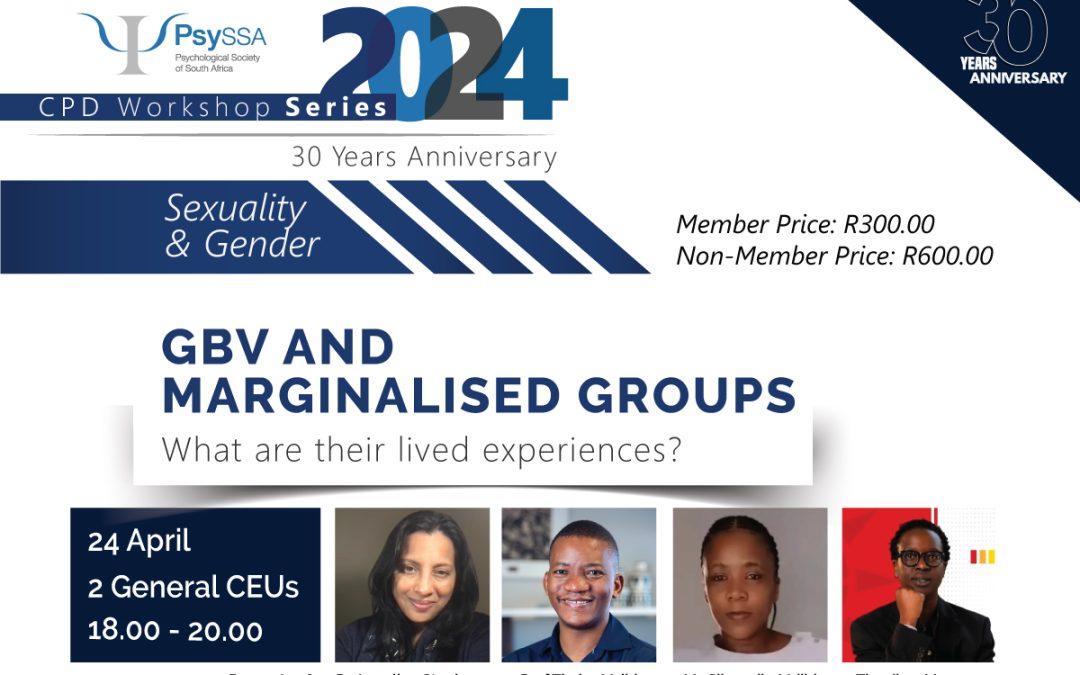
Workshop 2: GBV and Marginalised Groups: What are their lived experiences?
About this workshop:
As South Africa gears up for its seventh democratic general elections, we pause to reflect on changes on the ground. Several initiatives at national and provincial levels have been implemented, that seek to address the persistent reality of violence. Yet, violence continues to define the society that we create and live in.
This workshop focuses on the lived experiences of violence, specifically gender-based violence and sexual violence among gender and sexually non-conforming persons. We take a personal, intimate look at the experiences of violence among marginalised persons. We reflect critically at the dynamics at play and ask what has changed and what needs to change. What role can/should psychologists play as practitioners and activists in contributing towards a violent-free society?
What to expect:
- A survivors account of GBV by Sibongile Mdibi
- Understand the intersection of (S)GBV, gender and sexualities with a focus on masculinities by Prof Thabo Msibi
- Gain insights into policy implementation and GBV programmes with Thenjiwe Mswsane
- Shared experience by Dr Angeline Stephens on working with SGBV survivors
- Participate in an interactive session where your thoughts and experiences contribute to the discussion.
Meet our Presenters!

Angeline Stephens, PhD (she/her) is a psychologist working in student mental health at the University of KwaZulu-Natal. She is also an executive member of the Sexuality and Gender division of the Psychological Society of South Africa (PsySSA). Her work is informed by feminist, critical and decolonial approaches to psychological praxis that recognise the interconnectedness between persons and contexts. She is particularly interested in the intersections of gender, sexuality, violence, citizenship, and work with marginalised people. Her current work focuses on trauma and healing from sexual and gender-based violence.

Thabo Msibi is the Deputy Vice Chancellor for Teaching and Learning and a professor of Curriculum Studies in the School of Education at the University of KwaZulu-Natal. He completed his Master of Education degree at Teachers College: Columbia University and obtained his PhD in Education from the University of Cambridge. He has published research in South African and international journals and books and is author of the book Hidden sexualities of South African Teachers: Black male educators and same-sex desire. He has also co-edited a book entitled Gender, Sexuality and Violence in South African Educational Spaces, with Deevia Bhana and Shakila Singh. He also is an associate editor in The Oxford Encyclopedia of Gender and Sexuality in Education. Prof Msibi is a recipient of a Distinguished Teacher’s Award from the University of KwaZulu-Natal and is an NRF P-rated scholar. He is also the recipient of the Early Careers Distinguished Alumni Award, awarded by Teachers College: Columbia University and the Chen Yidan Visiting Global Fellow, awarded by Harvard University. Prof Msibi also received the inaugural Human Sciences Research Council Young Scholars Medal for the Social Sciences and Humanities in 2019. In 2022, Prof Msibi was appointed by the Basic Education Minister to serve on the sixth Umalusi Council. At the University of KwaZulu-Natal, he also leads the University Staff Doctoral Programme offered via the United States-South Africa Higher Education Network.

Sibongile Mdibi, known as Sbo MaDlamiini, is a mother of three girls and three grandchildren. She is a survivor of GBV. She is the author of the book ‘No one marries to divorce’ and was one of 16 women who contributed to a book of poems, This is how we mend our bones, which was facilitated by Masoodah Mohamed. Despite the hardships that she has endured, Sbo manage to study and obtained a BA degree in Health Science and Social Services, specialising counselling. Sbo is very passionate about working with families who experience GBV, especially those living in deep rural areas. She offers counselling support and seeks to empower and encourage families to speak out against GBV.

Thenjiwe Mswane is SGBV Strategic Coordinator at the University of Kwa-Zulu Natal. Before taking up this role, Thenjiwe worked as the Education Campaigns Officer at Wits University’s Gender Equity Office (GEO). Thenjiwe has also worked for the Centre for the Study of Violence and Reconciliation (CSVR), Livity Africa, Kwa-Zulu Natal Research Institute for TB and HIV (K-RITH), and the Centre for Aids Research In South Africa (CAPRISA). Thenjiwe is the author of the Sunday Times Literary Awards shortlisted novel All Gomorrahs Are the Same (Blackbird Books, 2021) and has written for numerous publications including HOLAafrica! the GALA Queer Archives Queer Realness.


