CEP Divisional Webinar 2

CEP Divisional Webinar 2

CEP Divisional Webinar 2

Climate justice for traditional communities with a psychological lens. What do you think?

About this Webinar

Date: 21 May 2024

Time: 15h00-16h00

Platform: Teams

In this webinar we propose a reflection on the social and territorial organization of traditional peoples and communities in Brazil, arguing that environmental justice for these groups is essential for the maintenance of socio-biodiversity on the planet and to mitigate the environmental and climate impacts that affect our historical time. Therefore, we will discuss new lens for discuss environmental issues, taking into account the possible contributions of psychology, in dialogue with anthropological science, to the defence of territorial rights. In this sense, we will take into account some historical experiences of territoriality, highlighting how it plays a fundamental role in understanding the world, in the epistemological practices, sociality, and housing of communities such as Indigenous peoples, Quilombolas, and other traditional groups, which challenge the universality of binomial concepts such as people/environment, nature/culture, rural/urban, etc. We defend the necessary incorporation of an ethical-political dimension in its work. Finally, since we acknowledge the urgency of the demands posed by a development agenda that values human dignity and other forms of life on our planet, encompassing a complex processes that involve global challenges, particularly in the contexts of the periphery of the global South, we believe it is possible to draw parallels between the Brazilian and South African realities.

See the link below to join!

Meet our Presenter

Prof Raquel Diniz: PhD (2015) and Master (2010) in Psychology at the Federal University of Rio Grande do Norte (UFRN). Received funding from the Brazilian National Council for Scientific and Technological Development (CNPq) to develop a doctoral internship at the Research Group in Social, Environmental and Organizational Psychology (PsicoSAO/University of Barcelona) (2013-2014). Researcher at the Person-Environment Study Group (GEPA/UFRN), and coordinator of the Observatory for Latin American Environmental Psychology (obPALA/UFRN). She works in teaching and research at undergraduate and postgraduate levels in the areas of Epistemology and Research Methodology in the Human Sciences, focusing on critical and participatory perspectives. She also works in the area of Environmental Psychology with the themes of environmental issues and sustainable lifestyles, plural territorialities in contexts of traditional peoples and communities, and the history and developments of Environmental Psychology in Latin America. She worked as an assistant professor at the University of International Integration of Afro-Brazilian Lusofonia (Unilab), marking her approach to post/anti-colonial thinking and southern epistemologies. She is currently an assistant professor in the Department of Psychology at the Federal University of Rio Grande do Norte (UFRN) and at the Postgraduate Program in Psychology (PPgPsi/UFRN).

 

DRM Divisional Webinar

DRM Divisional Webinar

Talanoa Methodology for Transformative Climate Action

On 9 May 2024, Dr Olivia Yates joined Fatima Peters for the first DRM Webinar of 2024, to discuss Dr Yates’s use of talanoa, a Pacific qualitative method/ology, in collaborative research on climate migration from Tuvalu and Kiribati to New Zealand. Dr Yates contextualised talanoa and explored the nuances of its use by non-Pacific peoples, like herself.

Dr Olivia Yates (she/her) is a New Zealand community psychologist with English, Irish and Scottish Ancestry. Her action-oriented PhD was focused on Pacific climate mobility and related policy solutions. She currently works for World Vision New Zealand in climate change advocacy as a policy and research advisor.

You can access the webinar recording on the DRM You Tube Channel here:


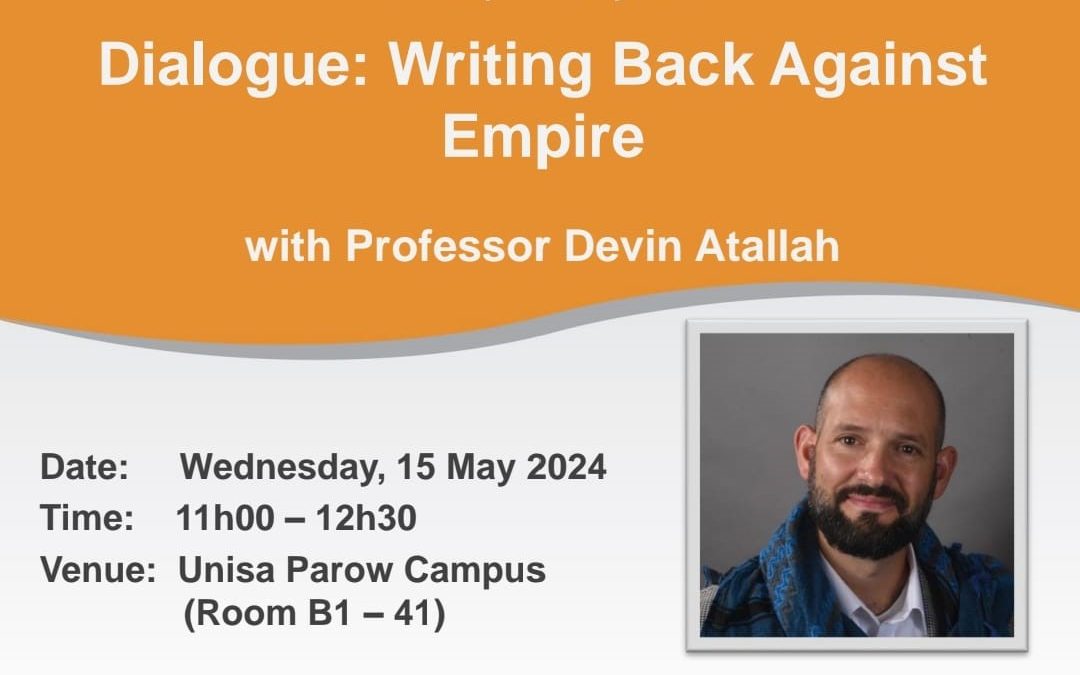
Dialogue: Writing Back Against Empire

Dialogue: Writing Back Against Empire

The Institute for Social and Health Sciences cordially invites you to a Dialogue: Writing Back Against Empire.

Presenter: Prof Devin G. Atallah

Date: Wednesday, 15 May 2024

Time: 11h00 – 12h30

Venue: Unisa Parow Campus (Room B1 – 41)


Meet our Presenter!

Devin George Atallah is a Palestinian from the shataat/diaspora currently living and working in Boston on the lands of the Wampanoag, Massachusett, Nipmuc, and other Indigenous peoples of the Northeast of Turtle Island (in the nation-state of USA) with his beloved children and community.  Atallah’s Indigenous roots return to the mountains, trees, and kinships of the village of Beit-Jala in occupied Palestine. Atallah is an assistant professor of psychology at the University of Massachusetts Boston. He is a researcher, scholar, activist, and healer dedicated to transnational decolonial movements, and Palestinian liberation. Atallah’s work focuses on decolonial psychology, and builds off his extensive community and clinical psychology experience. He strives towards contributing to understandings of decolonial resistance in Palestine while drawing linkages to movements and critical knowledges of Black and Indigenous communities transnationally, studying intergenerational trauma, grief, and revolutionary healing in the face of settler colonial violence and genocide. Atallah is author of the recent publications, “CURCUM’s Trees: A Decolonial Healing Guide for Palestinian Community Health Workers” available online with MayFly Books, which Atallah co-authored with colleagues in Palestine and the shataat; and “A World Without Palestinians” which he co-authored and is published in Mass Review; and “Beyond Grief: Decolonial Love for Palestinian Life” published in the Journal of Palestine Studies.

The 17th Biennial SACNA Conference

The 17th Biennial SACNA Conference

The 17th Biennial Conference of the South African Clinical Neuropsychological Association (SACNA) will be held at The Capital Menlyn Maine, Conference Centre in Pretoria from 18 – 21 September 2024.

The conference focus is on Neuropsychology: Looking to the future.

SACNA invites you to submit abstracts for oral and poster presentations, and symposiums, on all topics associated with the field of neuropsychological assessment, forensic neuropsychology, neuropsychological treatment and rehabilitation, and the issues unique to neuropsychological practice and research in South Africa.

Find out what’s new in neuropsychology, participate in discussions, share your experiences, engage with old colleagues and meet new ones, have fun with the social programme. Are you steeped in neuropsychology or simply curious? Then you don’t want to miss this!

The Pre-conference workshops take place on Wednesday 18 September. The Conference takes place on the 19 – 21 September 2024.

Abstract Submission Deadline: 31 May 2024

Hospice Week: 5-11 May 2024

Hospice Week: 5-11 May 2024

Hospice Week honours the compassionate care and support provided to individuals and families facing life-limiting illnesses. It’s a time to recognize the dedication of hospice workers, volunteers, and caregivers who offer comfort, dignity, and respect during one of life’s most challenging journeys. Let’s celebrate their invaluable contributions