PsySSA SD National Mentorship Programme 2025 Mentor Applications are OPEN!

PsySSA SD National Mentorship Programme 2025 Mentor Applications are OPEN!

National Mentorship Programme 2025 Mentor Applications are OPEN!

Calling all psychology postgraduates and professionals! The Psychological Society of South Africa (PsySSA) Student Division has opened mentor applications for its National Mentorship Programme 2025.

The National Mentorship Programme is transformative, imparting practical and academic knowledge and skills to mentees with a passion for Psychology. It’s the opportunity of a lifetime, so send your applications today as we have a limited number of positions.

The National Mentorship Programme is a highly regarded year-long, PsySSA-endorsed initiative that prides itself on consistent excellence. The Programme strives to promote personal and academic growth in mentees with the organic transfer of knowledge. Each mentee is paired with a mentor for the duration of the Programme. The assignments are relevant to psychology’s current field and science landscape. Mentors share their experiences and knowledge, and the assignments encourage and expand critical thinking, the application of knowledge in theory and practice, and topics that pertain to the current milieu of psychology.

This is a remarkable opportunity to join a well-respected, prestigious programme.

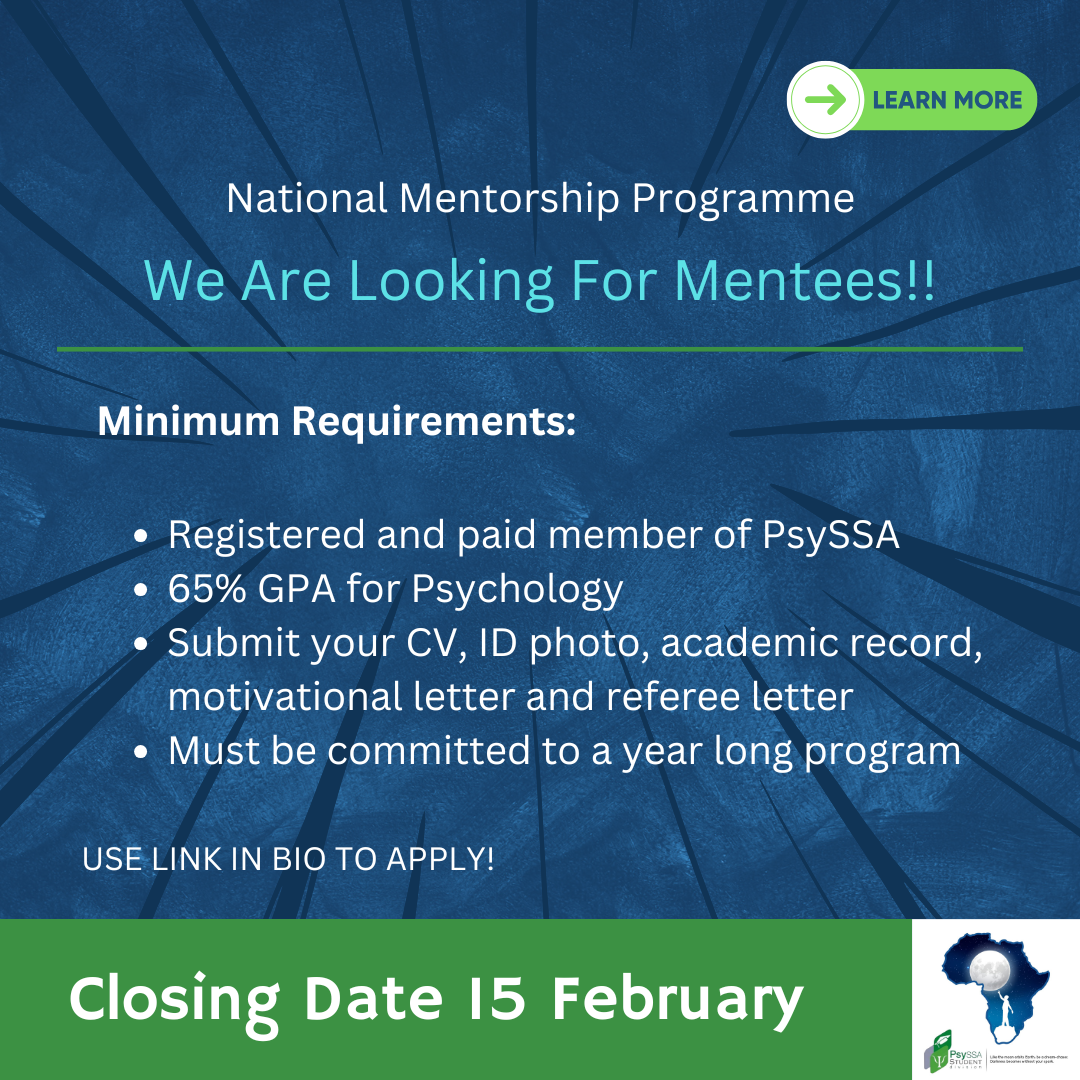
Mentor positions pertain to individuals who have completed Psychology Honours, are currently studying Master’s, post-Master’s, or Psychology practitioners.

Applications close on 15 February 2025.

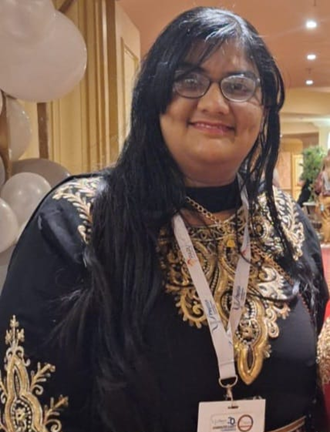
PsySSA Intern, Ms Indira Pillay, wins AOSIS Award

PsySSA Intern, Ms Indira Pillay, wins AOSIS Award

Congratulations to PsySSA Intern Member, Ms Indira Pillay, whose article, “The impact of inequality and COVID-19 on education and career planning for South African children of rural and low-socioeconomic backgrounds,” has been awarded the prestigious AOSIS Award for achieving the most citations in the four-year period (2020–2023)

Click the button below to view the insights into the ‘African Journal of Career Development’ Editor’s Choice article:

PsySSA SD National Mentorship Programme 2025 Mentee Applications are OPEN!

PsySSA SD National Mentorship Programme 2025 Mentee Applications are OPEN!

PsySSA SD National Mentorship Programme 2025 Applications are OPEN!

Calling all psychology postgraduates and professionals! The Psychological Society of South Africa (PsySSA) Student Division has opened mentee and mentor applications for its National Mentorship Programme 2025.

The National Mentorship Programme is transformative, imparting practical and academic knowledge and skills to mentees with a passion for Psychology. It’s the opportunity of a lifetime, so send your applications today as we have a limited number of positions.

The National Mentorship Programme is a highly regarded year-long, PsySSA-endorsed initiative that prides itself on consistent excellence. The Programme strives to promote personal and academic growth in mentees with the organic transfer of knowledge. Each mentee is paired with a mentor for the duration of the Programme. The assignments are relevant to psychology’s current field and science landscape. Mentors share their experiences and knowledge, and the assignments encourage and expand critical thinking, the application of knowledge in theory and practice, and topics that pertain to the current milieu of psychology.

This is a remarkable opportunity to join a well-respected, prestigious programme.

Mentor positions pertain to individuals who have completed Psychology Honours, are currently studying Master’s, post-Master’s, or Psychology practitioners.

Applications close on 15 February 2025.

16 Days of Activism for No Violence Against Women and Children – 25 November-10 December 2024 (3)

16 Days of Activism for No Violence Against Women and Children – 25 November-10 December 2024 (3)

Global and Local Context of Gender-Based Violence


By Mrs Rekha Kangokar and Ms Shaazia Patel – Executive committee members of RCP

The United Nations describes Gender-Based Violence (GBV) as “Any act of gender-based violence that results in, or is likely to result in, physical, sexual or psychological harm or suffering to women, including threats of such acts, coercion or arbitrary deprivations of liberty, whether occurring in public or private life” (WHO, 2024).
In South Africa, where GBV is described as the “second pandemic” by President Cyril Ramaphosa, the government has introduced legislative reforms to protect women through The National Council on Gender-Based Violence and Femicide Bill, enacted in May 2024, which aims to ensure safety for women and children (SONA, 2024). Despite these efforts, GBV remains alarmingly high, with reports indicating over 42,780 rape cases in 2022-2023 alone (Commission for Gender Equality, 2024).
The World Health Organization (WHO) emphasizes that ending violence against women is achievable if action is taken collectively (WHO, 2024). The World Health Organisation (WHO) asserts that “Ending violence against women is possible, but only if we act together, now.” They are now doing 16 days of activism against gender-based violence from November 25 to December 10, 2024 (WHO, 2024).. WHO’s ongoing “16 Days of Activism” campaign highlights that GBV is a global issue, exacerbated in areas of displacement and conflict. Survivors face significant barriers to accessing healthcare, particularly mental health support, due to stigma and patriarchal norms (WHO, 2024)..
Recently, there has been a phenomenal increase in advocacy and awareness for GBV, with advocates bringing cases to light through film. In October 2024, Netflix released a Hindi film – Do Patti which explores the pervasive issue of GBV through the lens of twin sisters, Saumya and Shailee. The film showcases the complex familial, psychological, and emotional factors that impact and influence Saumya and those closest to her. Saumya’s story reflects the experiences of countless women who endure abuse in silence, trapped by societal expectations and personal guilt. The film highlights how deeply trauma can impact individuals, particularly within the context of domestic abuse, cultural pressures and patriarchal dominance. If it were not for one woman in law enforcement, Saumya would have possibly suffered the same fate as her victimised mother.
The summary formulation presented below is for educational purposes and serves to highlight key aspects that are common in cases of GBV against women. This article and its contents do not serve as a medical or professional mental health opinion or diagnosis. If you or anyone you know might be experiencing any of the points below, we strongly urge you to reach out for support via the helplines and contact centres found at the end of this article.
A Summarised Formulation Employing a Person-centred Methodology for Saumya Pundir’s Character in Do Patti (2024):

Sources of Trauma Experienced by Saumya
• Domestic Abuse
• Family Trauma
• Psychological Impact
• Post-Traumatic Stress
• Internal Conflicts

Person-centred Interventions – This approach is especially relevant for trauma survivors, who are grappling with emotional wounds and self-blame. The goal is to create a safe therapeutic environment, allowing one to process her feelings and heal.
To provide Saumya with therapeutic support, a trained and qualified psychologist would likely focus on:
• Creating a supportive environment
• Building self-compassion
• Reconnecting the victim with her strengths
• Gradual trauma processing

By considering the above case in the South African context, GBV infiltrates the social, political and economic structures within a patriarchal society, and power inequalities which include gender, sexuality and race. Patel et al. (2020) report that the most affected by violence and inequalities in South Africa are women and children (as cited in Mazana, 2022), and it is believed that while exact statistics are lacking on the rate of sexual based GBV in South Africa, there is certainty that a woman is killed every 3 hours in our country (Wilkinson, 2020). The role of law enforcement and strong legislation is another core theme of the film and this is a crucial element to combating GBV and facilitating empowerment and support to affected individuals. Various Bills passed by the government are implemented to protect against domestic abuse, trauma, and mental health. The National Strategic Plan on GBV includes extensive legal reforms, psychological support, and the establishment of Thuthuzela Care Centres (TCCs), which provide comprehensive services to survivors, from medical care to legal assistance. There are currently 63 centres across the country (SONA, 2024).

Support Services and Interventions
South Africa has implemented various measures to support GBV survivors:
• Thuthuzela Care Centres (TCCs) offer holistic services, including medical exams, legal support, and counselling. https://www.gov.za/sites/default/files/gcis_speech/THUTHUZELA%20Care%
20Centres.pdf
• TEARS foundation – TEARS believes that responding to sexual violence in our society and holding perpetrators to account starts with supporting survivors in ways that are respectful of their dignity, healing, and choices. HELPLINE: 08000TEARS | 0800 083 277
• The Warrior Project aims to address Violence based on gender and Domestic Violence by providing information and access to help.
• People Opposing Women Abuse (POWA) – is a South African, feminist, women’s rights organisation established in the 90’s. POWA provide free counselling, sheltering, skills development opportunities, legal services, sector capacity building and  strengthening as well as public awareness and education to assist abused women. POWA also engages in advocacy to ensure the realisation of women’s rights and thereby improve women’s quality of life.
• She Conquers – is a three-year national campaign with an aim to improve the lives of adolescent girls and young women in South Africa. https://sheconquerssa.co.za/sexual-gender-based-violence/
• WHO also provides training for healthcare providers on managing cases of rape and intimate partner violence, especially in crisis settings.
• Gender-Based Violence resource guide – https://www.gov.za/sites/default/files/images/GBV%20_booklet.pdf
• SADAG (South African Depression and Anxiety Group) and Lifeline provide counselling services, helping survivors access mental health care.

A recent article by Mail and Guardian, titled Gender-based violence affects one in three women regardless of income group, reports that shelters and homes are no longer safe havens for women (Comins, 2024). Women mention that the only “safe space” they are lucky to have is their workplace (Comins, 2024). The importance of showcasing this film also speaks to the grave extent of GBV across the globe and appropriate depictions such as films and social media may become tools of change and empowerment. Integrating movies such as Do Patti in articles brings awareness by not only shedding light on the employed and unemployed individual suffering but also highlighting the urgent need for systemic change and mental health support for GBV survivors worldwide.

References:
Comins, L. (2024) Gender-based violence affects one in three women regardless of income group. Mail&Guardian. Retrieved from https://mg.co.za/news/2024-08-28-gender-based-violence-affects-one-in-three-women-regardless-of-income-group/
Mazana, N. N. (2022). Bayasibulala:# AmINext? an analysis of Instagram as a tool for activism against Sexual Gender-Based Violence in South Africa. http://hdl.handle.net/11427/37515
Wilkinson, K. (2020). Five facts about femicide in South Africa. News24. Retrieved from: https://www.news24.com/news24/5-facts-about-femicide-in-south-africa-20190905
https://www.stateofthenation.gov.za/priorities/making-communities-safer/gender-based-violence#:~:text=New%20Legislation%20to%20fight%20GBV,law%20on%2024%20May%202024
https://www.who.int/campaigns/16-days-of-activism-against-gender-based-violence/2024
https://www.parliament.gov.za/storage/app/media/OISD/Reports/Commission_for_Gender_Equality/2024/01-08-2024/GBV_Index_Report.pdf
https://www.who.int/news-room/fact-sheets/detail/violence-against-women

Message from the PsySSA President

Message from the PsySSA President

“I am deeply honoured that you have entrusted me to be the president of the Psychological Society of South Africa during our 30th anniversary year. Past presidents have provided sterling leadership, and my role is made so much easier because I stand on the shoulders of strong predecessors who have worked tirelessly to advance South African Psychology as a science and profession that is locally and globally relevant. There can be no doubt that when we consider the vibrancy and excellence of scholarly work embodied in and through Psyssa and our recent October conference, that (South) African Psychology is strong and responsive to societal needs. We can reimagine different ways of seeing Psychology without always completely throwing out that which is globally considered to be Psychology. I look forward to this term and working with all of you, especially the PsySSA divisions and local and global collaborators who so ably, help us to enact our vision for Psychology in South Africa and beyond.”

Prof Ronelle Carolissen
PsySSA President

Meet the 2025 Executive Committee

Prof Ronelle Carolissen

President

Prof Ronelle Carolissen is a clinical psychologist and full professor of Psychology in the Department of Psychology at Stellenbosch University. She is an NRF rated researcher and the current president of PsySSA (Psychological Society of South Africa) Her predominantly qualitative research expertise and publications explore transformation in higher education. Her research focuses on decolonial feminist pedagogies and critical, decolonial community psychologies in higher education contexts, highlighting experiences of marginalised university students and academic staff. She serves on South African and international journal editorial boards that intersect in the fields of education and community psychology and serves on managing boards, most notably the SAMRC (South African Medical Research Council 2019-present). She holds the 2016 Psychological Association of South Africa award for excellence in teaching psychology in higher education. She was a visiting professor at Stanford University’s Bing overseas community engagement programme in Cape Town (2015-2019) and is a Fulbright research scholar (2021-2022) alumni and a member of ASSAF (Academy of Science of South Africa). She is the Chief Editor of PINS (Psychology in Society).

Prof Jace Pillay

President-Elect

Prof Jace Pillay is a registered educational and counselling psychologist and the South African Research Chair in Education and Care in Childhood in the Faculty of Education at the University of Johannesburg. In February 2024 he was appointed a UNESCO Chair in Mental Health and Psychological Support for Teachers and Learners in SA. His previous positions at UJ were the Head of the Department of Educational Psychology and Vice Dean in the Faculty of Education. Currently, he heads a research team focusing on the mental health of learners and teachers as well as psychosocial support in schools.

Prof Mercy Tshilidzi Mulaudzi

Past President

Prof Mercy Tshilidzi Mulaudzi is a Professor of Psychology, and Executive Dean in the Faculty of Health Sciences at the University of Venda. She has supervised Masters and doctoral students, and has served as external assessor for students in national and international universities. Her interests are in Mental Health, HIV and AIDS, Gender-Based Violence, and epidemiology. She has presented her research work in local, national and international conferences and some of those papers are published in national and international journals. 

Ashley van Heerden

Treasurer

Ashley van Heerden is an HPCSA registered Clinical Psychologist practicing in the Western Cape. She holds a Master’s Degree in Clinical Psychology and a Master’s Degree in Research Psychology. Ashley’s professional focus is on child development, and she has had extensive experience working with children, adolescents, parents and families across both public and private sectors. Beyond her clinical practice, Ashley has developed and implemented cost-effective human rights programmes within the South African context, under the auspices of the United Nations. She further holds a certification in Programme Management from the University of Geneva.  

Daniel den Hollander

Additional Member

Daniel Hilbrand den Hollander is a clinical psychologist with extensive experience in both public and private specialised mental health settings in South Africa. He currently is a community psychologist in private practise in Athlone specialising in trauma: interpersonal, complex and structural violence. He is currently the current chair of the South African Society of Clinical Psychologists Division of PsySSA. He is specifically interested in the effects of structural violence and developing South African Psychology.  He is passionate about cultivating and promoting empowerment and change: may it be in the therapy room, on radio, or at conferences.

Dr Pakeezah Rajab

Additional Member

Dr Pakeezah Rajab is a Research Psychologist and Psychometrist interested in executive functioning across the lifespan, academic and employee performance, and psychometric assessment development and evaluation. She joined the JVR Africa Group in 2016 and is currently the Senior Researcher in the Product and Research team. She is also a 2024 International Test Commission (ITC) Early Career Scholar.

Dr Kemoneilwe Momi Metsing

Additional Member

Dr. Kemoneilwe Momi Metsing is a registered psychologist and Senior Lecturer at UNISA, She is a Clinical Supervisor for Masters in Educational Psychologist Students and Interns, and an external examiner for Masters in Education Psychology.  She guides Master’s students in Educational Psychology, nurturing their growth as professionals. Dr. Metsing is committed to excellence in teaching, research, and community engagement. 

Dr Avivit Cherrington

Additional Member

Dr Avivit Cherrington is an educational psychologist with expertise in community development and system-level programmes for mental health and well-being. She is currently an independent consultant and a Research Associate with Nelson Mandela University, supervising postgraduate students aligned to the Chair for Critical Studies in Higher Education Transformation (CriSHET). Her research has focused on understanding and fostering well-being and hope from an Afrocentric lens, as well as promoting critical thinking and engaged humanising pedagogy in teacher education programmes to foster future teachers who are agents of transformative social change.

Prof Angelina Maphula

Additional Member

Angelina Maphula is a Clinical Psychologist and an Associate Professor in the Faculty of Health Science at the University of Venda. As an academic, her role involves teaching, research and supervision of post graduate students in the field of psychology. She has published more than 20 journal articles both nationally and internationally and is known for her impactful community engagement. Her research interest areas include Trauma, HIV/AIDS and mental health. A founder of Prof Angie Foundation – focusing on young people to bring practical solutions. She is currently doing her post-doctoral studies with UCLA in Los Angeles where her focus is on Trauma. She has served previously as vice chair in the DRM division. 

Dr Nick Malherbe

Additional Member

Nick Malherbe is a Senior Researcher at the University of South Africa’s Institute for Social and Health Sciences and the South African Medical Research Council–University of South Africa Violence, Injury and Social Asymmetry Research Unit. His research interests include violence, visual methods, and discourse.