Invitation for Qualified Practitioners to Submit Curriculum Vitaes

Invitation for Qualified Practitioners to Submit Curriculum Vitaes

 Invitation for Qualified Practitioners to Submit Curriculum Vitaes

Dear Stakeholder

The Professional Board for Psychology (PSB) invites suitably qualified practitioners to assist in the following roles:

  • Experienced Examiners, Moderators and Invigilators for PSB Board examinations. Click here for the requirements.
  • Suitably qualified evaluators for evaluation of educational and training institutions. Click here for the requirements. 

For submission and more information, please contact Ms Matshidiso Mogole of the Division: Education and Training at MatshidisoMo@hpcsa.co.za.

All the best.

The Professional Board for Psychology

De-Toxify Our Workplaces – June 2025

De-Toxify Our Workplaces – June 2025

As health professionals, it is not only incumbent on us to be role models of ethical behaviour and safeguard human rights, but to also to help build ethical and humane workplaces. This is after all where most working adults spend the bulk of their productive time. To enable positive outcomes, we need to upskill health care professionals in diagnosis and prognosis of toxic workplaces. We look at this topic through 3 lenses: individual, team and the organisation.

Defn: Toxic behaviour is behaviour that is harmful to an organization, including either its property, reputation, or people.

Toxic by its very nature implies that this behaviour is both contagious and bad for others. Prof Dylan’s Minors team showed that if someone is influenced by toxic colleagues, that person is then 50% more likely to become toxic, too. One Cornerstone On Demand report found that good employees were 54 % more likely to leave when forced to deal with a toxic co-worker.

 
Advertisement Disclaimer:
 
This is a paid advertisement. The content, views, and claims expressed are those of the advertiser and do not reflect those of PsySSA. PsySSA remains an independent, non-partisan organisation committed to ethical standards, social justice, and professional integrity. Want to advertise with us? Email info@psyssa.com.
Advertisement Disclaimer:
 
This is a paid advertisement. The content, views, and claims expressed are those of the advertiser and do not reflect those of PsySSA. PsySSA remains an independent, non-partisan organisation committed to ethical standards, social justice, and professional integrity. Want to advertise with us? Email info@psyssa.com.
PsySSA supports the International Day Against Homophobia, Transphobia, and Biphobia (IDAHOBIT) 2025

PsySSA supports the International Day Against Homophobia, Transphobia, and Biphobia (IDAHOBIT) 2025

Why communities matter in addressing prejudice

By the Sexuality & Gender Division of PsySSA

Stigma and discrimination against LGBTQIA+ (hereafter queer) people are often driven by community attitudes and practices. But what happens when communities come together to protect those who are vulnerable?

The International Day Against Homophobia, Transphobia, and Biphobia was created in 2004 to draw attention to the violence and discrimination experienced by lesbian, gay, bisexual, trans and intersex people, and all of those with diverse sexual orientations, gender identities or expressions, and sex characteristics.

It’s theme for 2025 is “The Power of Communities” and we write, as the Sexuality and Gender Division of PsySSA, to ask pertinent questions about the nature and role of “community” in both driving and addressing stigma and discrimination.

It’s important, firstly, to note that communities are varied and variable in South Africa, there is no single notion of “community” we can rely on. The idea of community is a social construct – it can be a place, a group of people with a common interest, a collection of actions based on shared expectations, values, beliefs and meanings between individuals, an “imagined” sense of belonging, easy to feel but hard to pin down.

Stigma towards queer people, through the lens of “community”, can be understood in two ways. Symbolic stigma can be seen as giving weight to the otherness, the “undesirability” of queer people; questioning their morality deems them unfit to be declared human and equal, as part of “our” community. Through this spoiled identity, harms towards queer people can be enabled and justified, and so instrumental stigma can be seen as those attitudes and actions which result in the physical distancing of queer people – by harming and ousting them “we” feel physically safer. One example of this is the way in which trans and gender diverse people are literally being declared persona non grata in the United States, as if their very right to exist is being challenged.

As a result, trans and gender diverse people are no longer seen as part of “the community”, as US citizens, as moral subjects. Not only is threat and impact symbolic, it is literal, as we see attacks on trans people, and queer people more broadly, on the rise globally.

But not all communities feel the same way. While the queer community (more accurately, “communities”) does not always see eye to eye, intra-queer allyship is critical in this moment and we should, as mental health practitioners, support LGBTQIA+ people to process internalised homo/trans/bi and intersex-phobias and see each other as part of a marginalised group that needs to hold each other together.

In addition to this, we, as mental health practitioners, need to contribute to work which destigmatises queer and alternate identities – we should be clear that anti-trans sentiment has already seeped into anti-gay and anti-lesbian projects. After queer people, conservative forces come for immigrants and other minorities, and this should be challenged.

Finally, as mental health practitioners we owe it to the families we work with to empower them to be advocates and allies for their queer kin. Research has shown that “conversion” practices begin with the family, who cannot cope with the stigma (their own and that of their community) around queerness. This is fixable, we have the skills and the knowledge to help families “reimagine” what a family is: people who are a proxy for the broader community of care, concern and connection. We really are stronger together than apart.

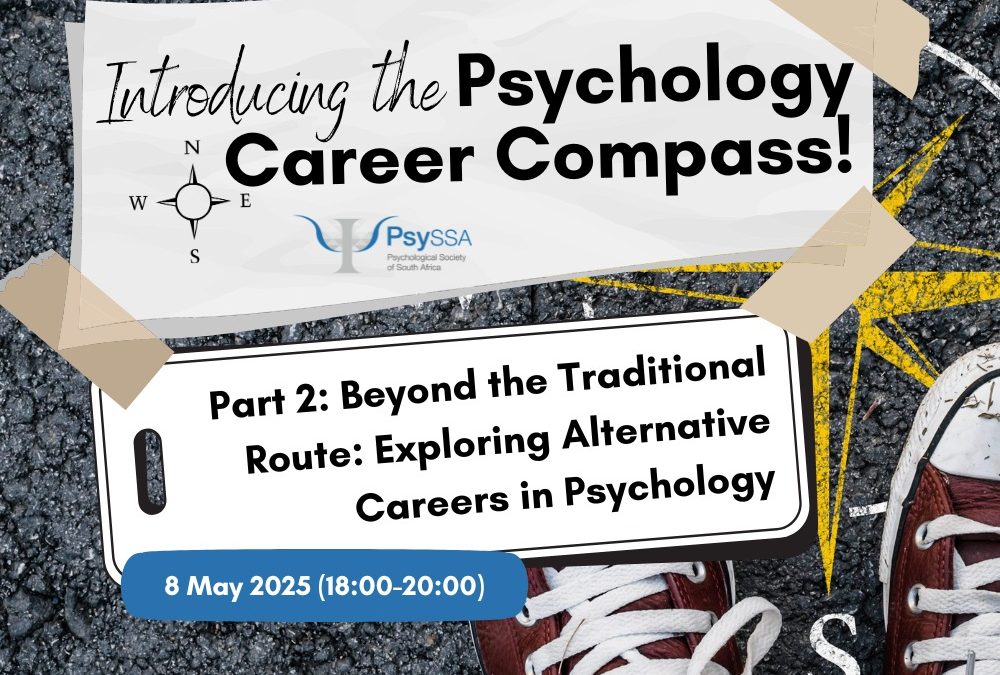
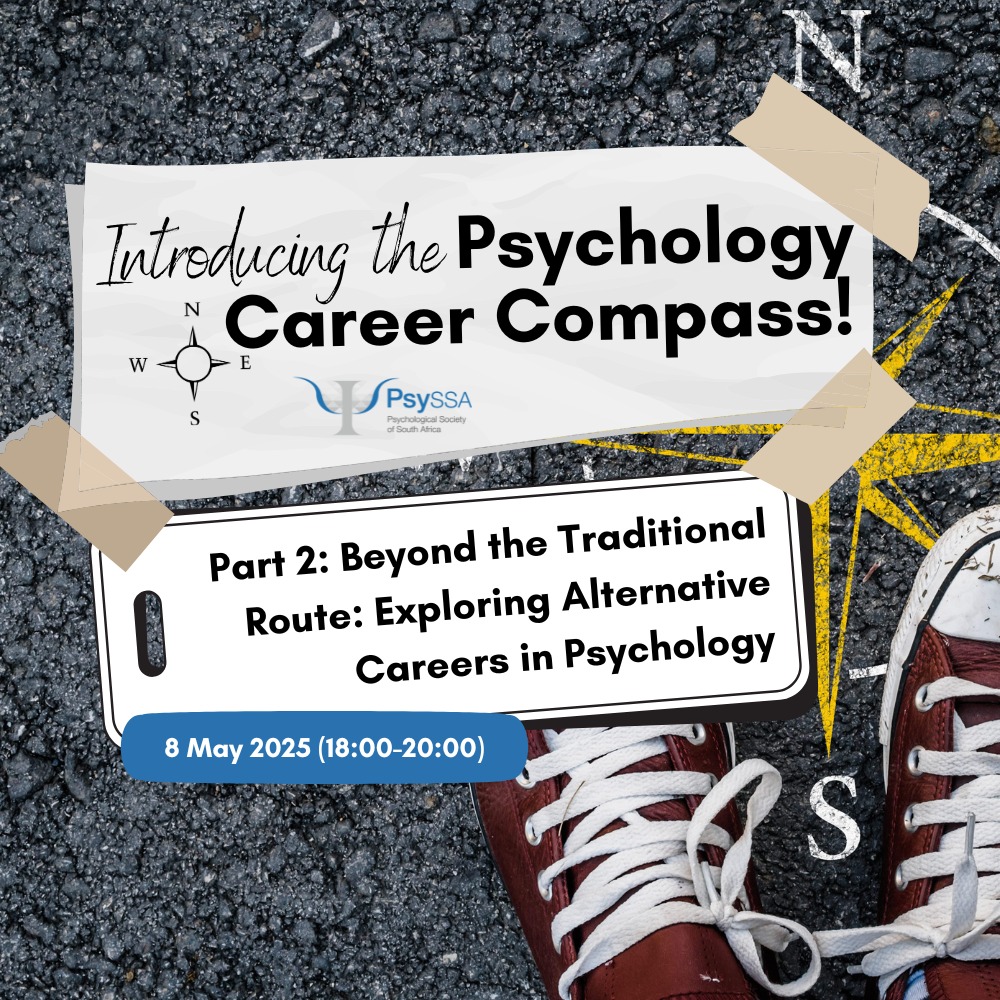
The Psychology Career Compass Series: Part 2 – Recording Out Now!

The Psychology Career Compass Series: Part 2 – Recording Out Now!

The Psychology Career Compass Series

Recording Now Available – Part 2

Recording Now Available: Psychology Career Compass Series – Part 2
Exploring Alternative Psychology Pathways Beyond Traditional Routes

PsySSA is excited to share the recording of Part 2 of our transformative Psychology Career Compass Series, held on 8 May 2025.

This session focused on the diverse, non-traditional career opportunities available to psychology graduates—particularly those navigating paths beyond Honours or following unsuccessful programme placements.

Whether you’re a student, recent graduate, or early-career professional, this workshop offers practical insights into how your psychological training can be applied across sectors like:

User experience and design
Behavioural science
Digital marketing
Corporate training
Research and innovation
…and more.

Our panel of dynamic professionals shared their unique journeys, highlighting the importance of adaptability, continuous learning, and creative career thinking in a shifting job market.

About the workshop

Not every journey in psychology follows a straight line—and for many, the path beyond Honours or unsuccessful programme placements can still lead to a fulfilling, impactful career. This workshop is designed for students and early-career graduates who are exploring how to apply their psychology skills in innovative and non-traditional contexts.

Join professionals who have transitioned into dynamic roles across industries such as user experience, digital marketing, behavioural science, corporate training, research, and more. Through engaging discussions, they will share how their psychology background positioned them for success, what additional skills or mindset shifts were needed, and how to leverage psychological training in fields outside of clinical or registered practice.

Meet the Presenters
Prof Ronelle Carolissen

Prof Ronelle Carolissen

PsySSA President

Leonie Vorster

Leonie Vorster

Chairperson: Division for Research and Methodology (DRM)

Dr Sharon Truter

Dr Sharon Truter

Neuropsychologist and Counselling Psychologist

Dr Momi Metsing

Dr Momi Metsing

PsySSA: Executive Member; Chairperson: Society for Educational Psychology of South Africa (SEPSA)

Kgomotso Sekhute

Kgomotso Sekhute

Vice-chairperson: The South African Society for Clinical Psychology (SASCP)

Barry Viljoen

Barry Viljoen

Vice-Chairperson: Psychology in Public Service (PiPS)

Dr Ewald Crause

Dr Ewald Crause

Interim Chairperson: Artificial Intelligence Division (AID)

Fatima Peters

Fatima Peters

Divisional Additional Executive Member: Climate and Environment Psychology (CEPD) & Division for Research and Methodology (DRM)

Anne Kramers-Olen

Anne Kramers-Olen

Secretary & Treasurer: Psychology in Public Service (PiPS)

Lynne Richards

Lynne Richards

Chairperson: Trauma & Violence Division

HPD Webinar: Hope for women with endometriosis – harnessing a digital cognitive behavioural therapy intervention to relieve persistent fatigue

HPD Webinar: Hope for women with endometriosis – harnessing a digital cognitive behavioural therapy intervention to relieve persistent fatigue

Health Psychology Webinar

Our presenter, Dr. Alexandra Spyrelis, has a keen interest in health and development, with more than 15 years experience in research, monitoring and evaluation, and the development of psychosocial interventions. She recently graduated with a PhD from the Psychology Department at Stellenbosch University and is currently working on a range of projects focused on health innovation, digital health applications, women’s health, and HIV prevention. Her work focuses on bridging the gap between research and practice, with a vision to create accessible and impactful solutions.

Dr Spyrelis’ study assessed the feasibility, acceptability, and exploratory outcomes of a six-session cognitive behavioral therapy (CBT) intervention for endometriosis-related persistent fatigue, called Managing Fatigue in Endometriosis (MEND). MEND was delivered virtually to 21 participants by trained Registered Counsellors. A high eligibility rate (83%) and lower enrolment rate (49%) was recorded. Session attendance varied (43%-76%), with a 57% completion and 28% drop out rate, mainly due to countrywide power outages during implementation. The intervention was acceptable to participants and interventionists. While not sufficiently powered to determine effectiveness, findings signal improvements in fatigue severity, depressive symptomology, quality of life, and cognitive and behavioural responses to symptoms, although not all improvements were sustained at follow-up.

Date: 28 May 2025

Time: 13:00


Meeting ID: 343 951 601 864 7

Passcode: ri3FG27w