

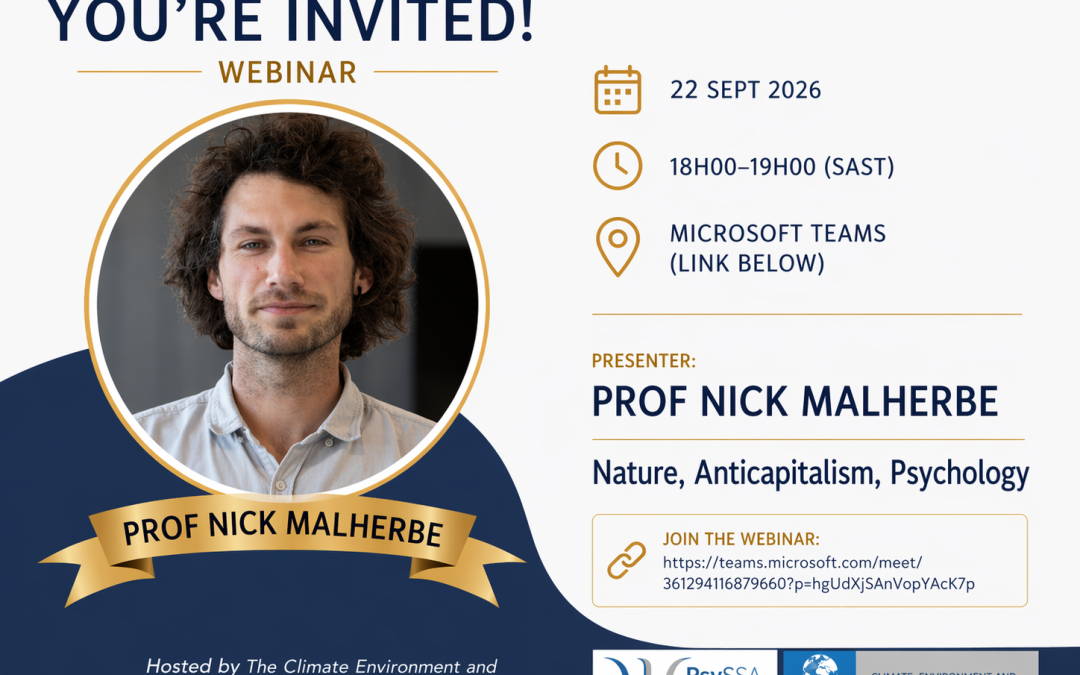
CEP Division Webinar: Nature, Anticapitalism, Psychology
About the Webinar:
The stability of capitalism is dependent on the unending growth of capital. Deterring capitalist crises requires increased production, greater consumption, redoubled markets, swelling profit margins, and accelerated supply chain lead times. The environment is no exception to this expansionist logic. Under capitalism, the environment serves as either a sink for endless dumping or a tap for limitless extraction. Psychology has, for the most part, done little to oppose capitalism’s environmentally destructive operations. Much mainstream psychology reads ‘healthy’ psychological development through the logic of infinite growth. When psychologists do consider environmental destruction (most do not), they tend to locate its origins in individual human behaviour, rather than the structural mechanisms of capital accumulation. The natural world thus emerges within most psychological disciplines as a static entity that exists entirely apart from human beings. Against all of this, we will attempt in this webinar to formulate another kind of psychology, one concerned with anticapitalist struggles for ecological justice. Specifically, and by way of a practical example, we will consider what it could mean to attune psychology to the psycho-political demands of these struggles, and when these struggles might require us to step away from psychology altogether. It is by taking seriously these sorts of concerns that we can begin to articulate an anticapitalist psychological practice in and for the web of life.
Date: 22 September 2026
Time: 18:00-19:00
Platform: Microsoft Teams
https://teams.microsoft.com/meet/361294116879660?p=hgUdXjSAnVopYAcK7p
Meeting ID: 361 294 116 879 660
Passcode: gy7y2RT6
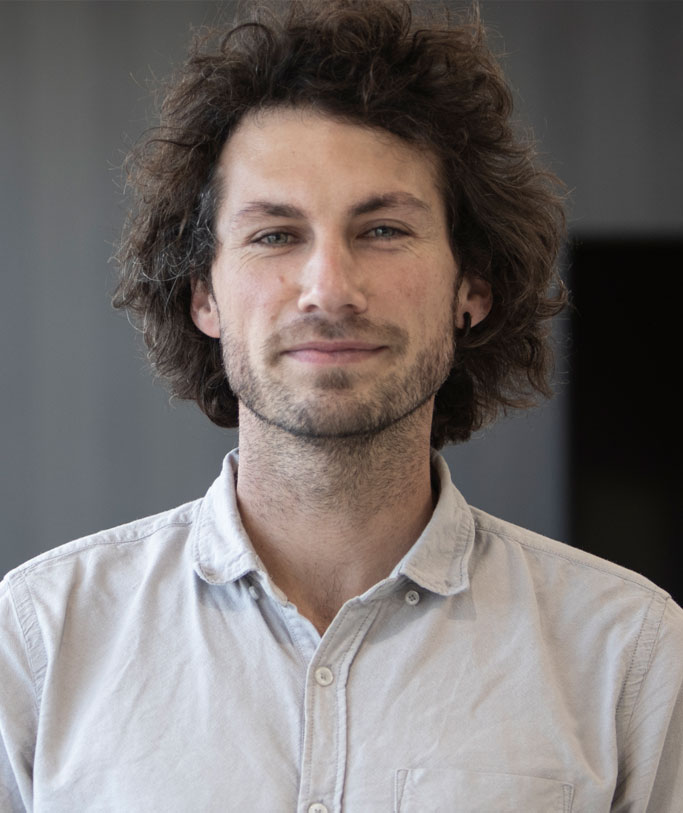
About the Presenter:
Nick Malherbe is researcher at the Institute for Social and Health Sciences, University of South Africa, and is affiliated with the South African Medical Research Council-University of South Africa Violence, Injury and Social Asymmetries Research Unit. He works with social movement actors, cultural workers, and young people. His research interests include violence, discourse, and community praxis.