


TOGETHER AGAINST LONELINESS
What Educational Psychologists Must Do Differently
BY DR PAKEEZAH RAJAB, ON BEHALF OF THE SOCIETY FOR EDUCATIONAL PSYCHOLOGY OF SOUTH AFRICA
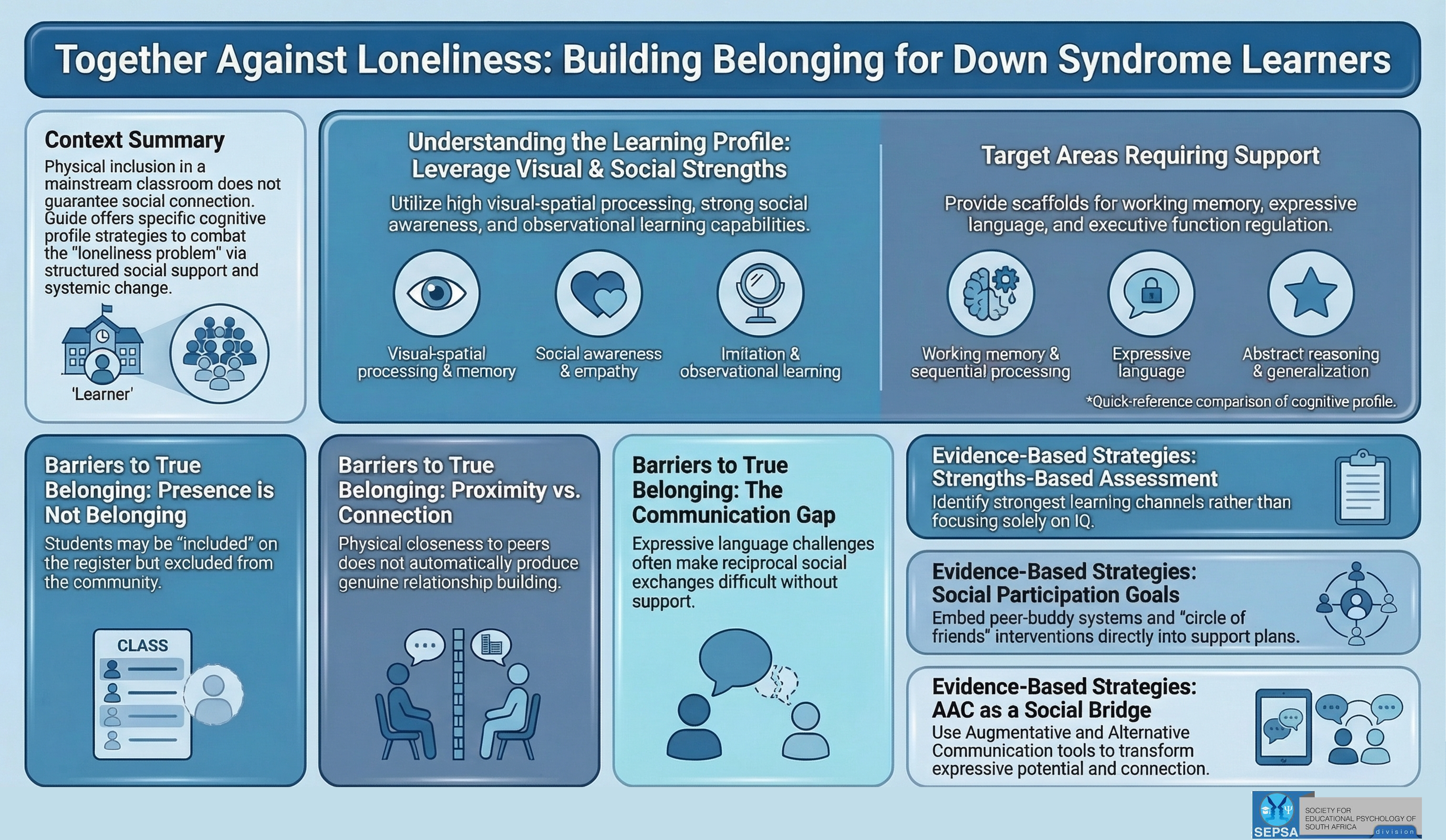
Placing a child with Down syndrome in a mainstream classroom does not guarantee inclusion. True inclusion means belonging, feeling known, valued, and genuinely connected to peers. This World Down Syndrome Day, we ask: are our schools producing presence, or producing belonging?
World Down Syndrome Day is observed on 21 March each year. This date is deliberately chosen to represent the triplication (trisomy) of chromosome 21, the genetic hallmark of Down syndrome. The 2026 theme, “Together Against Loneliness,” is not merely a compassionate slogan. It is a research-backed call to action.
Studies consistently show that children and young people with Down syndrome are at heightened risk of social isolation and loneliness, not because of their chromosomes, but because of how our environments, schools, and social systems are designed. As educational psychologists, school psychologists, and educators, we have both the tools and the obligation to change this.
World Down Syndrome Day
Rekha Kangokar Rama Rao
World Down Syndrome Day (WDSD), observed annually on 21 March, is a global awareness day dedicated to promoting the rights, inclusion, and well-being of people with Down syndrome. The date (21/3) represents the triplication of chromosome 21, the genetic condition responsible for Down syndrome. In South Africa, this day provides an important opportunity to highlight the experiences of individuals with Down syndrome, raise awareness about their health and developmental needs, and promote inclusive policies that support their full participation in society.
Down syndrome is a chromosomal condition caused by the presence of an extra copy of chromosome 21, known as trisomy 21. This additional genetic material influences physical growth, cognitive development, and certain health outcomes (Antonarakis et al., 2020). Internationally, Down syndrome occurs in approximately 1 in every 700 live births (Bull, 2020). In South Africa, estimates suggest a similar prevalence; however, the data is outdated, as most studies were conducted during the 2000s (McGlinchey et al., 2025). This could be due to underreporting and inconsistent surveillance systems. Despite these limitations, research indicates that Down syndrome remains one of the most common chromosomal conditions affecting children in the country.
Children and adults with Down syndrome often experience a range of developmental and health challenges. These may include intellectual disability, characteristic physical features, and increased susceptibility to certain medical conditions such as congenital heart defects, hearing impairments, thyroid disorders, and vision problems (Bull, 2020). Studies conducted in South Africa have also identified congenital heart disease as one of the most common medical complications among children with Down syndrome, emphasising the need for early screening and specialised healthcare services (McGlinchey et al., 2025). Early intervention programs, including physiotherapy, speech therapy, and occupational therapy, can significantly improve developmental outcomes and independence.
However, the challenges faced by individuals with Down syndrome in South Africa extend beyond healthcare. Social stigma limited public awareness, and barriers within the education system often restrict opportunities for children with intellectual challenges. According to Statistics South Africa (2024), in the report generated in 2022, persons with disabilities are significantly less likely to complete schooling or access employment opportunities compared to the general population. This disparity highlights the importance of inclusive education policies and social support system that enable children with Down syndrome to reach their full potential.
South Africa has made important policy commitments to protect the rights of persons with disabilities. The White Paper on the Rights of Persons with Disabilities emphasises equality, dignity, and access to services for individuals with disabilities (Department of Social Development, 2016). The inclusive education initiative, guided by the Education White Paper 6 on Special Needs Education, aims to create a more inclusive schooling system that accommodates learners with diverse developmental needs. When implemented effectively, inclusive education can improve academic achievement, social integration, and long-term independence for learners with Down syndrome.
World Down Syndrome Day also highlights the importance of self-advocacy. Increasingly, individuals with Down syndrome in South Africa are speaking out about their rights, participating in community activities, and advocating for greater inclusion in education and employment (Down Syndrome South Africa, 2023). Their voices are essential in shaping policies and services that affect their lives, aligning with the global disability rights principle of “Nothing about us without us” (Koontz et al., 2022).
In conclusion, World Down Syndrome Day provides an opportunity for South Africans to reflect on progress made and the work that still lies ahead. While healthcare improvements and supportive services have enhanced the quality of life for many individuals with Down syndrome, barriers to education, employment, and social inclusion remain significant. Strengthening inclusive education, improving access to healthcare, and increasing public awareness are critical steps towards building a society where individuals with Down syndrome are respected, valued, and empowered to participate fully in their communities.
References
Antonarakis, S. E., Skotko, B. G., Rafii, M. S., Strydome, A., Pape, S. E., Bianchi, D. W., Sherman, S. L., & Reeves, R. H. (2020). Down syndrome. Nature Reviews Disease Primers, 6(1), 9. https://doi.org/10/1038/s41572-019-0143-7
Bull, M. J. (2020). Down syndrome. The New England Journal of Medicine, 382(24), 2344-2351. https://doi.org/10.1056/NEJMra1706537
Department of Social Development. (2016). White Paper on the Rights of Persons with Disabilities. Government of South Africa. https://www.gov.za/sites/default/files/gcis_document/201603/39792gon230.pdf
Down Syndrome South Africa. (2023). About Down syndrome. https://www.downsyndrome.org.za
Koontz, A., Duvall, J., Johnson, R., Reissamn, T., & Smith, E. (2022). “Nothing about us without us:” engaging at users in at research. Assistive Technology, 34(5), 499-500. https://doi.org/10.1080/10400435.2022.2117524
McGlinchey, E., Fortea, J., Vava, B., Andrews, Y., Ranchod, K., & Kleinhans, A. (2025). Raising awareness and addressing inequities for people with Down syndrome in South Africa. International Journal for Equity in Health, 24(10, 7. https://doi.org/10.1186/s12939-024-02349-3
Statistics South Africa. (2024). Prevalence of disability on the decline in SA. Pretoria: Statistics South Africa. https://www.statssa.gov.za/?p=17391
Down’s Syndrome and Issues Relevant to Neuropsychological Practice
Down syndrome (DS) is a chromosomal abnormality associated with intellectual disability. Biologically, DS is a genetic condition caused by the presence of an extra copy of chromosome 21, resulting in 47 chromosomes rather than the typical 46. For this reason, it is also referred to as trisomy 21. There is no compelling evidence indicating that factors such as nationality, ethnicity, diet, medication use, illness history, or upbringing influence the risk of this genetic disorder. Similarly, maternal behaviour during pregnancy has not been conclusively linked to the course of the disorder. However, advanced maternal age has been identified as a risk factor.
In addition to distinctive physical characteristics, individuals with Down Syndrome may experience social, emotional and psychological challenges which impact their educability, independent living (in adults) and employability. For example, symptoms of depression may increase with age as individuals integrate socially within adolescent and adult peer environments. More often than not, neurological conditions such as epilepsy may also occur as comorbid medical concerns requiring cognizance and understanding of how seizure disorders impact overall emotional, cognitive and social functioning. It is important to note that individuals with DS exhibit varying levels of intellectual impairment, which may create substantial barriers to independent participation in mainstream education, training and employment. Furthermore, with advancing age, some individuals with Down Syndrome may develop dementia thus requiring ongoing cognitive and behavioural monitoring.
During early childhood development, significant delays in speech and language development are often observed, and cognitive impairments may also become more apparent over time. Despite these challenges, children with Down Syndrome often display distinct cognitive profiles characterized by both strengths and weaknesses which should be carefully documented in neuropsychological assessments. These patterns of functional capacity are best identified through multidisciplinary assessments that include neuropsychologists and other healthcare professionals such as occupational therapists. In addition to reviewing the literature on DS, clinical exposure, supervision, and specialized training in Down’s Syndromes patient populations are essential for professionals seeking to develop a deeper and when work in these settings.
Against this background, several issues relevant to neuropsychological and forensic practice become apparent.
1. Competency
Individuals with Down Syndrome frequently demonstrate limitations in communicating effectively with their legal representatives, in understanding legal proceedings, and making informed decisions. These difficulties arise from characteristic intellectual and adaptive impairments that may reduce their ability to participate meaningfully in court processes or fully comprehend the consequences of legal actions. As a result, neuropsychological evaluations play an important role in determining competency to stand trial and participate in legal proceedings. Individuals with Down Syndrome may experience cognitive difficulties specific to memory encoding, retrieval, and narrative organization, often undertaken by neuropsychologists skilled in applying appropriate assessment instruments to these populations. Impairments in recalling specific details, sequencing events accurately, or differentiating between real experiences and suggestions provided during questioning may become apparent. As a result, forensic neuropsychologists must carefully evaluate memory functioning and the conditions under which testimony particularly in criminal situations was obtained to determine its reliability.
2. Suggestibility and Vulnerability
Studies suggest that individuals with Down Syndrome may exhibit increased suggestibility and compliance, particularly in stressful situations or when interacting with authority figures. This heightened suggestibility can increase the risk of unreliable testimony, false confessions, or manipulation during police interrogation in criminal matters. Difficulties in social cognition, combined with a strong desire to please others, may further increase vulnerability to coercion, exploitation, or abuse. Standard police interviewing techniques often places individuals with intellectual disabilities such as Down Syndrome at a disadvantage due to complex language used in rapid questioning, and the intimidating nature of questioning. Modified interview approaches, including simplified language, slower pacing of interview questions and the presence of trained support persons or intermediaries is often recommended.
3. Criminal Responsibility
The intellectual disability associated with Down Syndrome can affect an individual’s ability to form criminal intent (mens rea) or understand the wrongfulness of their actions. Forensic neuropsychological assessments must therefore consider developmental level, comprehension of legal concepts, and contextual influences and their interactive influences with functional brain status. In many cases, individuals with significant intellectual impairment may not meet the legal standards required for criminal responsibility. Careful forensic neuropsychological evaluations with documented strengths and deficits are therefore essential in determining the degree of responsibility and appropriate legal outcomes (Baird & McGillivray, 2022; Schalock et al., 2021).
4. Capacity
Individuals with Down Syndrome may experience limitations in decision-making capacity related to informed consent, financial management, and independent living. Assessments should evaluate the individual’s ability to understand relevant information, appreciate risks and benefits, and apply reasoning to real-life situations. Beyond cognitive testing, forensic neuropsychological evaluations assesses adaptive functioning, focussing on the skills required for practical, social, and conceptual capacities required for everyday life. Individuals with Down Syndrome typically show varying levels of independence in areas such as financial management, personal care, and social decision-making. Documenting adaptive functioning in objective and narrative formats is critical to assisting courts considering life-altering decisions such as criminal responsibility, guardianship, and capacity for independent living. Furthermore, neuropsychological assessments form a critical part of the broad determination about the need for guardianship, and other daily needs such as the capacity to consent to medical treatment, and identifying vulnerability to financial exploitation.
5. Risk of Victimization
Due to cognitive, adaptive, and social vulnerabilities, individuals with Down Syndrome are at an increased risk of victimization, including abuse, neglect, and exploitation. Forensic and clinical neuropsychological evaluations should therefore consider protective factors and identify potential risks within the individual’s social environment. Some individuals with Down’s Syndrome may experience difficulties with impulse control, emotional regulation, and social judgment. These challenges can occasionally contribute to problematic behaviours or misunderstandings in social situations that potentially lead to legal involvement. Forensic neuropsychologists are often required to conduct structured risk assessments to evaluate behavioural regulation in various scenarios and environmental influences, prognosticating on the likelihood of future behavioural incidents. Such assessments guide courts in determining appropriate supervision or support services.
Professionals from multidisciplinary settings must ensure that appropriate safeguards and support systems are in place to protect individuals with DS from harm (Baird & McGillivray, 2022; Gudjonsson et al., 2017).
Members: Prof Theophilus Lazarus (Chairperson); Dr Ann Watts (deputy Chairperson; Barry Viljoen
(General Secretary and Treasurer); Dr Louise Olivier; Dr Lindiwe Mabena; Dr Karl Swain; and Hendrina Mosima
References
Baird, J., & McGillivray, J. (2022). Intellectual disability and the law: Forensic issues. Current Opinion in Psychiatry, 35(2), 98–105.
Gudjonsson, G. H., Sigurdsson, J. F., & Sigurdardottir, S. (2017). Suggestibility and compliance in individuals with intellectual disabilities. Journal of Forensic Psychiatry & Psychology, 28(6), 807–820.
Roizen, N. J., & Patterson, D. (2023). Down syndrome. The Lancet, 401(10377), 1136–1150.
Schalock, R. L., Luckasson, R., & Shogren, K. A. (2021). The definition and classification of intellectual disability: An update. Journal of Intellectual Disability Research, 65(5), 429–441.
Members: Prof Theophilus Lazarus (Chairperson); Dr Ann Watts (deputy Chairperson; Barry Viljoen
(General Secretary and Treasurer); Dr Louise Olivier; Dr Lindiwe Mabena; Dr Karl Swain; and Hendrina Mosima