


Telephonic and Virtual consultation codes offered by Medscheme in light of the COVID-19 nationwide public health emergency
The Corona Virus impacts on all systems
The 2nd of April is world autism day. The aim of this day is to raise awareness about Autism Spectrum Disorder on society. The theme for 2020 is to make the public aware of the hurdles that people with autism and others living with autism face every day.
The American Centres for Disease Control and Prevention noted in 2018 that 1 in 59 children is diagnosed with Autism Spectrum Disorder ( https://www.cdc.gov/ncbddd/autism/data.html). The numbers are rising as more people are diagnosed across the world.
People on the spectrum communicate and interact with others in ways that are different to most other people (https://africacheck.org/factsheets/factsheet-frequently-asked-questions-about-autism-in-south-africa/). As result, they may need particular kinds of help in their daily lives.
Children on the spectrum provide challenges to their families on a normal day. In this time of lockdown in dealing with a virus, families may find it more difficult to deal with their children. There will be changes in routine and the person with autism will be challenged on a sensory level with the increased hand washing. Most important is that the general anxiety and uncertainness that we are all experiencing will have a big impact on people with autism. Here are a few tips for psychologists to guide families and caregivers on how to support themselves and their relatives with autism during this very difficult time. These tips are also useful for other families with children with disabilities such as ADHD or specific learning difficulties.
- Download Carol Gray’s social story to help you explain about the virus. Another source is Mencap’s EasyRead information. Both available on https://www.autism.org.uk/services/helplines/coronavirus.aspx
- Children may struggle managing their emotions which makes it difficult to think logically how to cope with anxiety provoking situations https://www.understood.org/en/friends-feelings/managing-feelings/stress-anxiety/child-anxious-coronavirus. It is therefore important to validate their feelings and respond with empathy. To say everything will be ok is not the best way of managing anxiety. It is also important to keep your own anxiety in check and focus on the facts. Dealing with the situation calmly may reduce anxiety. Help children to differentiate between what is happening currently and the worry about what could happen. Give honest accurate information at their level. LISTEN LISTEN LISTEN.
- One of the most important tips is to establish routine. A mother of a child with autism gave lovely guidance in how to develop a daily visual schedule an article in the Washington Post https://www.washingtonpost.com/lifestyle/2020/03/17/parenting-autistic-kids-coronavirus/.
- Be available as a psychologist to support families. Just listening to their experiences may support families to manage the situation better.
References
- Centres for Disease Control and Prevention. Retrieved from https://www.cdc.gov/ncbddd/autism/data.html
- Africa check. Retrieved from https://africacheck.org/factsheets/factsheet-frequently-asked-questions-about-autism-in-south-africa/
- National autistic society. Retrieved from https://www.autism.org.uk/services/helplines/coronavirus.aspx
- Understood.org. Retrieved from https://www.understood.org/en/friends-feelings/managing-feelings/stress-anxiety/child-anxious-coronavirus
- Washingtonpost.com. Retrieved from https://www.washingtonpost.com/lifestyle/2020/03/17/parenting-autistic-kids-coronavirus/.
Dr Helen Dubar-Krige
World Autism Awareness Day (WAAD) – 2nd April 2020
Dr Tumelo Leeuw – (Peadiatrician)
Dr Petro Erasmus – (Educational Psychologist)
The number of children diagnosed with Autism has increased sharply in the past decade. Whether it is because of increasing number of reported new cases, or the consequence of improved diagnosis by health-care workers, awareness and acceptance still remain inadequate. The DSM definition and diagnostic criteria has evolved over time to the current diagnosis; that recognizes Autism spectrum as its “own” medical condition. This may be good news for the specialists who use the tool, but it still leaves many lay people in the dark about “What exactly is Autism?” Over time, Autism has been found it to be a diagnosis that is not made in one session, but over a number of interactions with the patient and the family, and ideally as a multi-disciplinary approach rather that ticking off points from a list of criteria.
Autism spectrum belongs to a group of neurological conditions, often presenting in the early developmental years of a child, and recognized when the child does not reach certain social and/or intellectual milestones. In some cases, parents may report a regression of milestones during the toddler years. It is characterized by a deficit in developmental socializing, inappropriate repetitive patterns of behavior and an exaggerated or almost-muted response to external sensory input. The fact that it is a spectrum indicates that presentation varies vastly from one child to the next. At its most severe, the child might be devoid of speech, completely uninterested in their surrounding and behave “inappropriately”. This may cause parents, who may not understand the diagnosis, to resort to drastic harmful interventions. At its least severe presentation, the child may be a high-functioning individual in society, who display subtle socially inappropriate behaviours, have good verbal skills and exhibit high cognitive and/or scholastic functioning.
Regardless of its presentation, in some instances and especially in countries which have advanced resources, diagnosis can be made as early as twelve months old. In a resource-scare country, like South Africa; there may be a delay in diagnosis for a number of reasons, such as inability to recognize signs by the parents, delayed presentation to the health-care professional, lack of cost-effective diagnostic tools for the condition; or non-acceptance of the condition and the seeking of assistance by the care-givers.
Once diagnosis has been made, parents and health-care professionals are still faced with a number of challenges. There is not enough training about the available appropriate therapies for children on the autism spectrum in South Africa, which may result in the professionals having to use treatments designed for and developed in other countries. These treatments thus have not yet been appropriately adapted to our cultures and communities. For some who can afford it, intensive remedial, occupational and speech therapies are provided for their children. For those who cannot afford this luxury, awaiting placement in government institutions and centers is all they can do. Unfortunately, this means many missed opportunities for early intervention for the young brains that can have improved quality of life if given the opportunity. These are just a few of the challenges we face in our country.
The question is always, to which government department do neurodevelopmental conditions belong? To the department of health for the diagnosing and therapies applied? The department of social development for the provision of social grants and support? Or to the department of education for the inclusive education programs and academic institutions where the children may need to be placed? They belong to us, the “village” that has to come together to raise its future generations! The need to educate every individual in our communities in an effort to create awareness and acceptance will always be the fuel that drives advocates and researchers on our South African soil to improve the quality of life for a child on the autism spectrum and their family. Knowledge is indeed power, and that power rests in our hands.
Current research and the WHO CST programme
Cara (Centre for Autism Research in Africa) is one of the leaders in autism research. Professor Petrus de Vries and Dr Liezl Schlebusch are also the leaders of the WHO (World Health Organisation CST (Caregiver Skills Programme) that offers a novel, open access Caregiver Skills Training programme for caregivers of young children with neurodevelopmental disorders. “This programme is specifically designed with resource-limited settings in mind, where non-specialist facilitators from the community deliver a 12-week intervention. During the intervention, caregivers learn skills and strategies to create a nurturing environment that promotes child development. The programme is currently undergoing field testing in more than 30 countries. The programme is set to launch in the North West Province in two communities in Potchefstroom and Mafikeng area.” (Dr Schlebusch). This programme will also form part of a more comprehensive research study.
Preliminary research findings following a survey done at the AUTISM symposiums held at NWU indicate that SA need an integrative approach to Autism research. These annual symposiums are attended by parents, teachers, professionals (therapists etc). Themes identified include the following:
Professionals expressed a need for networking.
Parents wanted to have more information on
- Schooling
- Placement
- Learning difficulties
- Learner engagement strategies in school settings
- Teaching strategies
- Curriculum
- Low Functioning ASD
- High Functioning ASD
- Siblings that doesn’t understand
- Coping with siblings as a parent
- Coping
- Coping with ASD children as a parent
- Coping as a teacher
- Diet/Nutrition
- Communication
- Behaviour
- Self-esteem of the parents
- How children on the ASD spectrum can become Independent / Valuable members of society
Professionals working directly with ASD children had the following questions:
- Integration Questions
- Holistic / Other intervention strategies
- Roles of professionals
- Co-morbid conditions
- Diet / Nutrition
- Awareness – communication
- Diagnosing
- Starting point
- Therapies
- Narratives – What can we learn by listening to the stories of parents and teachers about the journeys of the children on the ASD spectrum.
- Curriculum
- Transition – formal schooling
- Classroom management
- Parenting Programs
- Inclusive Education
- ASD Programs – skills
- Networking
- Employment ASD
From the responses it was also clear that there were unique concerns with regards the different developmental phases:
Baby 0-22 months
- Behaviour manifestation
Toddler – 2-5
- What are the best Teaching strategies
Pre-school 5-6
- How to develop Communication
Primary School 6-10 years
- Fears / Expectations
- Independence
- Quality of life
- Narratives – each one had a unique story
- Resilience – how to develop resilience
Early adolescent 11- 15 years
- Schooling
- Teacher training
- Curriculum
- Independence
- Quality of life
- Curriculum
Middle and late adolescent 16-20 years
- Peer/socializing
- Bullying
- Medication
- Motivation
Adult – 20+
- Loss / Grief
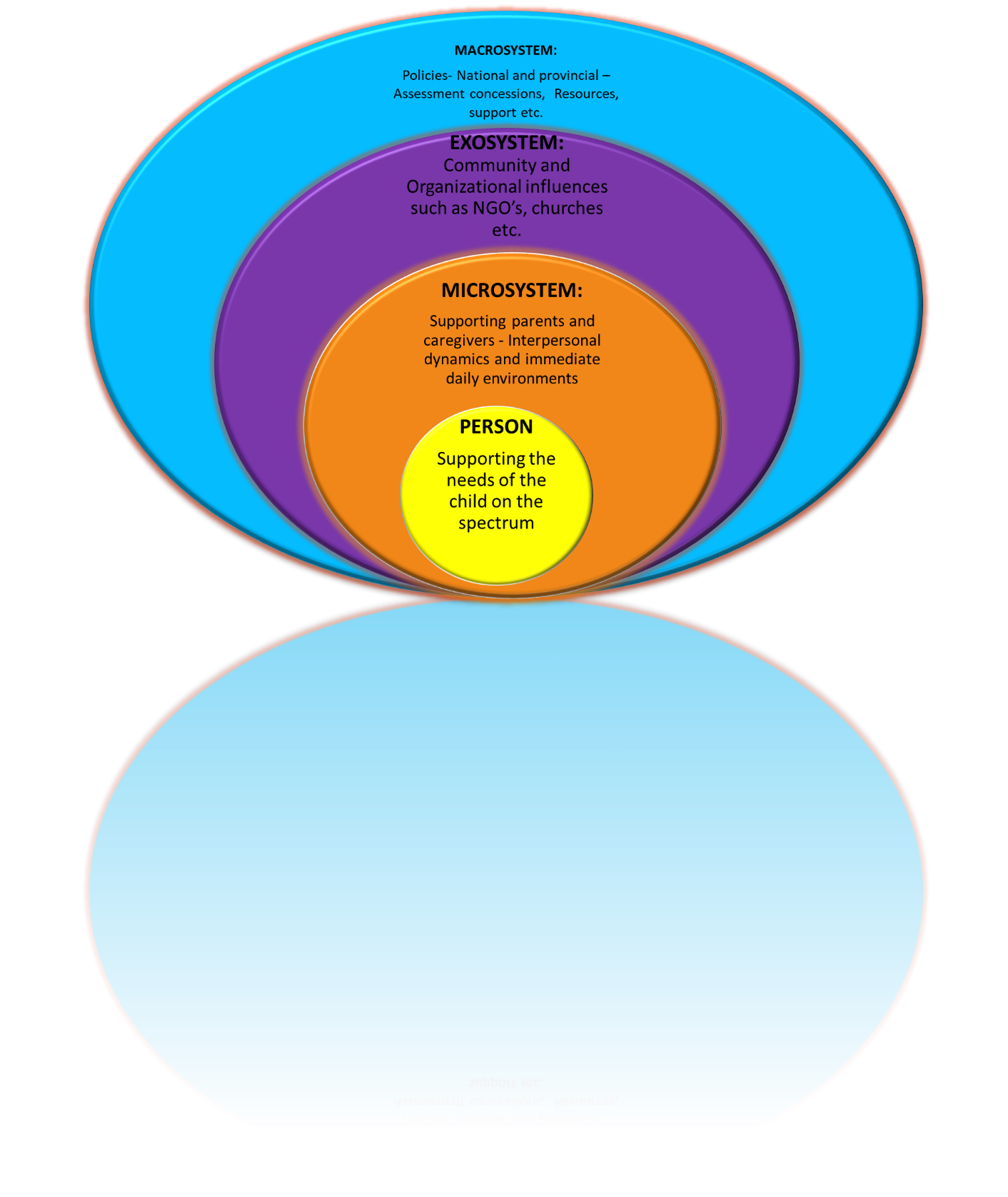
The North West University has embarked on a comprehensive awareness programme in 2016. Working closely together with CARA, NGO’s (ye-ye Foundations, Mmabana Foundation), Autism South Africa the aim is to reach every student in the Psychology, Education, Nursing and Social Work Departments. Students at undergraduate and post-graduate level are involved in this project. The aim is to raise awareness in our communities.
A new research focus area has been established at the North West University that will focus on neuro-developmental disorders (specifically Autism, ADHD and Dyslexia) from a systemic perspective. Students who are interested in doing their Masters or PhD studies in neurodevelopmental disorders are welcome to contact Dr Erasmus for more information.
The NWU is looking forward to working with academics across SA; Africa and the globe in demystifying neuro-developmental disorders.


Dr Liezl Schlebusch
- Centre for Autism Research in Africa
- Division of Child and Adolescent Psychiatry
- Department of Psychiatry and Mental Health
- Faculty of Health
- University of Cape Town
- South Africa
Dr Petro Erasmus
- Neuro-developmental research project – North West University,
- Department of Psychology,
- Faculty of Health Sciences
- North West University
- South Africa
- petro.erasmus@nwu.ac.za

Reflecting on Psychology Under Lockdown… a collaboration between Transdisciplinary African Psychologies Programme (TAP) of the University of South Africa’s Institute for Social and Health Sciences and the Psychological Society of South Africa
The 21-day lockdown is underway. Staff at the Transdisciplinary African Psychologies Programme (TAP) of the University of South Africa’s Institute for Social and Health Sciences and the Psychological Society of South Africa (PsySSA) have been working remotely since last week. Some of us are finding they are more productive and happier. Others feel they are anxious and not focused. And yet others say they could be more productive.
But the idea of the lockdown has got many of us into weird, unusual, changed, or fizzy-like states. With a bit of luck, we and our families, friends, students, professors, and colleagues will come out with our health not too negatively affected.
But what of our heads? And our life of feeling? And behaviours?
We have an idea. We would like to call on psychologists and psychology students to join us in marking these 21 days. We want to ask you to write down a kind of diary of ‘Reflecting on Psychology Under Lockdown’. Each day between now and 16 April you can send us a 2-minute voice clip on what you are thinking about your work or studies in these times. Do you feel that psychology has a role during these times? What is that role? How has the lockdown and thoughts on the virus affected your work, health, family, behaviour, thoughts and feelings? What are you doing differently?
Along with these voice clips, we would like you to write approximately 200 words DAILY reflecting on the same questions and related ones. You can stop when you get to 4000 words. Send your voice clips and diary entries to fatima@psyssa.com
We would like to put out a small publication before the end of the end year. We will also consider a compendium of spoken words from the voice recordings.


