
PsySSA Commemorates Freedom Day 2023!
Listen to our podcast, by President-Elect,Prof Mercy Tshilidzi Mulaudzi
#Freedom #ConsolidatingAndSafeguardingDemocraticGains #27thCongress #HopeAndHealing


Building a Unified, Relevant, and Responsive Psychology
Listen to our podcast, by President-Elect,Prof Mercy Tshilidzi Mulaudzi
#Freedom #ConsolidatingAndSafeguardingDemocraticGains #27thCongress #HopeAndHealing

Aligned to PsySSA’s Social Responsibility and mission, kindly note that we have untaken to support a home for Gender-based Violence victims and Youth in underprivileged communities. We invite all members to support these initiatives by donating to us when completing your membership application. Through your donation, we will be able to promote a better and safer society for us all.
Members are also invited to donate to these initiatives throughout the year by simply logging into their profile.

The 21st March 1960 marked a historic day in South Africa. Sixty-nine people died and 180 were wounded when police opened fire on a peaceful crowd that had gathered in Sharpeville to protest the pass laws. Human Rights Day is commemorated as a reminder of our indelible human rights and the enormous sacrifices of achieving human rights in South Africa.
Yet, on the 63rd anniversary of the Sharpeville Massacre, human rights for many South Africans remain out of reach. Recent weeks have seen strike action due to the high cost of living that has prevented sick people from accessing public healthcare services with dire consequences. On 9th March 2023, a 4-year-old child’s body was found in a pit latrine in an Eastern Cape School. That same day, in Bergville, KwaZulu-Natal, a 26-year-old woman was bludgeoned to death with a hammer, allegedly by her husband. Although the right to water is enshrined in our constitution, many South Africans do not have access to a reliable water source. Almost daily, South Africans are dealing with loadshedding and unstable sources of electricity. Corruption, unemployment, poverty and crime continue to undermine social and economic rights. The violation of human rights, particularly of vulnerable and marginalized people, remains rampant in our society.
Commemorative holidays are all too often reduced to an opportunity to have a party and take a selfie… As we pause to reflect on Human Rights Day, we need to be mindful of the ever-widening gap in the realization of social justice, human rights and equality in our society. If we pause and do not act, that trajectory will grow exponentially, the dream of human rights, mere rhetoric. We are at a historic crossroad; we need to pursue a bold transformative agenda to fully realise human rights and sustainable development in our country.
Since PsySSA’s inception 29 years ago, the Society has undergone exponential growth. Aside from remaining active during the COVID-19 pandemic. This past year has been an immensely successful one for the Society.
We would like to highlight our journals that members receive FREE access to. Assisting professionals to remain up to date and aware of the latest developments in psychology in South Africa and Africa.

The South African Journal of Psychology (SAJP) is the official journal of the Psychological Society of South Africa (PsySSA). The SAJP publishes peer-reviewed contributions in English from all fields of psychology. Whilst the emphasis is on empirical research, the journal also accepts theoretical and methodological papers, review articles, book reviews, and comments on articles published in the journal. Priority is given to articles relevant to Africa and that address psychological issues of social change and development draws scholarly works from both the national and international arena, and the blinded review process ensures high quality publications. Another progressive new development for the SAJP is the Online First publishing feature. This brings the SAJP in line with all of the major international journals in ensuring that accepted manuscripts are published online once accepted, each with a digital object identifier (doi). In order to encourage scholarly writing, the SAJP and PsySSA have facilitated a number of publishing workshops fore merging scholars. The Journal offers quarterly Continuing Professional Development opportunities to PsySSA members at no extra cost.

The African Journal of Psychological Assessment (AJOPA) is published in conjunction with AOSIS. AJOPA is intended to serve as a means of combining the current disparate research being conducted in psychometrics and psychological assessment in Africa. Manuscripts in the areas of psychometrics and psychological assessment are invited. Manuscript submissions must demonstrate a clear contribution to the field and must be of relevance to the African context. Manuscripts can focus on but are not limited to ethics in assessment, establishing the psychometric properties of an instrument, methods in assessment, research on core issues in psychological assessment (eg. assessment in low resource settings, multicultural assessment, acculturation and assessment, language and assessment, assessing people with disabilities) and/or specific areas in assessment (eg. cognitive, personality, vocational, intelligence, aptitude) and/or particular settings (clinical, educational, forensic, organisational, neuropsychological assessment). Manuscripts make take the form of original research studies, theoretical papers, test reviews and methods papers
Since PsySSA’s inception 29 years ago, the Society has undergone exponential growth. Aside from remaining active during the COVID-19 pandemic. This past year has been an immensely successful one for the Society. One in which we were able to take advantage of our stability as an organisation, as well as consolidate and build on our strengths. A major highlight has been the opportunity to gather together at our 26th Annual South African Psychology Congress.
The Society has remained consistent and agile during difficult periods while still putting the needs of our members, the profession and the South African Society first while advocating for psychology as a science and profession of global stature and promote psychological praxis as relevant, proactive and responsive to societal needs and well-being.
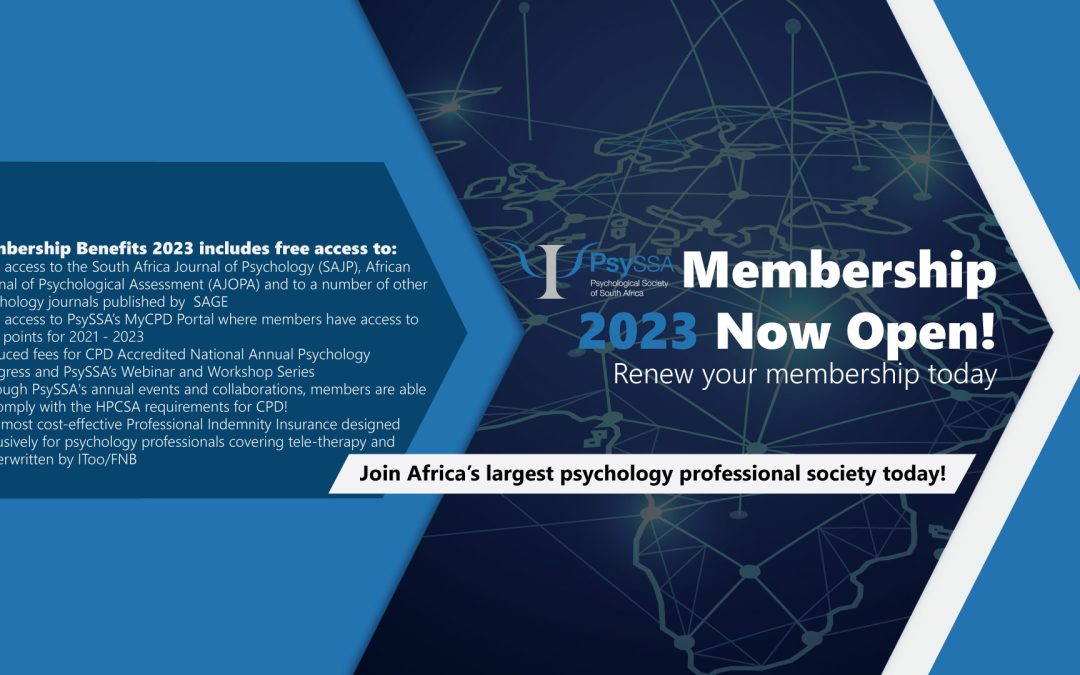
Over and above PsySSA’s comprehensive list of membership benefits, in 2023, PsySSA members will receive free access to PsySSA’s online MyCPD platform where members have the opportunity to earn CPD points for 2021 – 2023. Through PsySSA’s annual events and collaborations, members are able to comply with the HPCSA requirements for CPD! Moreover, professionals in private practice can enjoy free listing and regular referrals through the recently renovated PsySSA Directory of Psychology Professionals.
If that’s not enough, the membership package also boasts exceptionally low-cost professional indemnity insurance that covers tele-therapy!
We thank you for staying the course, retaining membership in Africa’s largest psychology professional society, and look forward to serving you yet again.
Kindly note that the opening of the membership system was delayed as we listened to our members and ensured that the system was more user friendly!
In solidarity,
The Psychological Society of South Africa

“In every community, there is work to be done. In every nation, there are wounds to heal. In every heart, there is the power to do it.” – Marianne Williamson
Written by Maryam Gangat [1]
International Volunteer Day is celebrated on the 5th of December every year by volunteers from across the globe. Each year, a theme is selected and celebrated in the spirit of spreading awareness and acknowledging the volunteers who are role models within their communities. The theme for this year, 2022 is: Solidarity Through Volunteering. The theme for this year encourages volunteers to work together within their communities in order to find common solutions for the countless inequalities that people experience throughout the globe.
The United Nations (UN) have emphasised the importance of volunteerism by articulating that it is one of the most vital delivery mechanisms for global transformation, and ensuring a lasting impact with its ability to change people’s mindsets, attitudes, and behaviours. Here are some ways in which you can advocate, spread awareness, and promote volunteerism in your community:
Advocacy begins with you. The best way to promote volunteerism in your community and to encourage it in others, is to work towards spreading awareness by supporting your community in various ways. Supporting a worthy cause in your community today, helps build a better world for tomorrow. By volunteering to take care of the environment, lending a hand at underprivileged schools, and passing on valuable skills to the youth, you can help to create a better future and set an example for future generations.
If you are unable to physically volunteer your time or if you have the financial means to do so, donating to a volunteer organisation enables you to help underprivileged communities move towards living healthier, more productive lives. By donating money and other items, organizations can provide their services to the larger community and donated items can be used by individuals in your community who are need.
When people see and hear about how much volunteerism impacts their communities, it encourages them to volunteer. By educating the public on issues of concern and showing them how the contributions of others have changed things for the better, people become inspired to come together to assist their communities. By sharing and reflecting on your experiences of volunteering, it cultivates gratitude and creates a sense of belonging among individuals in a community.
Demonstrating genuine need among your community motivates people to volunteer and become more involved. When you create volunteer opportunities or make people aware of the opportunities that already exist within your community, it creates awareness and encourages advocacy. Many organisations rely on volunteers for their time and skills so that they can provide additional services or programs for the larger community. When communities become involved in finding solutions together, they are more likely to be feasible in the long term as they are more inclusive and people-centric.
People are constantly moving into and away from communities. This means that the needs of your community are constantly changing and evolving which creates numerous opportunities for volunteerism. By creating opportunities for individuals to volunteer within communities, it encourages individuals searching for new connections to come together, it promotes community-building and encourages a healthy culture of collaboration, friendliness, and open communication. Creating opportunities for volunteerism motivates individuals and creates a desire among individuals to have a real and tangible impact on one’s community.
In celebration of this year’s theme: Solidarity Through Volunteering, the PsySSA Student Division encourages all students to share their volunteer experiences and express their solidarity on social media using the hashtag #solidaritythroughvolunteering and #IVD2022.
[1] The Author writes in their capacity as a member of the Student Division of PsySSA (Psychological Society of South Africa) and the chairperson of Research into Student Empowerment.