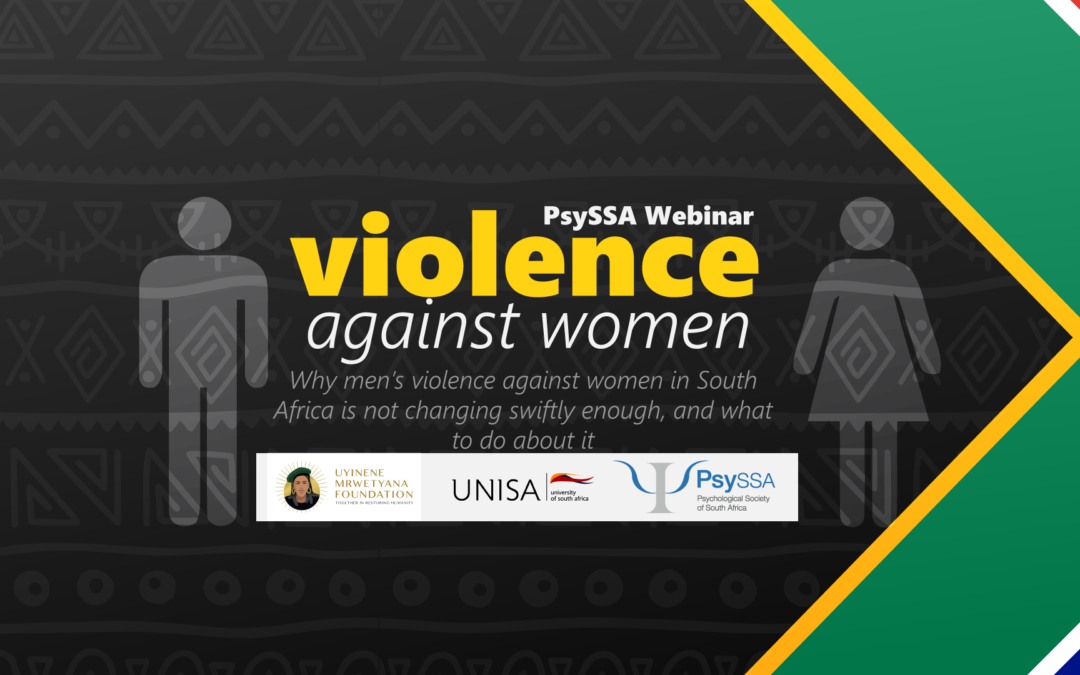
Why Men’s Violence Against Women in South Africa is Not Changing Swiftly Enough, and What To Do About It
Webinar Series
Why Men’s Violence Against Women in South Africa is Not Changing Swiftly Enough, and What To Do About It
Organised at the prompting of the Uyinene Mrwetyana Foundation (UMF), this webinar is to be held on the anniversary of what a male post office worker did to Mrs Mrwetyana’s daughter. What the man did to Uyinene, a student at the University of Cape Town, when she went to pick up a parcel at the post office on 24 August 2019, is disturbing mirror of the violence men commit against thousands of women and girls going about their daily lives. The main focus of the webinar is men’s violence to women. This violence is so pervasive as to be atmospheric, touching women in their homes, educational settings, workplaces and public spaces. The webinar is a collaborative initiative between the UMF, South African Medical Research Council-University of South Africa’s Masculinity & Health Research Unit, and the Psychological Society of South Africa. Among several premises of the organisers of the webinar is that unless we fundamentally overhaul and reconfigure at least three things, viz, (i) structural power relations that uphold men’s violent relations with women, (ii) psychologies, norms, beliefs and practices expressive of hegemonic masculinity, and (iii) the criminal justice system, it will be very long before we stop men’s violence. In addition to their inputs, the panellists and respondents will be asked about what is the large and enduring work, related to power, practices, psychologies, policies, and systems, that is to be done to nurture nonviolent men and shift the prevalent form of masculinity towards egalitarian relations.
Presenters
Moderator: Professor Kopano Ratele
How do we become who we are? How might we best think of our being and the world of human and other animals from our situatedness here, today, as men and women and other genders? These are some of the questions that the author of The World Looks Like This From Here: Thoughts on African Psychology (2019), Kopano Ratele. Kopano is the Director of the South African Medical Research Council Masculinity & Health Research Unit and Professor at the University of South Africa where he runs the Transdisciplinary African Psychologies Programme. His research interests include masculinity, race/racism, violence, and African-centred, decolonising critical and cultural psychology. Kopano is a member of the Ministerial Committee on Transformation in South African Universities, former president of the Psychological Society of South Africa, and former chairperson of Sonke Gender Justice. Other recent books are Liberating Masculinities (2016) and Engaging Youth in Activism, Research and Pedagogical Praxis: Transnational and Intersectional Perspectives on Gender, Sex, and Race (2018, co-edited with Jeff Hearn, Tammy Shefer, and Floretta Boonzaier).
Panellist: Prof Floretta Boonzaier
Floretta Boonzaier is Professor of Psychology and Co-Director of the Hub for Decolonial Feminist Psychologies in Africa at the University of Cape Town. She writes and works in feminist, critical and decolonial psychologies with emphasis on subjectivity, race, gender, sexuality, gendered and sexual violence as well as feminist decolonial methodologies.
Panellist: Rev. Bafana Khumalo
Bafana Khumalo is Sonke Gender Justice’s (Sonke) Co-Executive Director and co-founder. From 2000-2008 Bafana served as a Commissioner at the National Commission for Gender Equality from 2000-2006 and 2007-2011. At the CGE he was instrumental in assisting National and Provincial Departments of Government to plan and coordinate many activities related to men, gender, and HIV/AIDS. Bafana is an ordained pastor in the Evangelical Lutheran Church in Southern Africa and volunteers his service to the Tembisa East Parish in Gauteng.
Panellist: Prof Peace Kiguwa
Peace Kiguwa is an Associate Professor in Psychology at the University of the Witwatersrand. Her research interests include gender and sexuality, critical race theory, critical social psychology and teaching and learning. She is the current Chair of the Sexuality and Gender Division of PsySSA.
Panellist: Prof Malose Langa
Malose Langa is an associate professor at Wits University, Department of Psychology and associate researcher at SWOPS at Wits as well.
He is a Senior Researcher at the Centre for the Study of Violence and Reconcialition. His research interests include youth at risk, violence, trauma and masculinities. Prof Langa has published journal articles and book chapters on various topics. He is the author of Becoming Men: black masculinities in a South African township
Webinar Details
Date: 24 August 2020
Time: 14:00 – 16:00
Platform: Webinarjam
Join us on Webinarjam as we unpack Why Men’s Violence Against Women in South Africa is Not Changing Swiftly Enough, and What To Do About It, and earn 2 General CEU Points!