Launch of the African Journal of Psychological Assessment

Last week the African Journal of Psychological Assessment (AJOPA) was launched at the 24th Annual Psychology Congress, 12 September 2018.

AJOPA focuses on original research studies, theoretical papers, test reviews and methods papers in the areas of psychometrics and psychological assessment. Manuscripts must demonstrate a clear contribution to  contribution the field and to be relevant to the African context. Published in partnership with AOSIS, AJOPA is fully open access and charges no article processing fees (APC’s).

The AJOPA Launch Video

Regulations defining the scope of the Profession of Psychology

HEALTH PROFESSIONS ACT, 1974 (ACT NO.56 OF 1974) REGULATIONS DEFINING THE SCOPE OF THE PROFESSION OF PSYCHOLOGY

Persons are invited to submit any comments on the proposed regulations to the Director -General of Health:

Private Bag X828, Pretoria, 0001, for the attention of the Director: Public Entities Governance, mihloti.mushwanahealth.qov.za by 13 December 2018

The 24th Annual Psychology Congress kicks off with the Pre-Congress Workshops today, 11 September 2018

Book your spot for the Pre-Congress Workshops now!

The pre-congress workshops comprise a full-day (morning and afternoon session) of diverse, practical workshops prior to the formal commencement of the 24th Annual Psychology Congress (#MAMELA2018).

The pre-congress workshops will take place on Tuesday, 11th Septemper 2018 at Emperors Palace, Johannesburg.

Poking holes in heteronormativity: UKZN hosts launch of PsySSA’s practice guidelines

Poking holes in heteronormativity: UKZN hosts launch of PsySSA’s practice guidelines

Suntosh R. Pillay

How can we promote the mental health and human rights of people who are lesbian, gay, bisexual, transgender, or intersex (LGBTI)? This was the question up for discussion at a recent advocacy event at the University of KwaZulu-Natal (UKZN), which included the provincial launch of PsySSA’s historic publication, the Practice Guidelines for Psychology Professionals Working with Sexually- And Gender Diverse People. The event was sponsored by UKZN’s Division for Student Services, who is responsible for safeguarding the rights of LGBTI students on campus.

All three panellists engaged with the application of the Guidelines and how best to disrupt heteronormativity. Nonhlanhla Mkhize, the founder and director of Durban’s LGBT community centre, said “the engagement with these guidelines requires a continuous back and forth. The challenge will now be how to implement them”. Using the example of how lesbian women are murdered due to their sexual orientation, she urged the audience of over 100 health professionals, academics, and students to ensure that these guidelines are put into practice.

Siya Khumalo, author of the book You have to be gay to know God, confessed that his church messed up his identity and self-esteem as a teenager, causing him to unhealthily question who he was as a young man growing up in a rural area.

He asked, “What would happen if our birth certificates said ‘gender as we know it now’?” He was building on the point make by Kerry Frizelle, a counselling psychologist and lecturer at UKZN, who urged everyone let go of unnecessary binaries and embrace diversity.

“People don’t know what to do with you when you don’t fit into the binary, it can elicit murderous impulses in people!” said Frizelle. “The real problem,” she believes, “is that we are embedded in a heterosexual matrix and we need to poke a hole in this heteronormativity”. Frizelle reflected on being a queer woman in the academy and the prejudices experienced even in the university corridors. “We need to develop more equitable gender relations, but the challenge of poking these holes is that it cannot be left to people who identify as gender non-conforming… it’s too dangerous! It has to be the work of all of us”.

The Guidelines were the outcome of years of research by a core team in the PsySSA Africa LGBTI Human Rights Project.  Aimed at psychology professionals, they are broadly applicable to all health practitioners to work sensitively, ethically, and competently with people that are LGBTI, in a range of contexts, including research, teaching, and psychotherapy.

Suntosh R Pillay is a clinical psychologist in the public sector and co-author of PsySSA’s Practice Guidelines, which can be downloaded from www.psyssa.com

Gallery

Congress 2018: PsySSA Live Mobi App

PsySSA Live Mobi App

Search PsySSA Live in your app store.

Direct Download Links:
Android: 
iOS: https://apple.co/2NEBGAU

Features

  • Social Feed – post your photos and experiences at the congress
  • General info – General and important information about the event
  • Programme – view the programme and sessions for each day
  • Speakers – view the plenary speakers and their biographies
  • Exhibitors – view the different exhibitors at the event
  • Photos – an update of daily photos
  • Videos – view PsySSA videos
  • Map – Google map to the venue
  • Event Feedback – provide your overall feedback on the event

5 Days until the 24th Annual Psychology Congress

This comprehensive programme includes a wide range of scholarly and practice-oriented presentations that are certain to interest all psychology professionals and students from the African continent and the rest of the world.

Pre-Congress Workshops

Book your spot for the Pre-Congress Workshops now!

The pre-congress workshops comprise a full-day (morning and afternoon session) of diverse, practical workshops prior to the formal commencement of the 24th Annual Psychology Congress (#MAMELA2018).

The pre-congress workshops will take place on Tuesday, 11th September 2018 at Emperors Palace, Johannesburg.

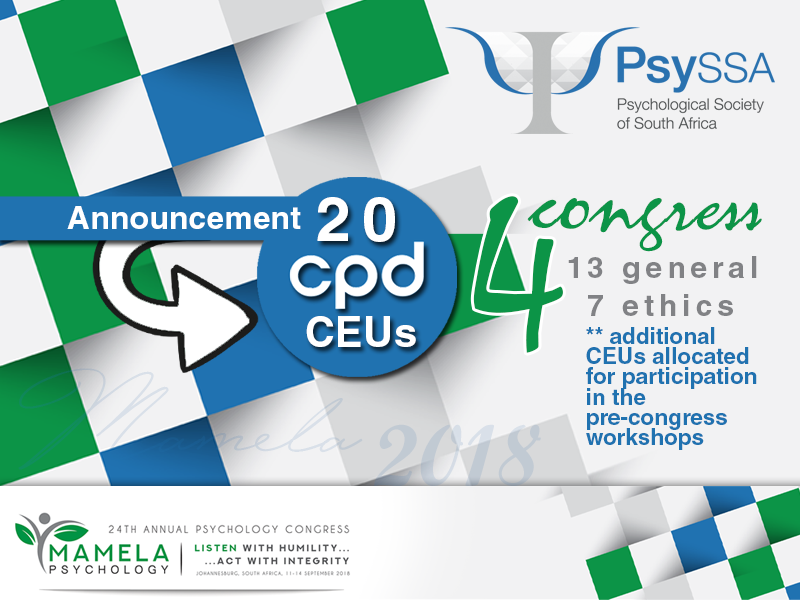
CEU Points