Global Indigenous Psychologies: movement toward healing historical harms: Reflections from the presenters

Global Indigenous Psychologies: movement toward healing historical harms: Reflections from the presenters

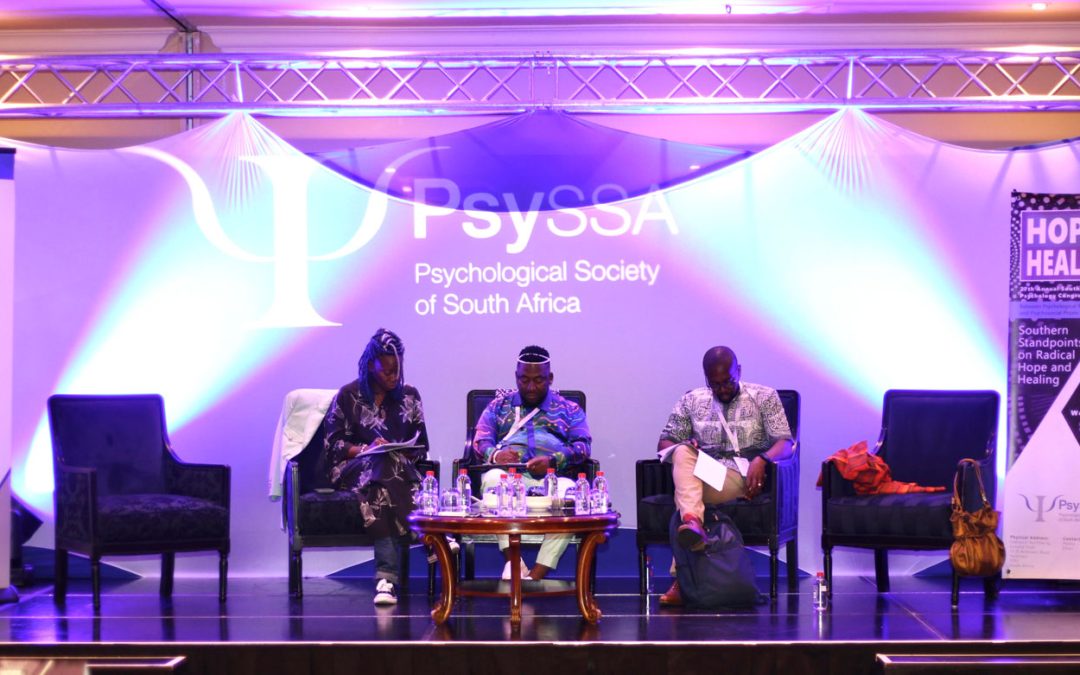
In the first Invited Panel, Global Indigenous Psychologies: Movement toward healing Historical Harms, Prof Peace Kiguwa, Prof Malose Langa, Dr Mmatshilo Motsei and Mr Anele Siswana explore the question of whose knowledge is considered existent or valid as central to the project of indigenizing and decolonising psychology. In this dialogue session, the panelists consider the question of ‘who knows’ in discussions around self-care, trauma healing and building healthy communities. Drawing on their own practice, the panelists explored indigenous epistemologies as critical responses to trauma in communities. Drawing links to the many political and social intersections that continue to proliferate in society, the discussions considered problematics of femicide and GBV, community fragmentation, emotional disconnect, trauma, homophobia, poverty as part of historical harm. In considering historical harm, the panelists cautioned against the dangers of ‘psychologising’ deeply political and social problems that are legacies of historical harms. Part of this caution is to attend to the ways that apolitical approaches to trauma inadvertently victim-blame and pathologise the very traumatized individuals and communities we seek to be of service to. In the engagement with the broader audience, the conversation extended to reflect on psychology’s roots in apolitical forms of thinking and practising, the pretense to objectivity and neutral value-free science, and its emphasis on western traditions of therapy and thinking that fail to really ‘see’ the human beings it attempts to help. Drawing on their own forms of practice, the panelists invited the audience to reflect on how we can do psychology differently and how indigenous psychologies offer us something that we have sidelined for a long time.

Incompleteness as a Framework for Convivial Scholarship and Practice in Healing

Incompleteness as a Framework for Convivial Scholarship and Practice in Healing

In his lecture at the 27th Annual South African Psychology Congress, hosted by the Psychological Society of South Africa (PsySSA), Francis B. Nyamnjoh emphasizes the urgent need for convivial scholarship in the field of healing. He argues that despite the independence of most African countries since the 1960s, colonial education, culture, and attitudes still persist, overshadowing indigenous healing traditions that have remained resilient yet largely unrecognized in the 21st century. Nyamnjoh advocates for a framework of decolonized healing practices that promote conversations and collaborations across various disciplines and organizations. He stresses the importance of integrating marginalized epistemologies rooted in popular universes and ideas of reality into the academic discourse. Central to his argument is the recognition and accommodation of incompleteness in individuals, disciplines, organizations, and knowledge-making traditions, challenging the illusion of completeness often perpetuated by zero-sum games of violence and violation. Instead, he calls for embracing compositeness and conviviality in healing practices while rejecting the outsourcing of debt and indebtedness to victims.

CLOSED – Calling all interested psychologists: Join the Western Cape Education Department Team

CLOSED – Calling all interested psychologists: Join the Western Cape Education Department Team

Are you a dedicated and passionate psychologist with expertise in educational, counselling, and/or clinical psychology, especially when it comes to working with children in the public sector? The Western Cape Education Department is currently seeking applications to fill several psychology positions across the province. If you’re eager to contribute to the well-being and academic success of learners, this could be your opportunity to make a difference.

We have multiple vacancies available, so let’s explore the positions and the districts where they are needed.

  1. Cape Winelands Education District (3 Vacancies)

Located in the heart of the Western Cape, the Cape Winelands Education District is seeking three dedicated psychologists to join their team. This district encompasses a diverse range of communities, and your work here will have a direct impact on the lives of learners and families in the region.

  1. Eden/Central Karoo Education District (2 Vacancies – Beaufort West and Oudtshoorn)

If you have a passion for working in more rural areas, consider applying for one of the two psychology positions in the Eden/Central Karoo Education District. You’ll have the chance to make a difference in the lives of learners in Beaufort West and Oudtshoorn.

  1. Overberg Education District (1 Position)

The Overberg Education District is looking for a dedicated psychologist to provide support and guidance to learners in this picturesque region. If you’re drawn to working in a coastal area with a unique blend of communities, this position may be your calling.

  1. Metro East Education District (1 Position)

Are you interested in working in an urban environment? The Metro East Education District is in need of a psychologist to help learners navigate the challenges of city life. Your expertise can make a significant difference in this bustling education district.

  1. West Coast Education District (1 Psychologist and 1 Senior Psychologist Position)

The West Coast Education District offers both a standard psychology position and an opportunity for career advancement as a Senior Psychologist. Whether you’re starting your career or looking to take the next step, this district has options for you.

How to Apply:

To apply for these exciting psychology positions, please visit the Western Cape Education Department’s official e-recruitment website and follow the application instructions. Be sure to read the requirements before submitting your application. Please include confirmation of an application to the South African Council for Educators (SACE) at [SACE Website](https://www.sace.org.za/). This confirmation is essential to ensure your application is considered.

Vacancies are listed on the WCED e-recruitment website: [WCED e-recruitment](https://e-recruitment.westerncape.gov.za/)

Application Deadline: Midnight, October 27, 2023

We are looking for dedicated professionals who are passionate about psychology and education, specifically in the public sector. If you are committed to making a difference in the lives of learners and contributing to their well-being and academic success, we encourage you to apply.

Join the Western Cape Education Department team and be a part of an organization that values education, growth, and community. Your work as a psychologist will be an essential part of shaping the future of our learners and our province.

If you have any questions or need further information about these positions, please contact Ewald Crause at [ewald.crause@westerncape.gov.za](mailto:ewald.crause@westerncape.gov.za).

Don’t miss this opportunity to be a part of something truly impactful. Apply today and help us create a brighter future for the learners of the Western Cape!

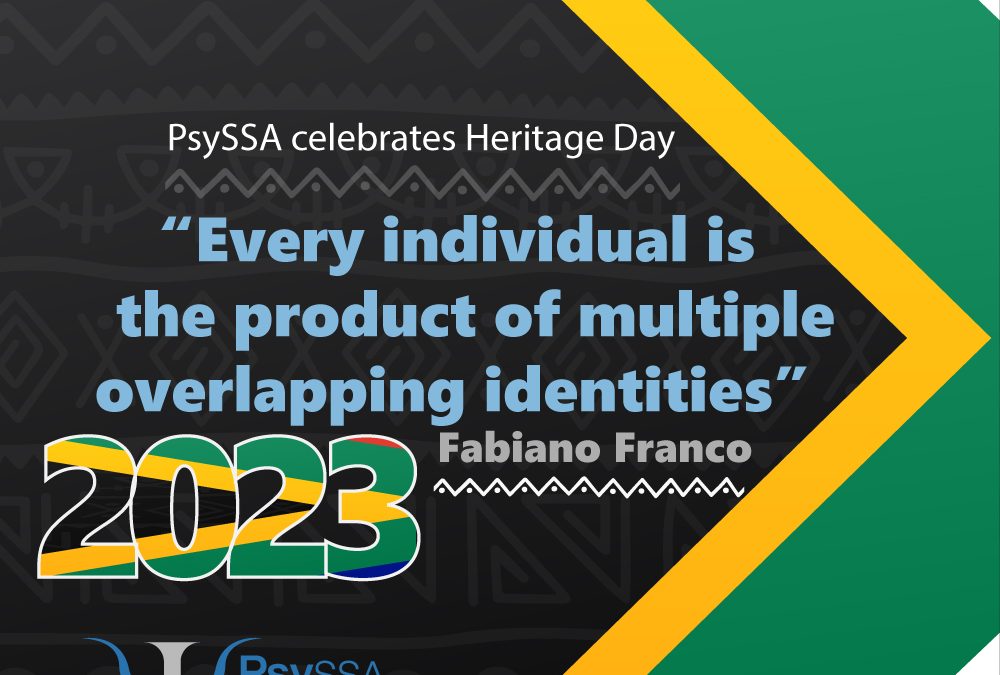
PsySSA Celebrates Heritage Day 2023 – “Every individual is the product of multiple overlapping identities” – Fabiano Franco

PsySSA Celebrates Heritage Day 2023 – “Every individual is the product of multiple overlapping identities” – Fabiano Franco

Heritage Day is intended to acknowledge and honour the cultural richness and diversity within South Africa. It is an opportunity to pay tribute to the heritage of the many different cultures that exist within our country.

For individuals, it is an opportunity to honour the various threads woven into the tapestry of one’s identity. Ethnicity, ancestry, religion, social traditions, family customs, language, and the geographic location where a person has spent most of one’s life, have all contributed to the shaping of a  personal set of cultural practices and ideologies. It is fascinating to observe which thread of the tapestry a person picks out for Heritage Day ‘dress up’ events.

Conversely, many intentionally and deliberately choose to relegate their heritage to their mental archives. September 24 is then merely Braai Day.

As professionals within the field of psychology, cultural competence (while not stereotyping and generalising) is a fundamental skill. Heritage Day creates a space to purposefully reflect on your cultural awareness, as well as your knowledge and the h of understanding of the culture of the populations that you work with.

PsySSA asked some of our members what Heritage Day meant to them as professionals in the field of Psychology in South Africa.

“Heritage Day means a day of celebrating what has been preserved and passed down to us from previous generations – the sacred knowledge of diverse existences. In the field of Psychology, our heritage is rooted in cultural diversity, social cohesion and compassion across the community. As a professional, I am reminded to look to our heritage brought down from the past to take new learnings and give this value in our present, and to preserve the values of our heritage for the future. We celebrate Heritage Day to value the kaleidoscope of people, places, cultures and ideologies, and we celebrate this connection of humanity spanning across our multiple existences. It is a day to celebrate as I have the opportunity to be a Psychological professional in a country blessed with such rich cultural diversity, embracing its growth with the spirit of ubuntu, towards inclusivity, acceptance and increased advocacy towards better mental health practices for all of South Africa and her people.”

(Genevieve Burrow, Division for Registered Counsellors and Psychometrists)


“From a research psychology/psychometry perspective, it’s an opportunity to reflect on how theories and assessments were previously used to discriminate against certain groups, and see how far we as a profession have come in developing and validating solutions that are fair and non-biased towards our population is something we should be immensely proud of. We should appreciate the work of our colleagues who have worked hard in establishing African-centred, Ubuntu-focused counseling interventions, and continue supporting those who strive to make psychological practice a service that benefits all South Africans.”

(Pakeezah Rajab, Division for Research and Methodology)